AMD Dramatically Expands Zen 5 Processor Family
- Paul Thurrott
- Jan 06, 2025
-
5
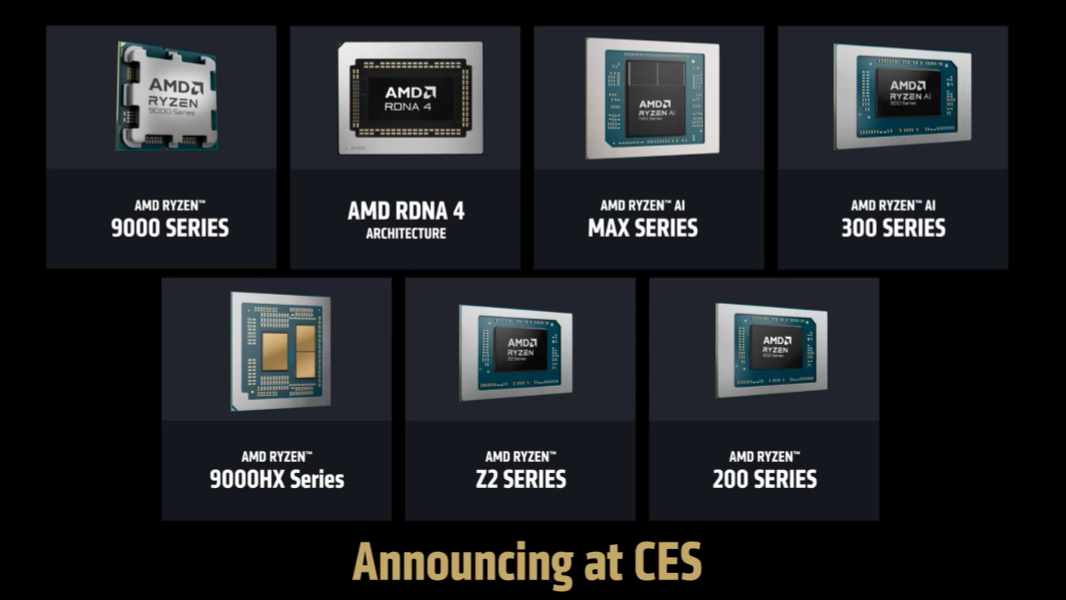
At CES today, AMD announced several new members of its Zen 5 processor family across gaming, AI, and enterprise portable and desktop PCs. There’s a lot going on there, but it appears that AMD is taking a page from the Apple Silicon playbook by introducing MAX and MAX PRO variants of its AI PC processors.
Gaming and content creators
Let’s start at the high-end, where AMD expanded its Ryzen 9000 series chips to include the new Ryzen 9 9950X3D processor. Described as the “world’s best processor for gamers and creators,” the 170 watt 9950X3D delivers 16 Zen 5 cores with a base frequency of 2 GHz, a maximum boost frequency of 5.7 GHz, and 144 MB of 2nd generation AMD V cache.
Compared to the previous generation 7950X3D chip, AMD reports that the 9950X3D delivers up to 58 percent better performance in modern 3D games, with an average boost of 8 percent. Compared to the Intel Core Ultra 285K, it provides up to 64 percent better performance in games, with an average advantage of 20 percent. The chip offers similar advantages for content creators, with up to 23 percent better performance in content creation tasks, or an average of 13 percent, when compared to the previous generation. Vs. Intel, those figures are 47 percent and 10 percent, respectively.
The Ryzen 9 9950X3D will arrive alongside a 9900X3D variant that offers 12 cores, a 5.5 GHz max boost, and 140 MB of cache at 120 watts. Both chips will ship in the first quarter of 2025.
AMD is also bringing this chip family to the mobile space as the Ryzen 9 9955HX3D, 9955HX, and 9850HX, the first of which is, of course, “the world’s best mobile processor for gamers and creators.” The 9955HX3D delivers 16 cores, a max boost of 5.4 GHz, and 144 MB of cache at 54 watts, while the 9955HX (16 cores, 80 MB of cache) and 9850HX (12 cores, 76 MB of cache) variants are just a bit less impressive.
AMD also announced its new Ryzen Z2 series processors for handheld gaming PCs. As you might expect, these chips provided better performance, battery life, and graphics quality than the previous gen, though the details are vague. AMD notes that ASUS, Lenovo, and Valve will all release new handheld gaming PCs based on these chips, and other as-yet-unnamed partners will announce new devices soon.
There are three variants: The Ryzen Z2 Extreme provides 8 processor cores, 16 graphics cores, 5 GHz max boost, and 24 MB of cache in a 15-35 watt package. And the Z2 (8 cores, 2 gcores, 24 MB cache, 5.1 GHz max boost, 15-30 W) and Z2 Go (4 cores, 12 gcores, 4.3 GHz, 10 MB, 15-30 W) round out the product family.
Those chips all use the current-gen RDNA 3 GPU architecture. But AMD also previewed its next-generation RDNA 4 GPU architecture at CES. This is built on a 4 nm process, and the focus here is on dramatic AI performance improvements, improved ray tracing, and better media encoding. These chips will deliver AMD’s Super Resolution 4 with machine language-powered upscaling to 4K. RDNA 4 will debut in new AMD Radeon RX 9070 XT and RX 9070 graphics cards that are coming first in new PCs from Acer, ASUS, and others in Q1 2025.
AI PCs
For AI PCs, AMD is building on the current-gen Ryzen AI 300 series with new Ryzen AI 300 and Ryzen AI PRO series chips for consumer and commercial AI PCs. These will be 7- and 5-series chips based on the current 9-series chips, helping expand the family to more PCs. The firm claims an average performance advantage of 35 percent against the Qualcomm Snapdragon Plus X1P-42-100 and 30 percent vs. the Intel Core Ultra 7 258V. It also beats out the NPU in both chips, albeit subtly. (I’d say all three are comparable.) They deliver over 24 hours of battery life on video playback.
There are several models here in both PRO and non-PRO variants, with the latter arriving in Q1 and the former coming in Q2. They feature 6 or 8 processor cores, 4.8 or 5 GHz max core boost, 22 or 24 MB of cache, 50 TOPS of AI performance, and run at 15-54 watts.
But there’s more. AMD also announced the Ryzen AI MAX and Ryzen AI MAX PRO processor tiers, which it says create a higher new class of AI PCs. These new chips will power new generation workstations, mobile workstations, and micro desktops, the firm says. They’re based on the Zen 5 architecture, of course, but feature RDNA 3.5 graphics, an XDNA 2 NPU, and deliver an “unprecedented” 256 Gbps of memory bandwidth. They are, as AMD says, the “most advanced mobile x86 processors ever created.”
The performance claims are off the charts. The Ryzen AI MAX series delivers up to 4x percent better overall performance than the Intel Core Ultra 9 288V across creator workloads, with an average improvement of 2.6X. But it blows the Apple Silicon M4 12-core chip out of the water, too, with up to 86 percent better performance. And it can take on dedicated graphics cards: The Ryzen AI MAX+ 395 offers 2.2X the AI performance of the Nvidia GeForce RTX 4090 24 GB with up to 87 percent lower TDP, AMD says.
Here, too, there are multiple models, ranging from 6 processor cores and 16 graphics cores all the way up to 16 cores and 40 graphics cores. AMD says that its PC maker partners will ship over 150 Ryzen AI designs in 2025. Ryzen AI MAX and MAX PRO designs will ship throughout Q1 and Q2, and will include the HP ZBook Ultra G1a mobile workstation, the HP Z2 Mini G1a workstation, and the Surface Pro-like Asus ROG Flow Z13. These chips look nuts.
For the low end, AMD also announced the Ryzen 200 series chips for pro and consumer laptops. These relatively inexpensive chips deliver “AI for everyday experiences” with AMD Pro management technologies. There are 11 new models–sigh–that range from the 4 core Ryzen 3/3 PRO 210 to the 8 core Ryzen 9 270, and aside from the two lowest end models, each provides a 16 TOPS NPU.
Enterprise PCs
We’re not done. For the enterprise, AMD announced the Ryzen AI 300 PRO series processors, with up to 2X the multitasking and AI performance of previous generation AMD and Intel Core Ultra chips. These are basically commercial versions of the existing Ryzen AI 300 PRO chips with additional management capabilities. AMD says that over 100 commercial PC models will ship with these chips in 2025.
Yikes!