The Settings Agent in Windows 11 Has Its Own AI Model
- Paul Thurrott
- Jun 23, 2025
-
2
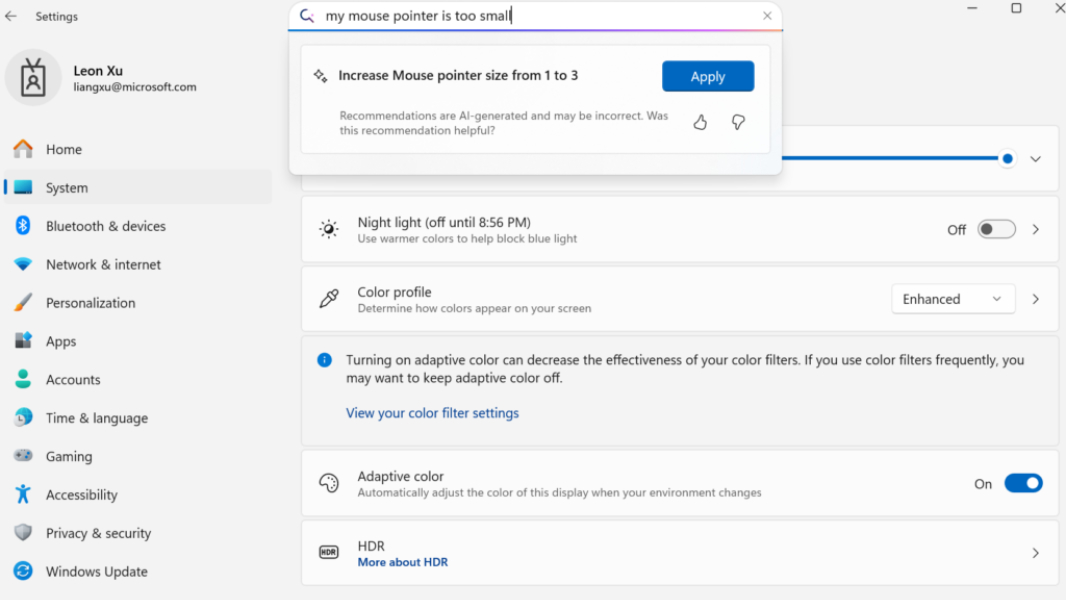
Microsoft today detailed Mu, its latest small language model (SLM) for Copilot+ PCs, which maps natural language queries to Settings function calls. Yes, the Settings agent that’s coming to Windows 11 will require its own AI model.
“Mu addresses scenarios that require inferring complex input-output relationships and has been designed to operate efficiently, delivering high performance while running locally,” Microsoft vice president Vivek Pradeep explains. “Mu is fully offloaded onto the Neural Processing Unit (NPU) and responds at over 100 tokens per second, meeting the demanding UX requirements of the agent in Settings scenario.”
According to Pradeep, Phi Silica, Microsoft’s best-known SML, informed the development of Mu, which is “micro-sized,” optimized for performance and efficiency, and task-specific. It uses a transformer encoder–decoder architecture that separates the input tokens from output tokens to reduce computation and memory overhead.
I can’t claim to understand most of the technical details here, but the short version is that Mu was distilled on Microsoft’s Phi models, resulting in a base model that could be fine-tuned into a more specific task-oriented model. It’s about as performant as Phi, but is only one-tenth the size.
Of course, what most will care about is how this works with Settings.
“Our goal was to create an AI-powered agent within Settings that understands natural language and changes relevant undoable settings seamlessly,” Pradeep says. “We aimed to integrate this agent into the existing search box for a smooth user experience, requiring ultra-low latency for numerous possible settings. After testing various models, Phi LoRA initially met precision goals but was too large to meet latency targets. Mu, with the right characteristics, required task-specific tuning for optimal performance in Windows Settings.”