Proprietary (Premium)
- Paul Thurrott
- Feb 09, 2023
-
28
If you haven’t watched Microsoft’s Bing AI/Edge presentation, you should: though it’s not clear why the software giant didn’t stream it live, it’s available on YouTube now. I’ve watched it twice, and I’ve read many reports from people who attended and who were able to experience the AI-infused Bing for more than a handful of queries. And I’m not sure that I like what I see.
Looked at broadly, we live in an age of misinformation triggered by the unfettered dominance of Big Tech, organizations that are in many ways more powerful than the governments and other regulatory bodies that ostensibly determine how their businesses operate. The introduction of AI into this market will exponentially exacerbate this problem, which is why I’ve openly wondered why Microsoft, a conservative, slow-moving company under Satya Nadella, would so aggressively move to embrace technology whose quality it can’t even control or vet.
But the answer might be semi-obvious: Microsoft, like other giant corporations, has what I think of as an institutional memory, and part of that memory is how it faltered in the dark decade after its antitrust transgressions hobbled it, and how competitors like Amazon (cloud), Apple (devices), and Google (search), were able to dominate markets that it feels were otherwise Microsoft’s to own. Institutional memory doesn’t make a company like a person, that’s nonsense. But it’s driven by people who still work at those companies, remember what happened, and now are in positions to make decisions that can help the firms redeem themselves by imparting revenge on their enemies.
Institutional memories of bad events are so strong, I think, that Microsoft—a company that once ethically took facial recognition capabilities away from law enforcement because it was inherently biased against dark-skinned people—is throwing caution to the wind and setting up the metaphorical Skynet future we often joke about. But it’s not a joke. We already expect to find every answer online in seconds. With AI, the creation of new content of all kinds will happen online in seconds, with no people needed, quality and accuracy be damned.
Unfortunately, it appears that some who attended the event are in no position to understand what’s happening. Kevin Roose, who was just a “nerdy, internet-obsessed preteen” when Google first arrived, was so blown away by Microsoft’s presentation that he’s immediately switching to Bing (“yes, Bing,” he elaborates). I think it’s a bit early to discount how Google will respond, but whatever. His report raises some issues about the world’s ability to understand what’s really happening here.
He tells the story of how “a Microsoft executive”—no need to name him, I guess (it was Yusuf Mehdi)— “navigated to the Gap’s website, opened a PDF file with the company’s most recent quarterly financial results, and asked Edge to both summarize the key takeaways and create a table comparing the data.” Except that’s not what happened: Mehdi explained up front that he would not be typing in any search queries live in front of the audience. Instead, these sequences were prerecorded “live” a day earlier. You guys don’t want to sit there and wait for him to type, right? We’d be there all day.
Though it apparently went unheard by The New York Times, this explanation was accepted without question by other attendees, most of whom obviously don’t remember the trouble that Microsoft executive Jim Allchin got into during the U.S. antitrust trial for manufactured videos. That said, it’s clear in the video that Mehdi never types anything. And if you actually think about it for a moment, you can figure out the real reason: AI is too unpredictable to deliver the same, reliable results to the same query every time. If Mehdi mistyped something by even a single letter, I bet, the results would be unreliable.
Look, we accept the fact that all Big Tech demos are canned in some way: engineers go over them again and again to make sure the audience will see what they want to see and, in this case, I’m sure there are some specific queries they wanted to use that simply weren’t delivering the wow they wanted. That’s all fine. But playing back a carefully orchestrated video when you appear to be making live queries against a backend service is disquieting.
And you can see why that’s so reading other reports: writing for the Washington Post, Geoffrey Fowler explains what really happens when this early AI technology is unleashed on the world in an unscripted fashion: the new Bing invented a Tom Hanks conspiracy theory on the fly. “There have been many theories and claims that Tom Hanks broke the Watergate scandal,” it claimed. “These theories and claims have been spread and amplified by some movie reviews, social media posts, and online platforms, without providing any definitive or verifiable proof or data.” Mr. Hanks was 15 or 16 years old during Watergate. And is an actor. “It’s a strange feeling to try to get factual information from the same technology that can also just invent a story of its own,” he concludes.
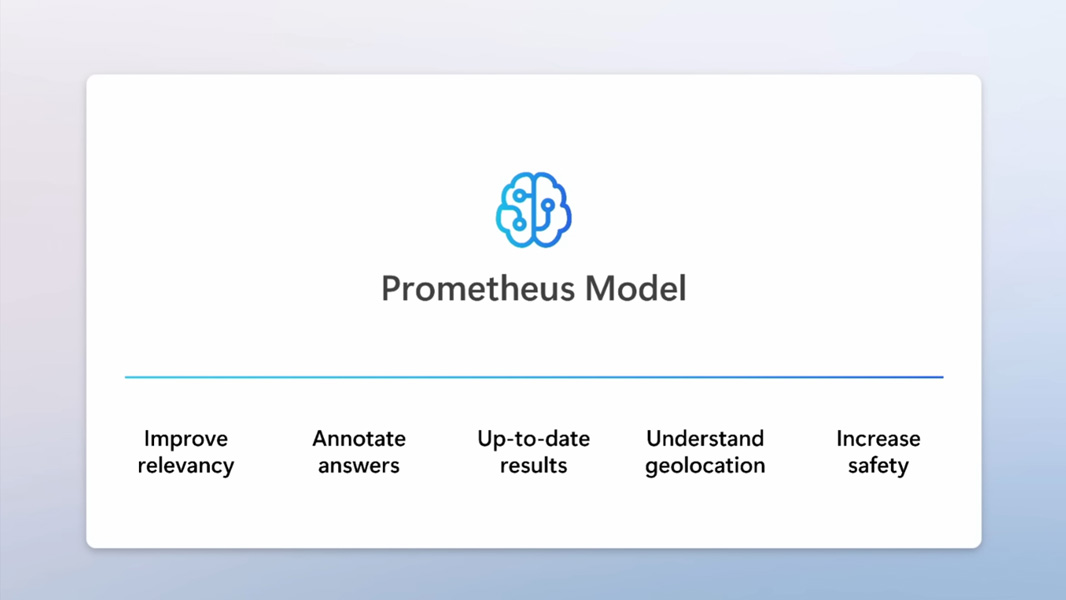
Of course, the misinformation goes both ways. Mr. Mehdi explained that Bing AI, as I’ll call it, uses a next-generation OpenAI large language model (most likely ChatGPT 4) that is customized for search, and that Microsoft uses a “proprietary” way of working with OpenAI, called the Prometheus Model, that allows it to “best leverage [its] power.” I’ve heard from people who were concerned about the ramifications of this term.
I think we’re reading too much into it. Leaving aside the fact that Microsoft, like Apple and Google, keeps its core assets protected behind proprietary code bases, and that this word use was at best unfortunate, what he was trying to explain, I think, was that Microsoft’s approach was unique to Bing and is a differentiator. Yes, others will take advantage of OpenAI, but our use is superior, he’s saying. Not that Microsoft is walking back from its use of open source elsewhere.
“At training and at run-time, we engage with the OpenAI model intelligently, through our knowledge of the web, via the Bing index, and some special query techniques,” he said. (The Bing index, for example, is proprietary.) This helps Microsoft improve the relevancy of answers, annotate the answers with citations, provide more up-to-date results, understand geolocation and incorporate that into the results, and increase the safety of the answers. That last bit is important because AI is all over the map right now.
And I think that’s the real takeaway here. Yes, this is exciting, and yes, this raises a lot of questions, some of which are quite scary. But this isn’t Microsoft leapfrogging a dominant competitor, Google. It’s Microsoft shooting an opening salvo across Google’s bow. Google has responded, to some degree, and it will continue to respond. And because Google Search—rather, the ad revenue generated by Google Search—is so important, so core, to that company, we can’t count it out.
On that note, I’m curious to see how much Bing usage improves when these new capabilities are available to the general public. And to see what Google has in place by then to prevent a mass exodus. And how lawmakers and regulators from around the world react to both. Everything is up in the air for now.

Gain unlimited access to Premium articles.
With technology shaping our everyday lives, how could we not dig deeper?
Thurrott Premium delivers an honest and thorough perspective about the technologies we use and rely on everyday. Discover deeper content as a Premium member.