Opera Goes Native on Windows on Arm
- Paul Thurrott
- May 16, 2024
-
1
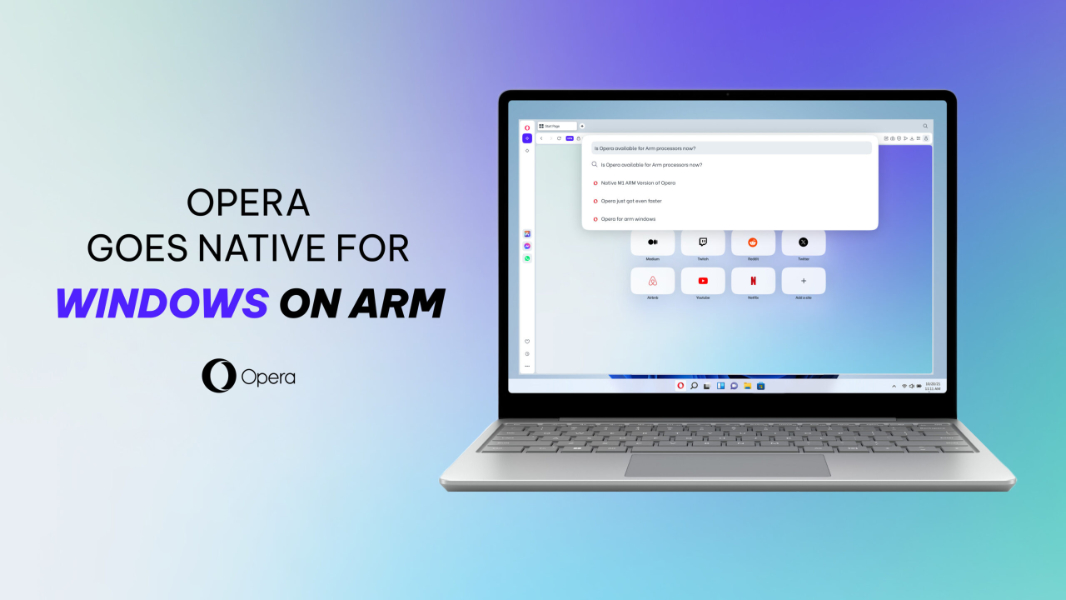
Opera announced today that it is bringing its flagship desktop web browser to Windows 11 on Arm. And it’s doing so with a little help from its friends at Microsoft and Qualcomm.
“If you’re one of the early adopters using a new Arm-powered Windows PC, here’s some great news: Opera is now optimized to make the most of your device’s capabilities,” Opera’s Santiago Benavides García writes in the announcement post. “Thanks to support from Microsoft’s App Assure team and Qualcomm Technologies, the latest Opera build runs more than four times as fast on this new generation of PCs. Opera is committed to providing the best possible experience on every device, including the newest Arm-powered Windows PCs.”
The Arm version of Opera for Windows is available now in Opera’s Developer channel, where you can also experience the company’s latest AI features. So it will presumably ship in stable by mid-year, roughly in line with the first generation of Snapdragon X-based PCs that we’re all looking forward to.
This type of announcement is always of interest, but this one is also a bit different for two reasons: Opera is the first third-party browser maker to acknowledge Microsoft’s help with this port, and Microsoft has weighed in separately, describing the work it did.
“Engineering assistance from the Microsoft App Assure team played a key role in the new Opera Browser for Arm-based Windows devices,” Microsoft corporate vice president Mike Adams says. “App Assure engineers worked directly with Opera’s engineering team, offering technical assistance and guidance. It quickly became apparent that both teams had a similar take on strong signals reflecting growing industry awareness of the performance and efficiency benefits offered by Arm devices.”
App Assure is a no-cost program that Microsoft provides to help developers port their apps to Windows 11 on Arm. And its Arm Advisory Service is available worldwide in multiple languages. In most cases, apps just run fine when compiled for Arm. But if developers encounter any issues, Microsoft will help, and it has helped over 300 developers bring their apps to Arm to date. In Opera’s case, the result was a version of the browser that didn’t just work on Arm but was optimized for this platform’s unique characteristics.
The basics of the porting work had already occurred in Chromium, the base on which Google Chrome and Opera are built, helping Opera produce a working build on the first day. But then it worked to improve quality first, and then performance, the latter determined in part by the browser’s scores on the Speedometer benchmark tests. It quickly doubled the scores of the emulated browser. And now the performance is four times as fast.
“Windows on Arm is going to revolutionize personal computing, and we are excited to offer App Assure to Windows on Arm developers to help all organizations see just how easy it is to build for this platform,” Adams says. “App Assure engineers can help you understand the nuances of emulated code translation and how to seamlessly interoperate between native and x64 code, configure build systems most efficiently for multi-architecture delivery, and obtain Arm-based hardware or get started with Azure Virtual Machines and then prepare those environments for development, continuous integration, or test runners.”
Exciting stuff. You can learn more about porting apps to Arm on the Microsoft Learn website. And if you need Microsoft’s help, you can fill out this form.