Meta Reveals Quest 3S Headset and ‘Orion’ AR Glasses Prototype
- Laurent Giret
- Sep 25, 2024
-
0

Meta has just announced big product updates at its Connect event today, with a more affordable Quest 3S mixed reality headset and an interesting AR glasses prototype named ‘Orion’. The company also announced new features for its existing Ray-Ban Meta glasses and improvements for its ‘Meta AI’ suite of generative AI features.
Meta AI has now crossed over 400 million monthly active users, making Meta a true juggernaut in the generative AI space. Today, Meta announced that users can now talk to Meta AI on Messenger, Facebook, WhatsApp, and Instagram DMs, with the AI assistant offering a choice of different celebrity voices including Kristen Bell, John Cena, and Judi Dench.
The other big update for Meta AI is the ability to upload a photo and ask questions about it to the AI assistant. Meta AI will also be able to make changes to uploaded photos using natural language prompts.

With the Meta Quest 3S, the company is launching its most affordable mixed reality headset with a $299.99 starting price. The headset will be available for pre-order starting today and start shipping on September 25.
The Meta Quest 3S will replace the Meta Quest 2 on the lineup, while the 512GB Meta Quest 3 will see its price drop from $649.99 to $499.99. The Meta Quest 3S features the same Qualcomm Snapdragon XR2 Gen 2 chip as the Meta Quest 3, and its 1,832 x 1,920 LCD display should deliver 4.5x the resolution and color compared to Quest 2, according to the company.
The Meta Quest 3S will be available in 128GB or 256GB configurations, and it will offer the same mixed reality experience as the more expensive Quest 3. That includes thousands of games and mixed reality experiences, and Batman: Arkham Shadow will also be included for free with the headset.
VR and MR headsets remain niche products as of today, and Meta is planning to discontinue its $999 Quest Pro headset at the end of the year. However, the Ray-Ban Meta glasses have become quite popular, and they will soon be available with new frames and lenses. But that’s not all.
Meta is making more apps and services available on Ray-Ban Meta glasses, including Spotify, Amazon Music, Audible, and iHeart. Users will also be able to use the glasses to scan QR codes, call phone numbers they see, and translate English, French, Italian, and Spanish in real time.
The Meta AI features on the Ray-Ban Meta glasses are also about to get better. Users will soon be able to start a conversation without saying “Hey Meta” every time, and the AI assistant will be able to respond using the celebrity voices I mentioned earlier. Meta AI is also adding video support, which means the assistant will be able to answer questions about things users are seeing in real time, and more.
The biggest announcement from Meta Connect today was definitely Orion, the company’s new AR glasses prototype. According to Meta, Orion is the culmination of its efforts to miniaturize the technology of VR and MR headsets into a familiar form factor that’s both lightweight and stylish. Indeed, Orion almost looks like regular glasses, and the current prototype comes with transparent lenses as well.
“Orion has the largest field of view in the smallest AR glasses form to date,” Meta said today. “That field of view unlocks truly immersive use cases for Orion, from multitasking windows and big-screen entertainment to life-size holograms of people – all digital content that can seamlessly blend with your view of the physical world.”
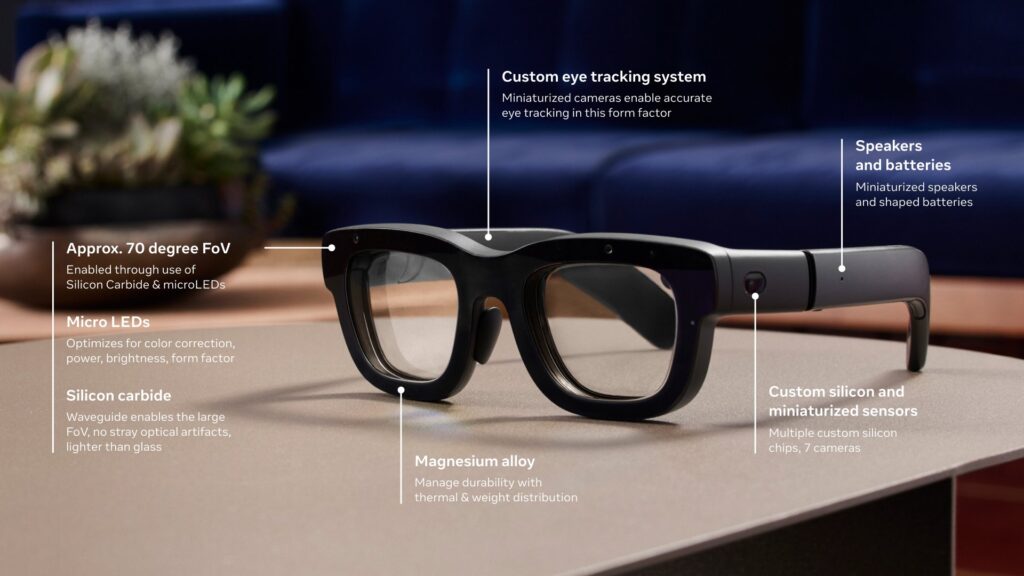
While the full specs for Orion are still unknown, the augmented reality glasses are powered by custom silicon that uses just a fraction of the power of a headset or smartphone. Meta also created an intuitive interaction model that combines voice, eye gaze, and hand tracking.
For now, Meta will only make Orion available for select Meta employees and a selection of people outside the company. The company will be listening to user feedback and improving its prototype to create what could eventually become a mass-market product. The company believes that Orion is “the most advanced pair of AR glasses ever made,” and the AR glasses prototype will certainly to push Apple, Samsung, and other competitors to rethink their mixed reality strategy.