Nvidia Unveils its GeForce RTX 50 Series GPUs
- Laurent Giret
- Jan 07, 2025
-
1
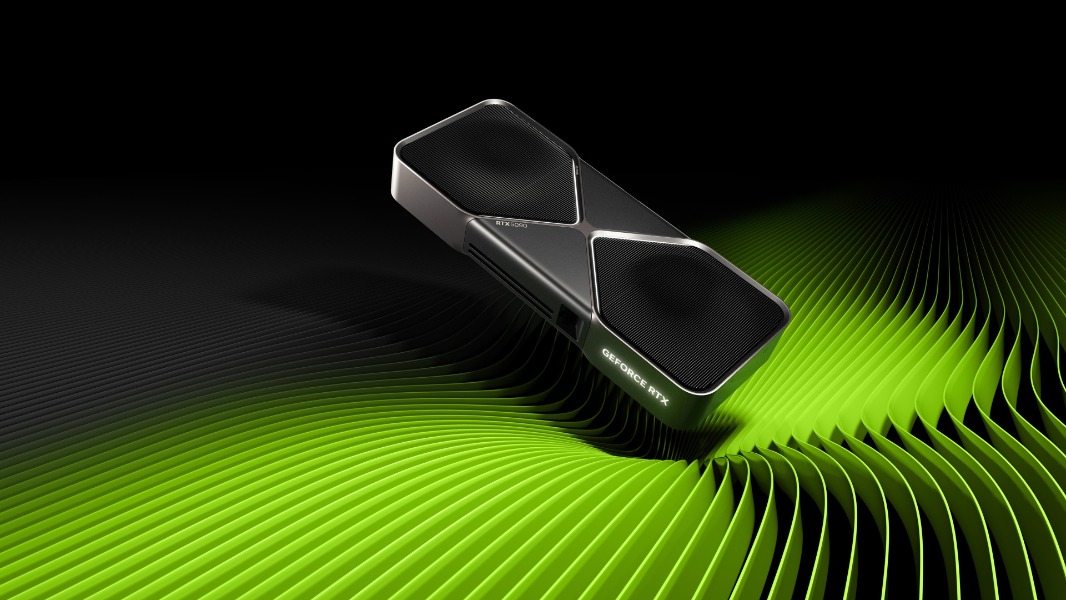
Nvidia put the wraps off its much-anticipated GeForce RTX 50 Series GPUs yesterday. The top-of-the-line GeForce RTX 5090 and GeForce RTX 5080 will start shipping on January 30, and they will be followed by the GeForce RTX 5070 Ti and GeForce RTX 5070 in February.
Nvidia’s GeForce RTX 50 Series GPUs leverage the company’s Blackwell architecture, which includes new RT Cores, faster GDDR7 memory with up to 1.8TB/s of bandwidth, and PCIe Gen5 and DisplayPort 2.1b support. This new architecture also enables DLSS Multi Frame Generation on GeForce RTX 50 Series GPUs, which generates up to three additional frames per traditionally rendered frame. 75 games and apps will support DLSS Multi Frame Generation technology at launch including Alan Wake 2, Cyberpunk 2077, Diablo IV, S.T.A.L.K.E.R. 2: Heart of Chornobyl, and Star Wars Outlaws.
The flagship GeForce RTX 5090, which will start at £1,939, comes with 32GB of GDDR7 memory with 1792 GB/sec of total memory bandwidth, 21,760 CUDA Cores, 680 5th gen Tensor Cores, and 170 4th gen Ray Tracing Cores. The company says that it’s 2x faster than the GeForce RTX 4090 in games like Cyberpunk 2077 thanks to the power of DLSS 4. With full Ray Tracing on, the RTX 5090 achieves 234 FPS at 4K resolution while the previous gen RTX 4090 only achieves 109 FPS with DLSS 3.5.
The GeForce RTX 5080, which will start at £979, comes with just 16GB of GDDR7 memory with up to 960 GB/sec of memory bandwidth. On average, it should be twice as fast as the GeForce RTX 4080 while playing games in 4K with full ray tracing and other settings maxed thanks to Nvidia’s DLSS 4 technology.
Let’s wrap up with the GeForce RTX 5070 Ti and GeForce RTX 5070: The first one, which will be priced at £729, comes with 16GB of GDDR7 memory with 896 GB/sec of total memory bandwidth, and it should be 2X faster than the GeForce RTX 4070 Ti when playing games with DLSS4 at 2560×1440 with full ray tracing and other settings maxed. The £539 GeForce RTX 5070, however, will have 12GB GDDR7 memory with 672 GB/sec of total memory bandwidth, but it also should be twice as fast as the GeForce RTX 4070 when playing games with DLSS4 at 2560×1440 with full ray tracing and other settings maxed.
In addition to these four RTX 50 desktop GPUs, the first laptops with GeForce RTX 50 Series GPUs from Acer, Asus, Dell, Gigabyte, HP, Lenovo, Mechrevo, MSI, and Razer will also start shipping in March. Nvidia’s GeForce RTX 5090 Laptop GPU will feature 24GB of GDDR7 memory, while the GeForce RTX 5080 Laptop GPU will have 16GB of GDDR7 memory, just like desktop cards. As for the GeForce RTX 5070 Ti and GeForce RTX 5070 Laptop GPUs, they will feature 12GB and 8GB of GDDR7 memory, respectively.
In other Nvidia-related news, the company also announced yesterday the upcoming launch of an official Nvidia GeForce NOW app for Valve’s Steam Deck. The company’s game streaming service is also coming to Apple Vision Pro spatial computers, Meta Quest 3 and 3S, and Pico virtual- and mixed-reality devices.