Google Pixel 10 Pro Fold First Impressions
- Paul Thurrott
- Nov 22, 2025
-
7
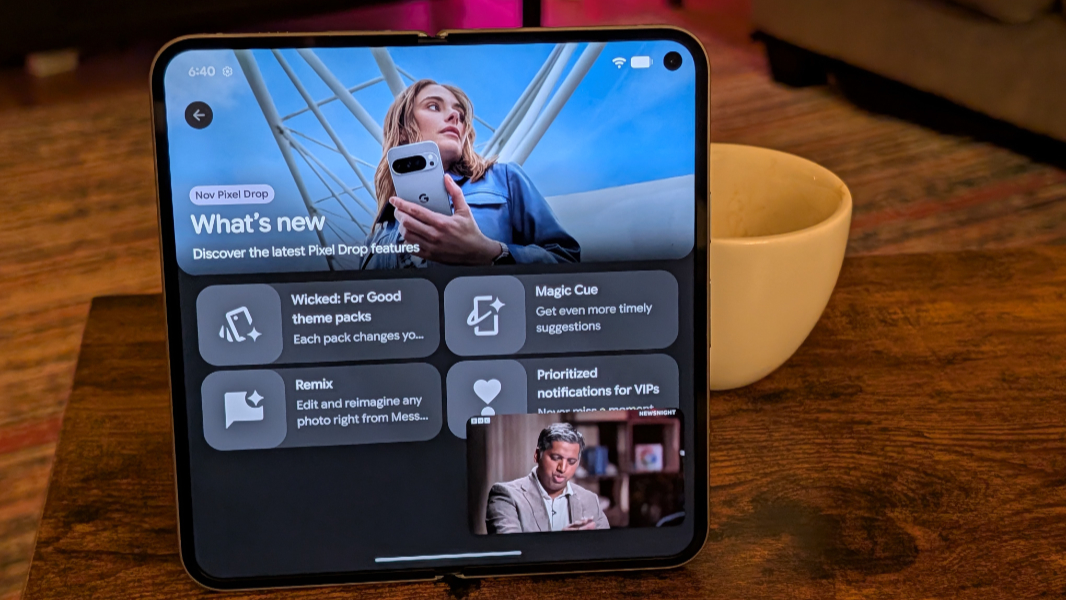
As soon as I opened the box containing the Pixel 10 Pro Fold, I knew I was going to have a problem. No, not with the phone. With my wife. She had been so decisive when it came to upgrading to a Samsung Galaxy Z Fold 7 about a month ago that by the time she finally decided to go for it, the offer had expired and it was too expensive to bother. And so I gave her an out: I was getting a Pixel 10 Pro Fold to use and review, I told her. And once I was done with that, she could use that for a month or two, or whatever, and see if she liked the form factor. And then maybe that could inform a future upgrade.
Yeah. Maybe.
The thing is, the Pixel 10 Pro Fold is gorgeous. It’s thinner and more elegant than I’d been led to believe by jaded and entitled tech reviewers. It’s also much more competitive with the Samsung Galaxy Z Fold 7 than some have suggested. I literally saw a review that claimed that The Z Fold 7 is so good that Google should have never even shipped the Pixel 10 Pro Fold.

Nonsense. By that rationale, Apple should give up on macOS because Windows exists. Or Burger King should give up because McDonalds exists. Or whatever.

The thing is, the Pixel 10 Pro Fold has very real advantages over the Z Fold 7. Just as the Z Fold 7 has some advantages over the Pixel. They are, in a word, competitive. And though the financial situation with Google worked in my favor—I was essentially able to apply two phone trade-ins to the purchase, dramatically lowering the cost—I would almost certainly pick Pixel over Samsung regardless. I mean, I would consider either, of course. But that’s the point. These things are comparable.

Anyway, I lifted this $1800 device out of the box and unwrapped the protective paper like it was the crown jewels. Because, to me, it sort of is, given the cost. And as it revealed itself, that thought entered my brain. Problem. A good problem, I suppose. But also a rare one, in the sense that my wife isn’t into technology for technology’s sake, and she hangs on to each phone a lot longer than I do. Maybe I could hide it from her.

“Where’s my Pixel Fold?” she called out from the other room, as if reading my mind. Here we go.

The Pixel 10 Pro Fold is the third-generation Pixel Fold, after the first generation version I looked at briefly in 2023 and last year’s Pixel 9 Pro Fold. It’s interesting for many of the same reasons that any Pixel device is interesting, though I feel with this form factor that the camera capabilities I prize so much in the standard Pixel Pro/Pro XL models takes a bit of a backseat to the overall experience, with Google’s voluminous quantities of helpful software and services coming to the forefront instead. The Fold is just too thin for the Pro cameras.

That said, I’m not worried about camera quality all that much. My experiences with every generation of Pixel hardware and, most recently, with the terrific base Pixel 10, tell me that Google’s computational photography capabilities are strong enough to overcome middling camera hardware. And we’ll see, but I don’t think the camera hardware here is middling. There’s a triple-lens rear camera system with a 48 MP main (wide) lens, a 10.5 MP ultra-wide lens, and a 10.8 MP telephoto lens with 5x optical zoom.

(There are also two selfie cameras, go figure, one centered above the external (“cover”) display and one in the upper-right of the internal display; both are 10 MP wide lenses and I believe they’re identical.)
But you’re not here for the cameras, not really. You’re here for the screen. Or, more accurately, the screens. Like other full-sized foldable phones, the Pixel 10 Pro Fold has two screens, that external “cover” display and the bigger internal display.

The cover display is a 6.4-inch Full HD (1080 x 2364) OLED panel with a 60 to 120 Hz variable refresh rate (VRR) that emits 2000 nits of brightness and 3000 nits of peak brightness. So it’s somewhere between the 6.3-inch panels found on the Pixel 10 and Pixel 10 Pro and the 6.8-inch panel used by the Pixel 10 Pro XL. But closer to the smaller phones.

The internal, foldable display is where the magic happens. This is an 8-inch LTPO OLED display panel with a resolution of 2076 x 2152 and a 1 to 120 Hz VRR that emits 1800 nits of brightness and 3000 nits of peak brightness. There is a crease in the middle that’s either invisible or plainly visible depending on the angle and what you’re doing. And the bezels surrounding it are pretty big.

When open, the Pixel 10 Pro Fold is incredibly thin, barely thicker than the USB-C port found on the device’s bottom.

When closed, the Fold is a bit thicker than a Pixel 10 Pro XL or iPhone Pro Max of whatever vintage, but not in any egregious way. I feel like this will work fine as a normal phone, which is 50 percent of the battle when it comes to this hybrid device making any sense at all. (In the photo below, the Fold is in a case.)

Google reworked the hinge for this release, but I never had the previous generation version, so I can’t really compare it. What I can tell you is that it’s quite smooth and seems to hold whatever angle position you set it at. The Fold has an IP68 dust and water resistance rating, a first for a foldable, so it should be durable in ways that other foldables are not.

The battery is 5015 mAh, which is quite large, but it only supports 30-watt wired and 15-watt wireless (Qi2) charging. It is at least Pixelsnap/MagSafe compatible, so it should work with any of those accessories.

Each Pixel 10 Pro Fold comes with 16 GB of RAM, which is ideal for today’s Gemini and other AI needs, and you can configure it with 256 GB, 512 GB, or 1 TB of UFS storage (Zoned UFS in the latter two cases). There are also just two color choices, the now-familiar Moonstone (a dark blue-gray) and Jade (a yellow-green). I ordered mine in Moonstone with 256 GB of storage.

I always get a case for my smartphones and given the price of the Fold, I was obviously keen to do so here while being curious how such a thing would even work. So I did end up getting a Pixelsnap Case for Pixel 10 Pro Fold, and it is indeed an odd thing, with two sides, one of which is just a frame with stickers, while the other side (that protects the back) is a bit more traditional. I’m curious how well this will protect it.
Now if I can just keep my wife away from it, I will find out. More soon.