Spotify Paid the Music Industry $10 Billion in 2024
- Paul Thurrott
- Jan 28, 2025
-
7
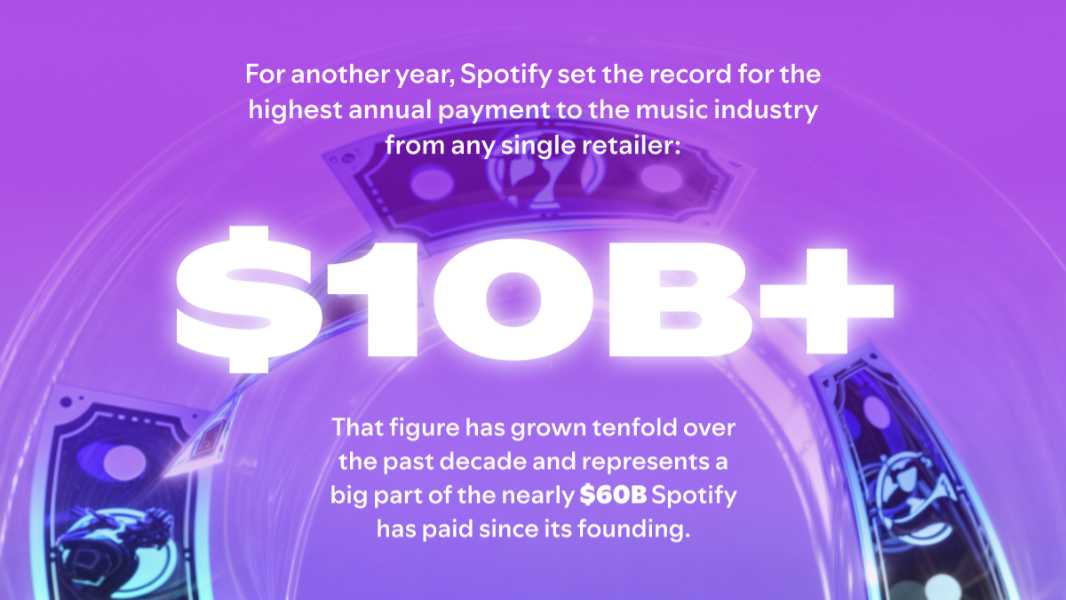
Spotify said today that it paid out a record $10 billion to the music industry last year, bringing its total payments to over $60 billion. It paid $9 billion in 2023, then a record.
“The system we’ve built together is working, and where we are now is only the beginning,” Spotify vice president David Kaefer said. “Today, there are more than 500 million paying listeners across all music streaming services. A world with 1 billion paying listeners is a realistic goal we should collectively set.”
By comparison, Spotify notes that it had 15 million paying subscribers and contributed $1 billion to the industry in 2014. That year was “a low point” when global recorded music revenues were just $13 billion.
Spotify is often criticized for its relatively low per-stream payments, but it’s also the largest music streaming service and makes the single biggest revenue contribution each year to the industry. And those payments are only low on a per-play basis compared to the past. Today, no company pays more to the music industry, including Apple. “Spotify is not only the most popular subscription streaming service but also the highest paying,” it says.
Spotify’s success comes, in part, from its ad-supported free tier, an option Apple Music lacks. In addition to the ad dollars that offering generates, the firm says that 60 percent of its far more lucrative paying subscribers were once free tier users.
Further pushing the point, Spotify cites a third-party report claiming it generates about one-third of all music industry revenues. But it also notes that over half of all independent music revenues comes from Spotify. “Spotify’s model is uniquely enabling more room for more artists to find success and ultimately sustain a career in music, demonstrating real change across the music business,” it says.
One final data point: In the nadir of 2014, 10,000 artists generated at least $10,000 per year on Spotify. Today, there are more than 10,000 artists who generate over $100,000 per year on Spotify.