Apple Reveals New Siri AI and Other Software Updates Coming With its ’27 Releases
- Laurent Giret
- Jun 08, 2026
-
11
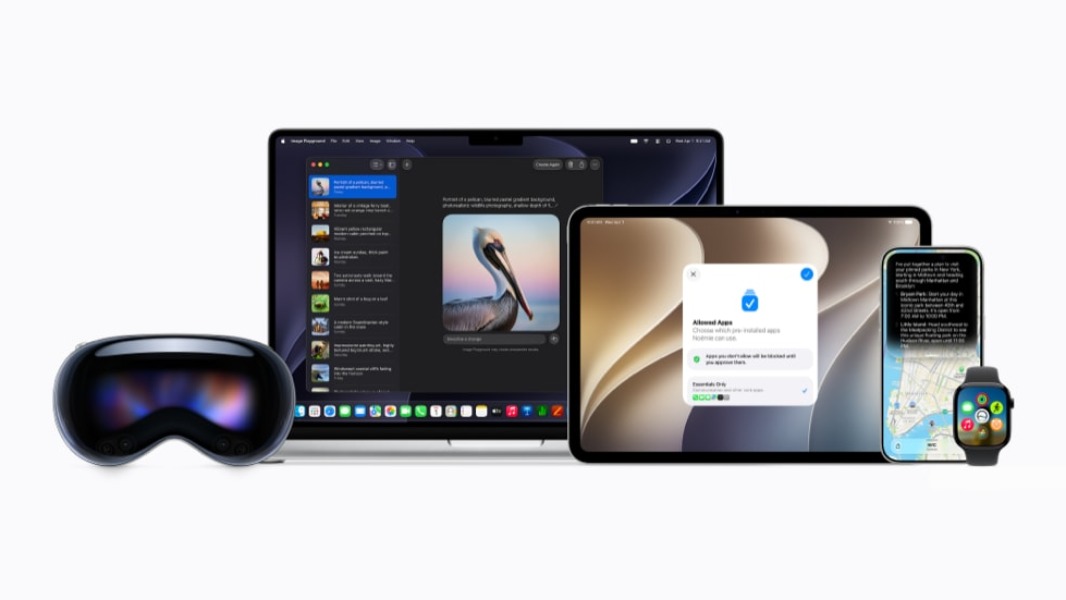
Apple just wrapped up its WWDC 2026 keynote, which was the last event to feature current CEO Tim Cook before his replacement by Senior Vice President of Hardware Engineering John Ternus on September 1. The keynote was a bit shorter than usual, but it did focus on platform improvements, trust and safety updates, and much-anticipated Apple Intelligence and Siri updates.
The first big news is that iOS 27 will support the same iPhone models that currently run iOS 26, including the iPhone 11 from 2019 and the 2nd-gen iPhone SE from 2020. Not all new features will be available on these older models, however.
Performance and design improvements
Following the rollout of Liquid Glass last year, Apple has listened to user feedback to improve its new design language. On iOS, Apple brought a new slider in settings to adjust translucency effects, and the company is also bringing a more unified toolbar on top of macOS apps.
On the performance front, system animations will be smoother on iOS 27, and users should also notice up to 30% faster app launches and up to 80% faster file transfers via AirDrop. On iPhones and iPads, transitioning from WiFi to Cellular connectivity should also feel more seamless.
Apple also said today that it has rebuilt the search index for Spotlight to improve responsiveness, and the performance improvements should also be noticeable across the Mail and Photos apps. In the latter, photos uploaded to iCloud should also sync much faster to other devices.
Trust and safety updates
Apple detailed today upcoming child safety features to give parents more peace of mind. Parents will now be guided through creating a child account when setting up a new Apple device for their child. These accounts are required for children under 13, but they’re also available for kids up to 18.
With child accounts, parents can choose which pre-installed apps their kids can use and control which apps they can download and buy from the App Store. With Ask to Browse, they’ll also be able to approve their kids’ requests to access a website.

With Child accounts, parents can also control who their kids can talk to over Messages, FaceTime, and Phone. Images that may contain nudity or violence are also automatically blurred.
Lastly, Time Allowances will allow parents to configure how long their kids can use categories of apps and websites during weekdays and weekends. “Parents can also set daily Schedules to manage which apps their children have access to at different times of the day and across the week,” Apple also explained today.
Apple Intelligence updates
Apple has been caught off guard by the rise of ChatGPT and other generative AI chatbots, and the launch of Apple Intelligence two years ago was quite underwhelming. Apple had no choice but to team up with Google to catch up with the competition, and today the company detailed next-gen Apple foundation models that leverage Google’s Gemini models.
On supported iPhones, the upgraded Apple Intelligence system will continue to privilege local compute while delegating more complex workloads to Apple’s Private Cloud Compute infrastructure. Apple emphasized that its AI systems remain more private than the competition, with the company not storing or accessing any personal data.
As it was previously reported, Apple Intelligence is getting the ability to understand users’ personal context, and it will also support on-screen awareness to offer tailored assistance based on what you’re currently doing. This will enable one-tap suggestions in the Messages app, and suggestions in Mail will also get the ability to take action with third-party apps.
In the Phone app, Call Context will be able to surface relevant information such as ticket numbers when you’re calling a business. Shortcuts, Apple’s Automation app, will now let users create routines by just using natural language prompts.
In the Photos app, the Clean up tool is being upgraded to remove distracting elements more precisely. There’s also a new Extend tool that will use generative AI to expand images, and a more advanced Reframe tool will let users reframe a picture by manually shifting the perspective.
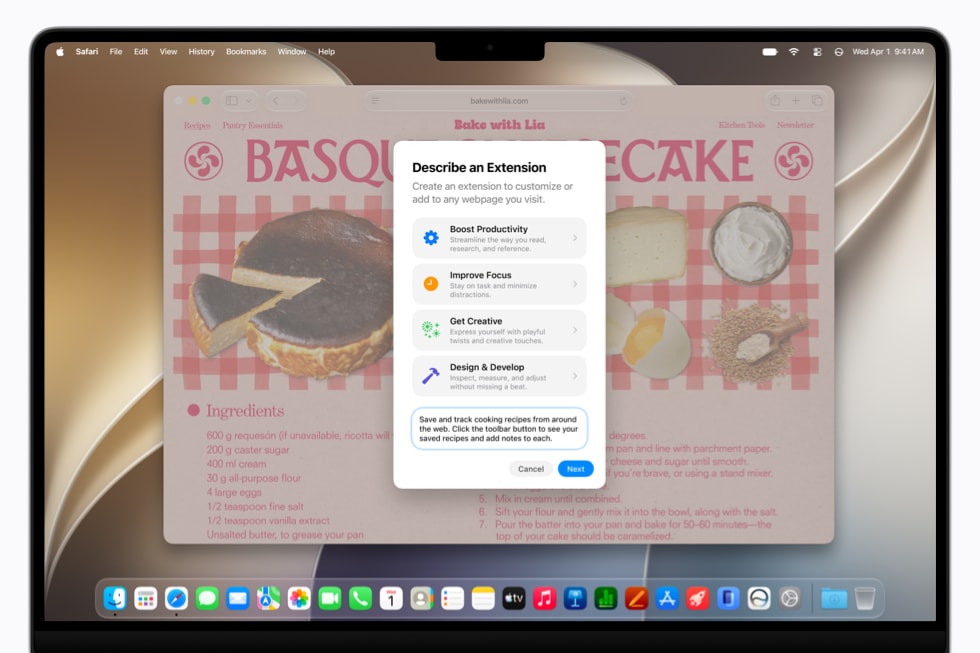
In Safari, Apple Intelligence will be able to intelligently organize tabs into topics, which can be later saved as a tab group. Users will also be able to create a custom extension by just describing what they want in natural language. Apple gave the example of an extension designed to save and rate recipes a user has tried, which Safari can add as a toolbar button.
Apple’s Passwords app is getting an agentic AI feature for automatically updating users’ weak passwords. “Using Apple Intelligence and Safari to agentically take action on a user’s behalf, Passwords securely navigates through websites to sign in and upgrade their accounts to strong passwords,” the company explained today.
Some new Apple Intelligence features such as image generation will have daily usage limits as they rely on cloud-based models, but users with an iCloud+ subscription will get higher quotas. iCloud+ will also unlock new Apple Intelligence features for compatible Home cameras.
New Siri AI to launch in Beta in English, but iOS and iPadOS in the EU won’t have it
Apple’s new Siri AI was probably the main highlight of today’s keynote, and it will launch in beta in English later this fall. However, it won’t be available on iOS 27 and iPadOS 27 in the EU at launch, and Apple blamed the DMA for the delay.
“When iOS 27 and iPadOS 27 launch later this year, users in the EU will not have access to Siri AI and its advanced capabilities — including the new dedicated app to revisit conversations, an expanded Visual Intelligence experience, integrated tools for writing, Siri mode in Camera on iOS, and other Siri AI capabilities announced at WWDC26. EU users will be able to access Siri AI on macOS 27, visionOS 27, and watchOS 27,” the company said today.
Apple blamed EU regulators’ “extreme interpretation of the DMA”, which would, in the spirit of competition, force Apple to “give any virtual assistant direct access to users’ private data — and the ability to directly control other installed applications — as soon as Siri AI is made available in the EU, without the essential protections necessary to keep users and their data safe.”
To comply with the DMA, Apple said that it designed a new solution called “Trusted System Agent” that would allow third-party AI assistants to “safely access the same features and capabilities as Siri AI for devices in the EU.” However, Apple said that the EU Commission rejected this solution as well as its other proposals.
“Apple will continue working to bring these features to the European Union as safely as possible. However, given the clear dangers to EU users and the regulators’ failure to acknowledge these risks, there is currently no timeline for Siri AI’s availability in the EU on iOS and iPadOS,” Apple said today.
As I mentioned earlier, the new Siri AI will still be available in the EU on macOS 27, visionOS 27, and watchOS 27 later this fall, because these platforms aren’t big enough to be regulated under the EU’s DMA. However, Apple currently has no timeline for Siri AI’s availability on iOS and iPadOS in the EU.
The new Siri AI will be available as a dedicated app on Apple devices that support Intelligence, but it will also remain accessible by saying “Hey Siri.” iPhone users will also be able to interact with the Siri AI by swiping down from the middle of the screen or by pressing the Action button.
On macOS, the new Siri AI will be integrated into Spotlight Search. The Camera app on iPhones and iPads will also offer a new Siri mode that will suggest relevant actions.
The new Siri AI app will show conversation history across Apple devices, and all data will be synced privately via iCloud. The assistant will work like existing chatbots, pulling information from the web and showing images and sources in its responses. But it will also have on-screen awareness and be able to understand users’ personal context.
“For example, users can ask Siri to find a restaurant recommendation a friend messaged them about, surface a hotel confirmation number from an old email, or pull up photos with friends and family from a recent trip,” Apple explained today. “With even more systemwide app actions, Siri AI lets users get things done across apps, like drafting an email from scratch, or editing and sharing a set of photos.”
Users will get the ability to customize Siri’s expressivity and pace in Settings. If the new Siri AI will only be available in English at launch, Apple plans to quickly add support for more languages.
The new Siri AI is available for testing today with the just-released iOS 27, iPadOS 27, macOS 27, and visionOS 27 developer betas. Public betas will follow in July ahead of the public rollout of iOS 27, iPadOS 27, macOS 27, watchOS 27, and visionOS 27 in the fall.
I mentioned the EU situation earlier, but Siri AI and the other new Apple Intelligence features also won’t be launching in China later this year. Apple said that it’s still working through regulatory requirements to launch its new AI features in the country.