What (Else) Usage Share Reveals About Microsoft Edge (Premium)
- Paul Thurrott
- May 01, 2023
-
24
I saw a headline stating that Safari usage had surpassed that of Microsoft Edge, but looking at the raw data raises an interesting question: why is Safari so much more successful than Edge, relatively speaking?
That is, if you look just at the desktop usage stats, Microsoft Edge and Apple Safari are almost neck-and-neck this past month, with the former accounting for 11.13 percent usage share and the latter delivering 10.92 percent usage share. Looking at a longer swath of time, we can see that the two browsers closely tracked each other from a usage perspective over the past year, and that in April 2022, Edge had 10.07 percent usage share while Safari had 9.62 percent.
Here’s why this is interesting.
Microsoft tells us that there are 1.5 billion Windows users worldwide and, more recently, that 1.4 billion people are using Windows 10 or Windows 11, which means that they are prime candidates to use Edge as well, since Edge is the default on those platforms.
Mac usage share is a little harder to figure out: in 2017, Apple said that there were over 100 million Mac users, but that number is out of date, and it’s reasonable to assume that the introduction of Apple Silicon-based Macs has shifted the user base upward at least somewhat. But Statcounter, the same source as the browser data noted above, claims that Windows has 69.4 percent usage share among all desktop platforms, while the Mac has 17.21 percent share. Using those numbers, Windows is used four times for every Mac, which seems low: I would be surprised if there were 350 million Macs in the world.
But let’s run with that because doing so doesn’t hurt my point. Which is this: somehow Apple, with far fewer users, is able to convince a far bigger percentage of those users to use its own browser than can Microsoft, which has far more users overall. That is, both Apple and Microsoft have convinced roughly 11 percent of all desktop computer users to use their browser. But Microsoft’s audience is at least four times bigger (and is probably even bigger still). So Apple has done a much better job of convincing people to use its browser than Microsoft. This, even though Safari is rarely updated in a meaningful way and Edge is updated every single month (and often more than that).
So why is that?
The first thing we should discuss is mobile: Apple’s success on mobile surely drives some of this desktop Safari usage because many (if not most) Mac users also have an iPhone (and many also have an iPad), and the firm has built in cross-platform “better together” capabilities that benefit those who use Safari everywhere. The most obvious example of this is Continuity.
But I’m arguing that it’s not just Continuity: after all, all web browsers offer some form of mobile and desktop integration, and most web browsers can even be used as a password manager on mobile, including on Apple’s devices. So while I’m sure that is a factor, it’s not the complete story.
And this can be stated plainly: a bigger chunk of the Apple user base uses Safari compared to Windows users using Edge because Safari is the better web browser. It better meets the needs of its customers, and is what many Mac users are looking for.
Both Safari and Edge share the aesthetic of the platform for which they are designed (yes, I know Edge is cross-platform). Where Safari is minimalist in design and minimalist in nature, Edge is busy and loaded down with superfluous features that would be better added via extensions.
The privacy protections of both browsers likewise mimic those of the platforms for which they are designed. Where Safari protects your privacy and prevents online trackers, Edge engages in privacy theater: it tracks your activities online, sells your information to advertisers, and still constantly harangues you to let down your defenses even further. Safari respects your choices, and Edge does not.
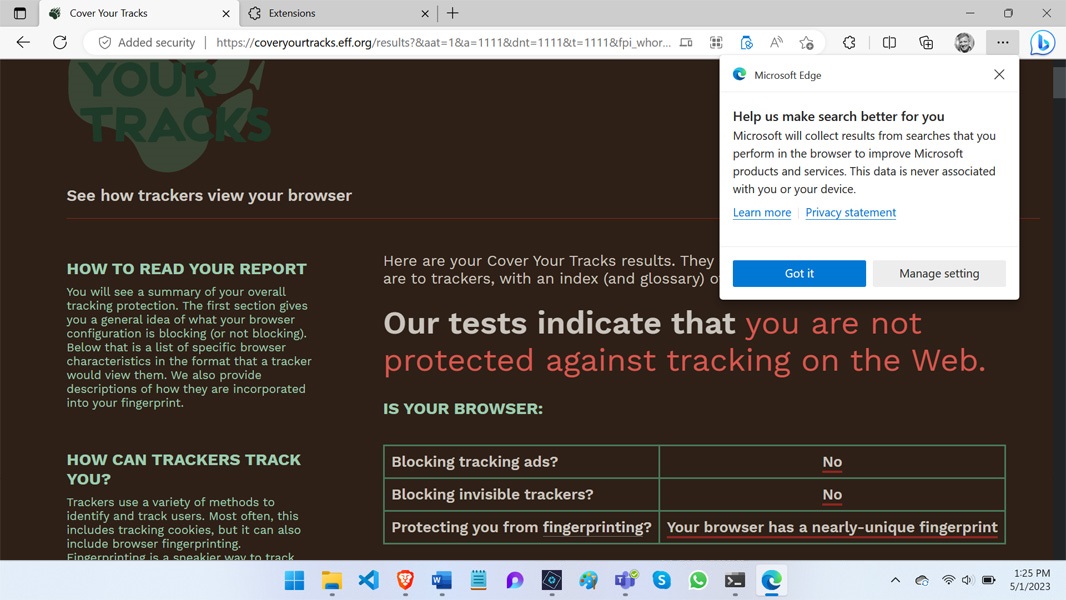
(Some people seem confused by this because Microsoft markets Edge’s privacy controls, but one way to check your browser privacy is to use the EFF’s Cover Your Tracks service. A default Safari install on Mac provides partial protection against tracking ads and invisible trackers, but a default Edge install on Windows or Mac provides no protection against either. And Edge betrays more bits of identifying information than Safari.)
Safari’s minimalism—in design and functionality—isn’t for effect. This browser still provides a lot of useful functionality out of the box—including tab groups, language translations, live text features for video content, visual lookup, and more—along with excellent performance, power management savings, and security, and you can add more features through extensions.
Sadly, Edge’s maximalism is likewise by design. As is the case with Windows 11, Microsoft Edge keeps piling on the features with no way to opt-out, tries to push users to Bing, MSN, and other Microsoft-owned web services so its owner can reap an advertising windfall, and it launches in various scenarios even when the user has selected another web browser as their default. The UI gets busier and busier with each passing month, and while some features are obviously useful, it’s been enshittified so much that it looks more like a garish neon advertisement for Microsoft than it does a tool to browse the web. Safari is there for its users and Edge is there for Microsoft.
Obviously, the vast majority of desktop users choose Chrome over both Safari and Edge. But Apple has objectively done a better job of attracting the remainder to its browser than has Microsoft, and I think a big part of that success is tied to the Mac maker’s more honest relationship with its customers. You pay Apple and you get a good experience. You mostly don’t pay Microsoft—Windows is, by and large, free to end users—and so you also get what you pay for, in the form of privacy invasions, tracking, and not-so-gentle steering towards Microsoft’s services and ad business. And I think that users react to that, by and large, even if they don’t have a firm grip on exactly what’s being done to them.
That most of them only use Edge to install Chrome, a browser that is even less secure and has the same privacy issues as Edge is, of course, also problematic. But that is a concern for another day. I just wish Edge was better.

Gain unlimited access to Premium articles.
With technology shaping our everyday lives, how could we not dig deeper?
Thurrott Premium delivers an honest and thorough perspective about the technologies we use and rely on everyday. Discover deeper content as a Premium member.