From the Editor’s Desk: One Story ⭐
- Paul Thurrott
- Sep 22, 2025
-
7
Like many people my age, I have stories. Some are well-worn in the sense that I’m particularly fond of them. And some just come up because something happens that reminds me of them. I recently found myself telling a bartender friend one of these stories, a chestnut that I’ve told repeatedly. And this reminded me of an idea I’d had sometime in the past year about how stories like this can be used for good.
First, the story.
My wife sometimes goes to the Boston area for a long weekend by herself to visit family and friends. I so sometimes go on these trips, of course, but I don’t want to as frequently as she does, and the weekends apart are probably healthy for all kinds of reasons. From a work perspective, this is a good chance for me to try and catch up.
When we’re in Pennsylvania, my wife and I typically have drinks and dinner each Friday night at our favorite restaurant/bar, Notch, which is a short 5-7 minute drive from our condo. We know everyone there, the bartenders and waitstaff and many patrons, so it’s always a good time. When my wife is away on one of those weekend trips, I typically stay in and eat leftovers or maybe some fast food so I can keep getting things done. But I will sometimes go to Notch solo on Friday too.
One of those occasions, I walked into the bar and Maddie, the head bartender and someone we’ve known since we first arrived in Pennsylvania, approach me with one hand held out.
“Give me your keys,” she said.
What? This was confusing. I had just walked in the door, and I stammered something to that effect.
“Give me your keys,” she repeated.
I complained that I hadn’t had anything to drink. I didn’t understand what was happening.
“Keys,” she said.
This was Maddie, so I dug the keys out of my pocket and handed them over. “Why?” I asked.
“You’re not leaving here without your leftovers this time,” she said, laughing.
Ah. I had left my leftovers on the bar on my three previous visits, somehow, only realizing the mistake on the drive home or later. And she had apparently run out into the parking lot with them the previous time but had just missed me. Hilarious.
I’ve told this story about Maddie dozens of times. Sometimes to people who know her—the restaurant and bar world in our area is as small as it is anywhere else, and everyone seems to know everyone—but more often to people who do not. Many of them are bartenders like Maddie, or perhaps servers or in some other restaurant/bar role.
This story resonates with them because it highlights one of the less obvious things that separate those who are great at their jobs from those who are not. Maddie isn’t just a great bartender, almost a scientist, really, in that capacity, she’s a great person. She remembers everything, including people’s names and what they like and don’t. And really cares about what she does. This is a rare combination of skills and it makes Maddie, and people like her, special.
In retelling this story sometime this past year, something occurred to me. This one story kind of encapsulates who Maddie is as a person. And I thought it would be an interesting mental exercise to think about the people who matter to us in life and see whether each can be explained, so to speak, by a single story. A single defining moment that sums up that person.
It’s a neat idea. Not because I thought of it, obviously, but because it makes you really think about people. And if you have that one perfect story, you can make it truly special by telling that person about it. I did this with Maddie last week, right before we flew back to Mexico City last Friday: My wife and I went to Notch on Thursday, the night before we flew, so we can say goodbye to Maddie and everyone else there. I’m not sure who enjoyed it more, Maddie or her coworkers, who gathered to hear it too.
Here’s one more.
My brother Jonathan and I have always been close, more friends than brothers. He’s special to me for all kinds of reasons, but I mostly love how we can be apart for months at a time and then we get back together and it’s like no time went by, and we’re immediately back to the same humorous exchanges. He was one of the few people who understood why we left the Boston area and he loves that we’re splitting time in Mexico now. He’s not ever bitter or upset, just supportive. And hilarious.
Our dad had had season tickets to the Boston Celtics, split with a group of several other guys, from the early 1980s into the early 2000s. But at some point, he asked me and Jonathan if we’d like to pick them up because he and my mother were less interested in going to 12 games and whatever playoff games every year. Plus, the tickets had gotten quite expensive.
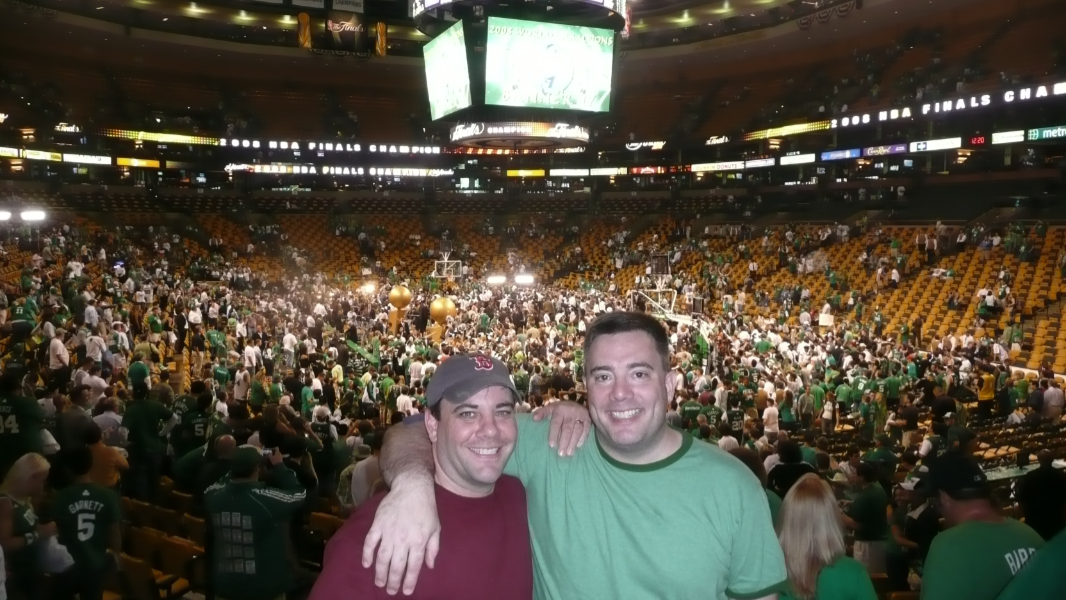
So for the next 15 years or so, Jonathan and I would go to at least 10 Celtics games every year. It was always a blast, and there are so many stories. So many. My brother and I were there to see the Celtics win the NBA championship in epic form in June 2008, with the person behind us wearing a Bill Walton mask and hugging me half the time and us getting trapped in Boston until 3 am. It was incredible.
But this is a different story.
Our seats moved around a bit over the years. And our most recent set of tickets were the first two seats in the last row of a courtside section angled off the bench, with a great view. This made it easy to get to the seats but also to bolt out into the tunnel and grab a drink or snack or whatever.
We were sitting there watching a game one night when Jonathan elbowed me in the ribs suddenly.
“Dude, what the hell is that?” he asked.
He was pointing at a couple walking up the aisle in the next section over to the left. The woman, to put this politely, appeared to be a prostitute. I mean, she probably wasn’t. But she was not dressed in a way that made any sense for the middle of the winter. It was a little bizarre. So we laughed about that for a bit and then turned our attention back to the game.
A few minutes later, we could sense people standing behind us, thanks to the position of our seats in the last row of that section their knees were roughly even with our heads. It was a man and a woman, debating whether they were in the right section. They were clearly confused.
Hearing this, we both half turned around. And sure enough, it was that couple. Jonathan, who literally cannot stop himself from trying to help people, said, “You guys are in the next section” and he pointed over to the aisle one section over.
“Thanks,” the man said, and they started to turn around to head back out the tunnel and then go over to the right entrance. But then he paused and came back.
“How do you know that?” he asked.
I turned in my seat to face my brother, a s#%t-eating grin on my face.
“Yeah, Jonathan,” I said. “How do you know that?”
The next second or two passed in what felt like an eternity, an eternity I thoroughly enjoyed as my brother stammered and turned red and then finally mumbled something. I can’t say I heard what it was, I was laughing too much. But the couple turned and left and got back to their seats. Jonathan may have punched me, but I didn’t feel it.
Totally worth it.

Gain unlimited access to Premium articles.
With technology shaping our everyday lives, how could we not dig deeper?
Thurrott Premium delivers an honest and thorough perspective about the technologies we use and rely on everyday. Discover deeper content as a Premium member.