Tearing Down Apple’s Feeble Response to Spotify (Premium)
- Paul Thurrott
- Mar 15, 2019
-
87
Apple responded to Spotify’s complaint about its abusive business practices in the only way it can: Ineffectively.
“After using the App Store for years to dramatically grow their business, Spotify seeks to keep all the benefits of the App Store ecosystem — including the substantial revenue that they draw from the App Store’s customers — without making any contributions to that marketplace,” an Apple statement notes. “At the same time, they distribute the music you love while making ever-smaller contributions to the artists, musicians, and songwriters who create it — even going so far as to take these creators to court.”
Woah.
Those are two unrelated charges, the second of which is quite spurious and—more to the point—completely unrelated to Spotify’s complaint against Apple. Like someone who has already lost an argument, Apple is lashing out at the party that embarrassed it and trying to shift the discussion elsewhere, lest the harsh light of reality is shown on the actual, valid complaint.
Which is this.
Not that Spotify is “wrapping its financial motivations in misleading rhetoric,” as Apple also claims, but rather that Apple is doing so. As Spotify complained, accurately, Apple’s App Store is not the level playing field that Apple presents. Instead, Apple gives its own apps and services visible preference over its competitors, such as in search results.
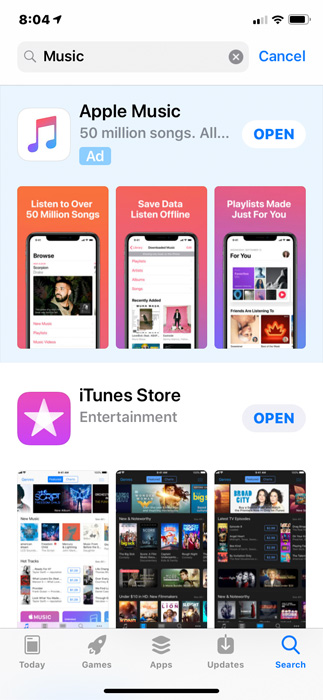
(Search for music in the App Store and count the number of Apple apps that appear before Spotify in the results. There are 7 Apple apps, including all five of the top five, the first of which is an advertisement. Spotify, the most popular music app in the App Store, is somehow the 11th result in that list.)
Apple also disadvantages Spotify by requiring that it pay Apple 30 percent of all revenue derived from users of its iOS app. Apple Music, meanwhile, does not suffer from this vig, and is in fact subsidized by the sales of the devices on which it (and Spotify) run, another unfair advantage. Apple also doesn’t allow users of its HomePod smart speaker to choose Spotify as their music service … for some reason. Spotify was likewise locked out of Apple Watch until the firm complained about it publicly. (Apple then suddenly approved its app.)
What this all points to is that Apple is giving its own apps and services unfair—and illegal—advantages over competitors on its own platforms. And given all that, let’s re-read Apple’s statement about Spotify wanting to “keep all the benefits of the App Store ecosystem … without making any contributions to that marketplace” and see it for the hypocrisy and double-speak that it is.
No, Apple. Spotify does not get all of the benefits of the App Store ecosystem. It gets locked out of key parts of it, and is required to pay fees where Apple does not, because Apple has decided that the service Spotify offers is one it wants for itself. There is no amount of words from Apple that can excuse this behavior.
Sorry, Apple. But you don’t have any valid arguments against Spotify or any other company in its position. (The prosecution calls Netflix, a company that paid Apple an unnecessary $853 million per year in subscription-related fees, as the next witness.) The problem with Spotify isn’t that it is “leveraging its scale,” as Apple complains. It’s that Apple’s App Store terms and vig are literally unfair—specifically, because Apple can tack that vig onto ongoing subscriptions for some reason—and because Apple unfairly and illegally punishes firms that have the temerity to compete with Apple in markets, like music, that Apple thinks are important for its future. Apple didn’t invent App Stores. But it did invent a new locked-in kind of App Store with a 30 percent vig and no way for users or partners to bypass it.
Put simply, any company seeking to establish subscription services that run through apps on Apple’s devices are a target now that Apple has proclaimed services to be its future. Apple’s own services are not beholden to the same fees and restrictions and thus can compete unfairly and illegally.
This behavior isn’t unique. Apple illegally entered the market for eBooks in 2010 by colluding with the top book publishers to punish Amazon, which was then, and is still now, the market leader; it was found guilty of this behavior around the world and paid reparations to customers who overpaid for eBooks as a result of Apple’s actions. That it is now unfairly punishing the dominant player in the music streaming business, another new market for Apple, suggests that this kind of protectionist and illegal behavior is both normal and endemic at Apple and not the exception. Thus, the firm needs to be regulated, not just in Europe, but around the world, to ensure that this can never happen again.
It’s time to be put a stop to this nonsense.
The good news? It’s happening.
“We have to examine the role of Apple and Apple’s app store,” EU Competition Commissioner Margrethe Vestager told German newspaper Tagesspiegel this week in the wake of Spotify’s complaint. “If we conclude that they have a market-dominating position, then the case would be comparable to our proceedings against Google.”

Gain unlimited access to Premium articles.
With technology shaping our everyday lives, how could we not dig deeper?
Thurrott Premium delivers an honest and thorough perspective about the technologies we use and rely on everyday. Discover deeper content as a Premium member.