Microsoft Edge Basics (23H2)
- Paul Thurrott
- Apr 28, 2024
-
2
For the most part, Microsoft Edge looks and works much like other modern web browsers. It offers all the features you expect, like tabbed browsing, an address bar with integrated search, support for themes and extensions, and so on.
But Edge also has unique features that visually and functionally differentiate it from the competition. For example, its prominent Copilot button unveils a sidebar with integrated text and image generation capabilities and a host of other online tools. You can use a Snap-like Split Screen feature to view webpages side-by-side. And Edge can save you money online with its integrated Shopping functionality.
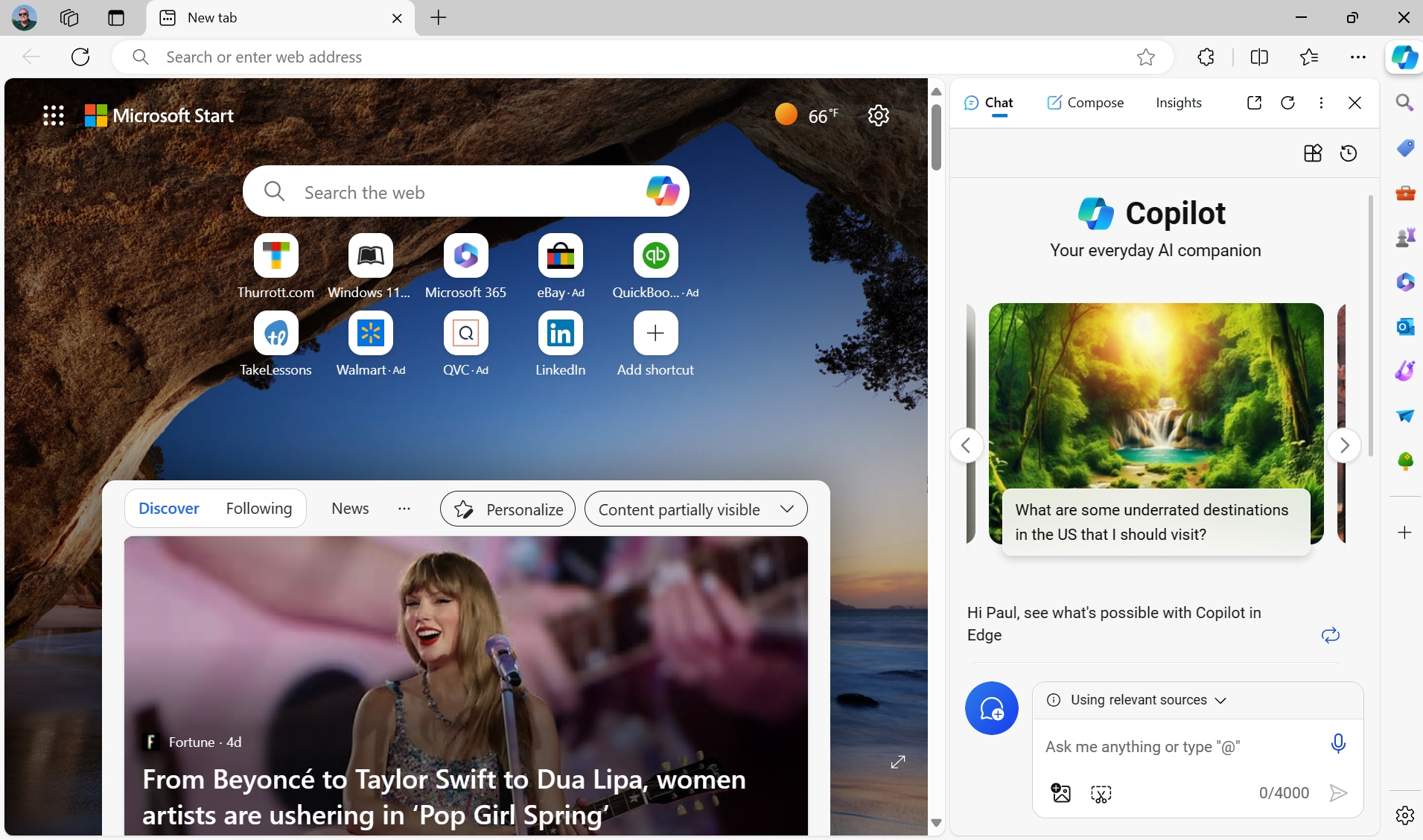
We know you’re familiar with web browsers and how they work. So, this chapter quickly examines common browser features and explains how they differ in Microsoft Edge. And subsequent chapters in this section focus on the biggest features that are unique to Edge.
Microsoft Edge is also available on Android smartphones and tablets, iPhone, iPad, Mac, Linux, and Xbox, so you can use it on all your devices and sync your browsing data between them if you’d like.
Toolbar and address bar
Microsoft Edge provides a somewhat minimal toolbar by default, with a large address bar in the middle (with “Read aloud” and “Add this page to favorites” buttons at its far right), “Back” and “Refresh” buttons to its left and several other buttons to its right.

The buttons you see to the right of the address bar vary depending on how you’ve configured Edge generally or its toolbar specifically. But you will see “Split Screen,” “Favorites,” and “Browser essentials,” “Settings and more” (“…”), and “Copilot” buttons if this is the first time you’ve ever used this browser.
Additional items can appear contextually. There are many examples of this, but here are some of the more common:
- A “Forward” button will appear if you visit a web page and then go back (by clicking “Back”) to the original page.
- An “Extensions” button will appear if you install one or more browser extensions.
- A “Downloads” button will appear when you’re downloading a file.
- A “Enter Immersive Reader” button will appear on the right of the Address bar when you’re reading an article.

Confusingly, some of the buttons can be moved to other locations. For example, the Profile button that normally appears in the far left of the app’s title bar can be moved into the Edge toolbar, where it will appear with the other buttons to the right of the address bar.

Indeed, the Edge toolbar is highly customizable. Many of the buttons, like “Favorites” and “Collections,” can be removed directly by right-clicking them and choosing “Hide from toolbar.”

Certain items, like the “Back” button and address bar, can’t be removed.
There are many more customization options in Edge settings. To find them, open Microsoft Edge settings by navigating to “Settings and more” (“…”) > “Settings” > “Appearance” and then finding the “Customize toolbar” section.
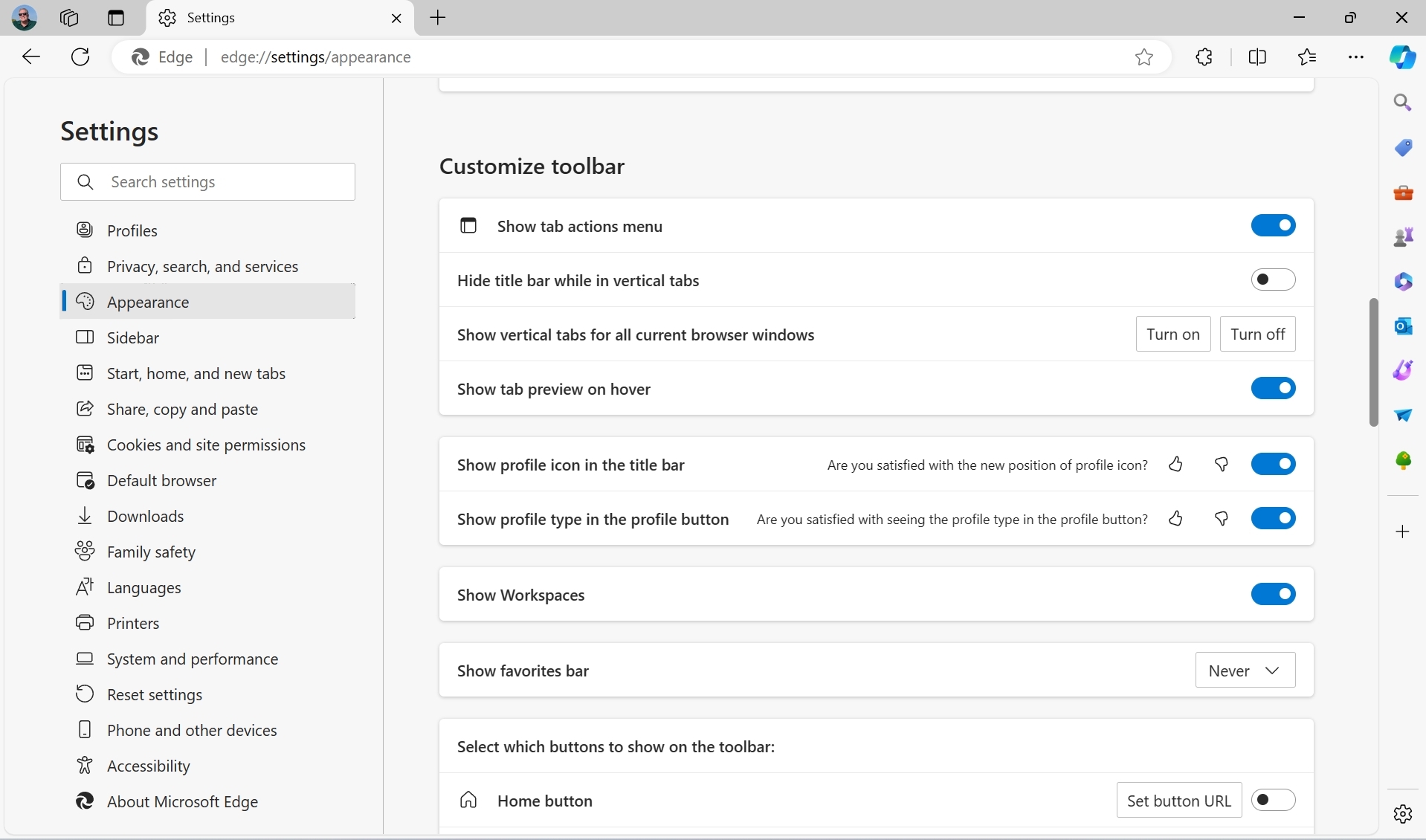
You can also open Settings and more by typing ALT + F.
Tabs
As you should expect, Microsoft Edge offers a rich set of features related to tabs, the familiar browser feature that lets you have multiple web pages open in a single app window at the same time.
Many tab-related features can be accessed via the Tab actions menu that appears when you click the “Tab actions” button in the upper-left of the app window, to the left of the row of tabs.

Multitask with tabs
As with other web browsers, Microsoft Edge lets you switch to a different tab by selecting it in the tab bar that’s found at the top of the app window, above the toolbar and address bar, by default.

You can also use the CTRL + TAB keyboard shortcut to switch to any each available tab, in turn. Use CTRL + T to open a new tab and CTRL + W to close the current tab.
You can also reopen a closed tab by typing CTRL + SHIFT + T.
Windows 11 also provides a unique integration with Edge that makes thumbnails for individual Edge tabs appear next to those for standalone windows while using the Alt-Tab multitasking feature.
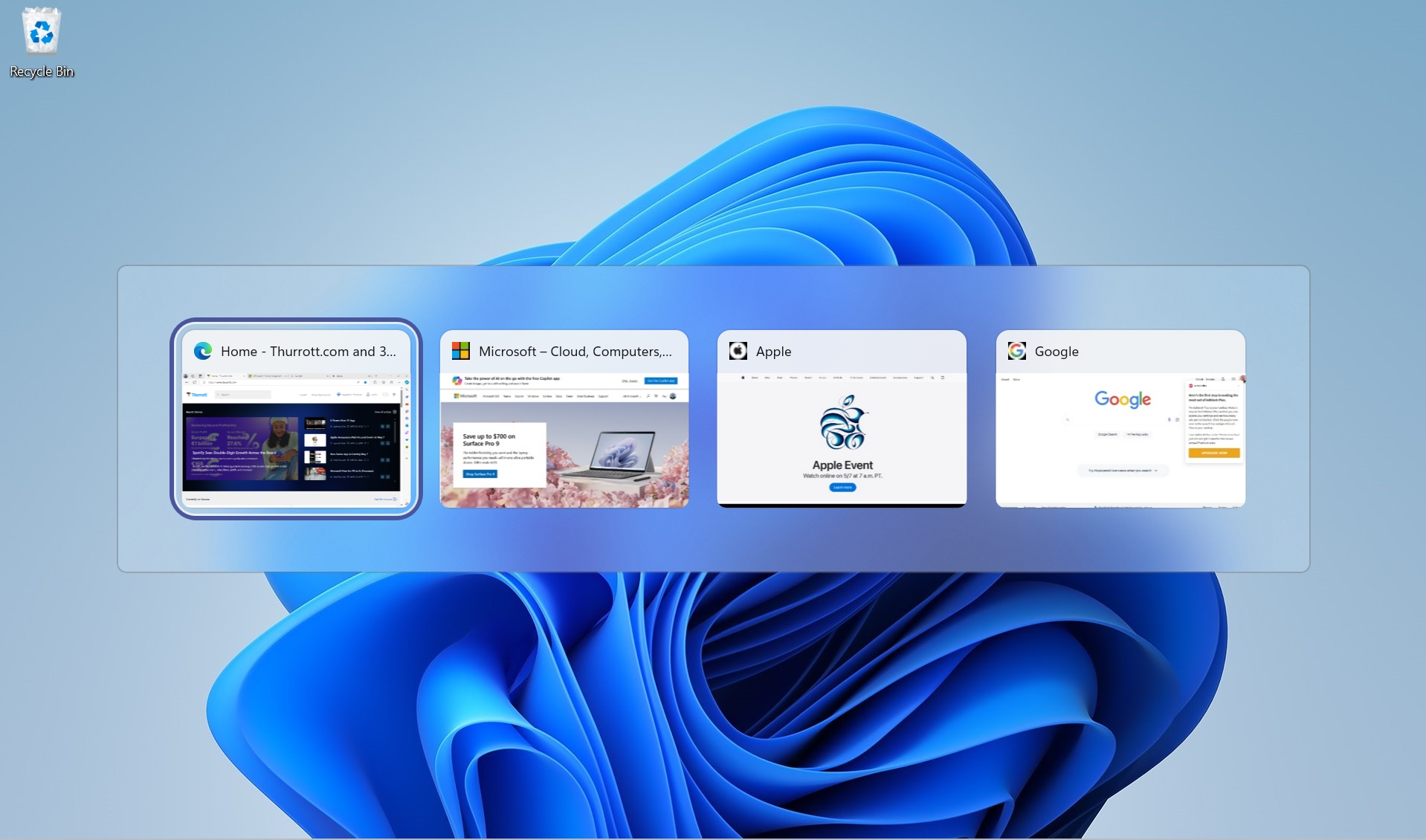
By default, the three most recently accessed Edge tabs will appear in Alt-Tab. But you can configure Alt-Tab to display the 5 or 20 most recent tabs, or no Edge tabs (meaning that only the Microsoft Edge window will appear in Alt-Tab).
You can learn more about this feature in the Alt-Tab chapter.
Search tabs
If you have a lot of open tabs, it can be difficult to find exactly the tab you want. One solution is an Edge feature called Search tabs that lets you search for text across all the open tabs.
You can also open Search tabs by typing CTRL + SHIFT + A.
To open Search tabs, click the “Tab actions” button, and select “Search tabs” from the menu that appears.
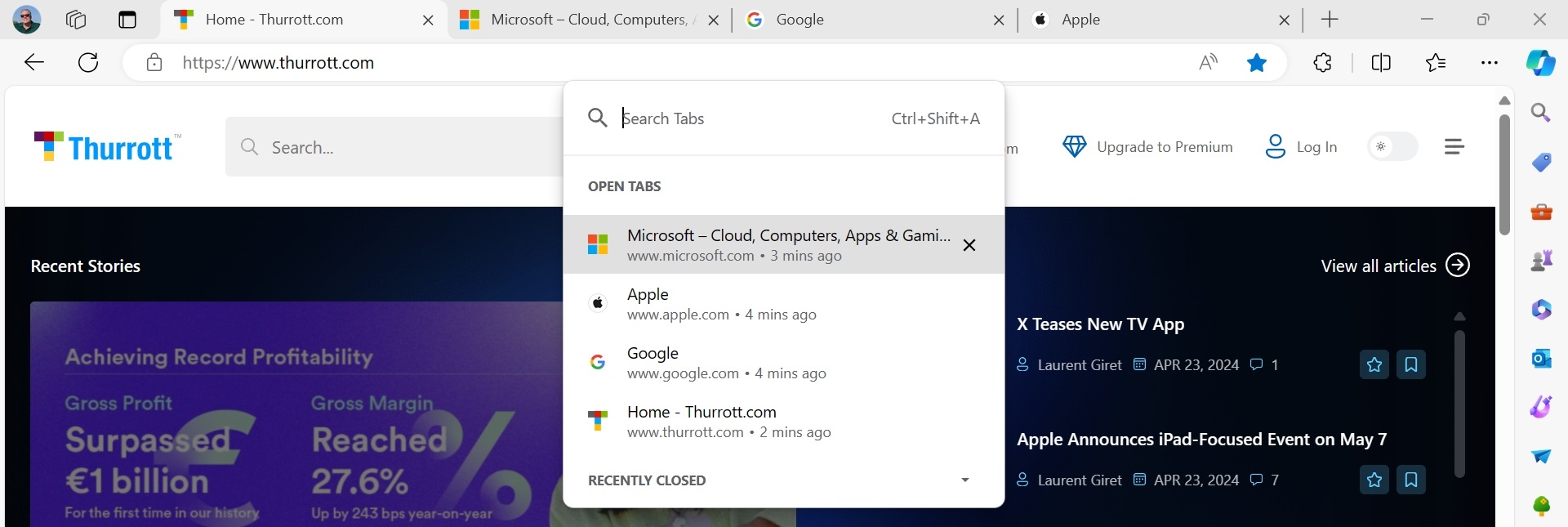
The Search tabs interface is simple enough. But be careful with the “Close tab” button (“x”) next to each tab in the search results: clicking that will close the relevant tab with no warning.
Vertical tabs
If you often have dozens of tabs open at once, you will have found that the horizontal design of tabs doesn’t scale very well: As you add more and more tabs, each becomes so small that they are hard if not impossible to differentiate from each other.
Vertical tabs is Microsoft’s attempt to solve this problem. When enabled, your tabs are displayed in a vertical pane on the left side of the Edge window. This layout makes it easy to see what each tab contains, and it provides a bit more room vertically for reading the content in the current tab.
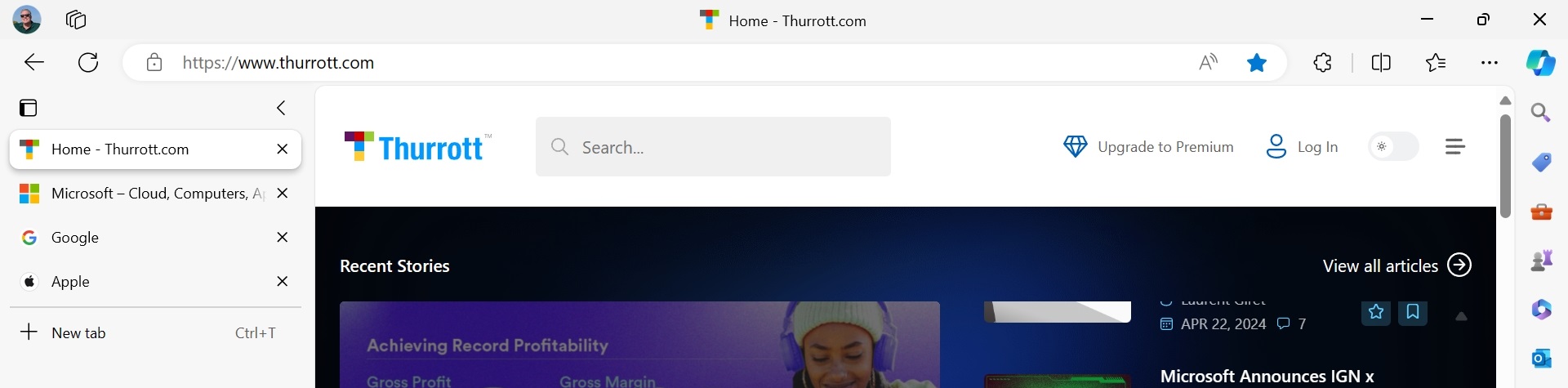
Because Vertical tabs eat into the horizontal space available to display web content, Microsoft Edge lets you resize this interface so that it’s only as wide as you need.
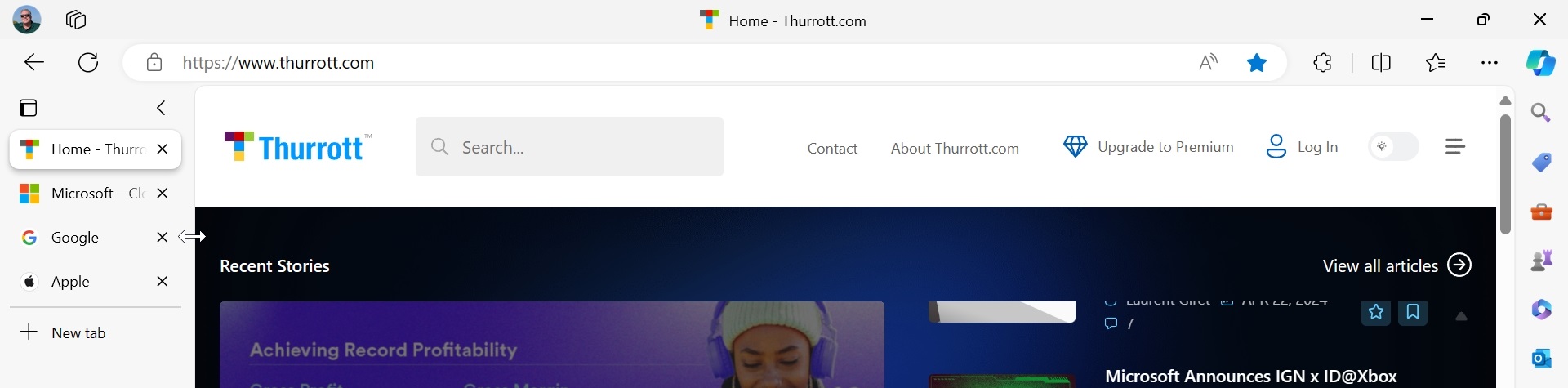

You can also collapse the Vertical tabs pane to provide even more space for content.
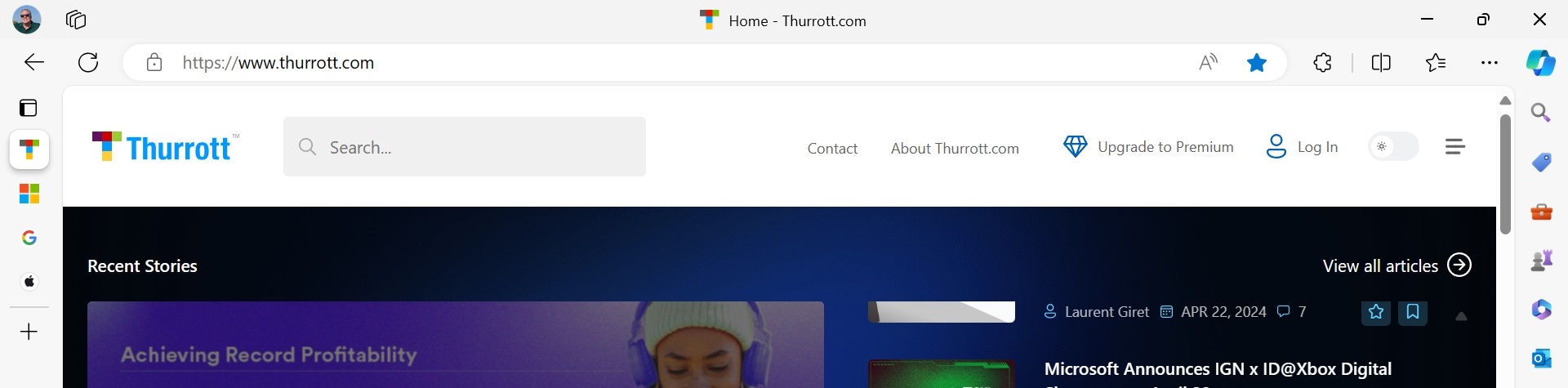
To do so, click the “Collapse pane” (“<“) button at the top of the pane.
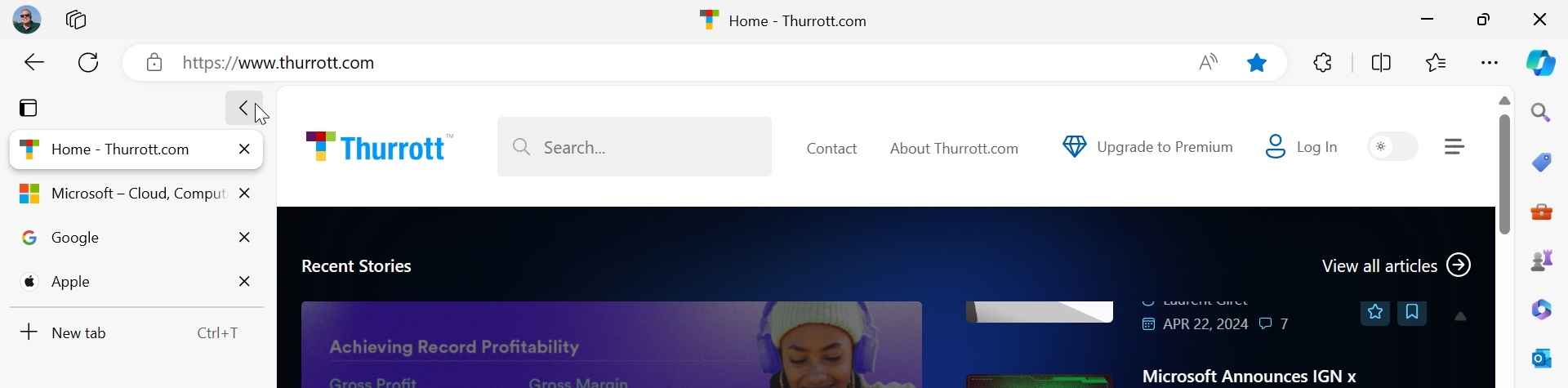
In the collapsed view, you can also mouse over the pane to cause it to temporarily expand and show more information about each tab.
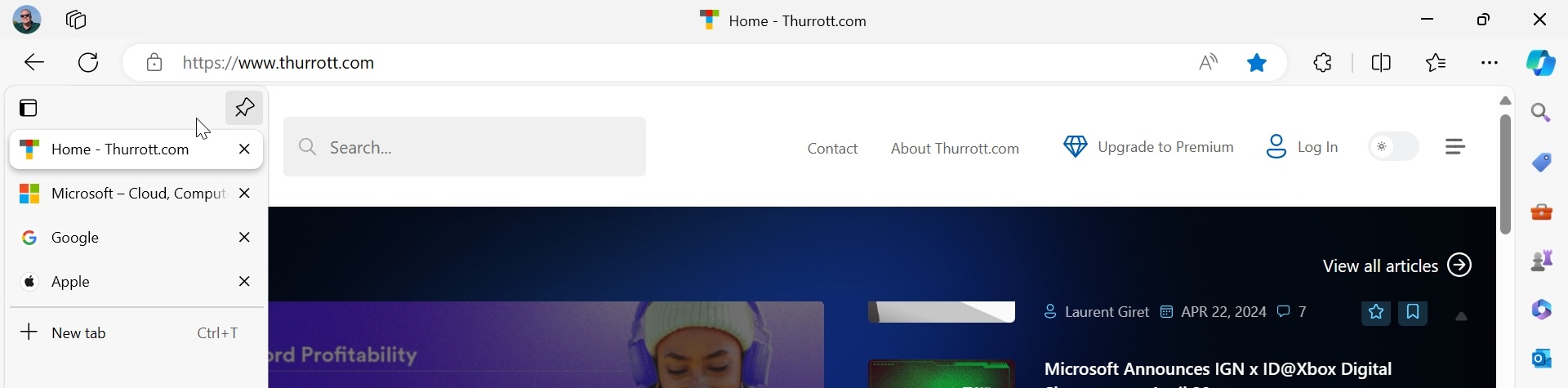
To enable Vertical tabs, select the “Tab actions” menu in the upper left of the Edge window and then select “Turn on vertical tabs” from the menu that appears.
You can also type CTRL + SHIFT + , (comma) to toggle Vertical tabs.
If you want even more space, you can hide the Edge title bar while using Vertical tabs too. To do so, open Edge settings and navigate to Appearance. Then, scroll down to the “Customize toolbar” section and turn the option “Hide title bar when in vertical tabs” to On.

Pinned tabs
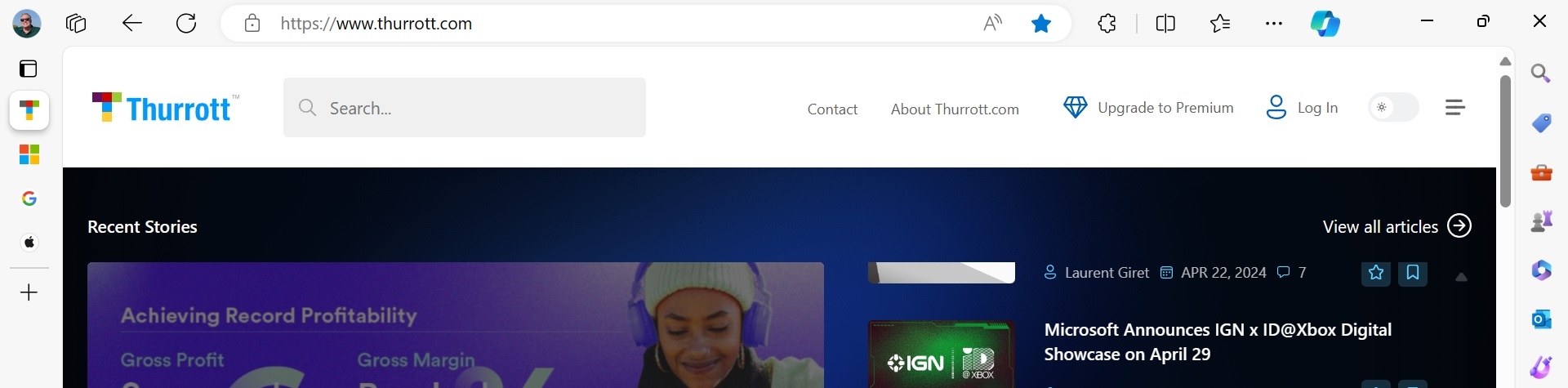
Like other web browsers, Microsoft Edge lets you pin commonly used websites or web pages so that they are always available in the browser window. Pinned tabs take up less space than non-pinned tabs because they only display the site’s icon and not its title, and they all appear together on the far left side of the tab row.

If you enable Vertical tabs, pinned tabs appear in a row above the other tabs.
To pin a tab, right-click it and choose “Pin tab.” You can likewise right-click a pinned tab and choose “Unpin tab” to unpin it.
Pinned tabs seem straightforward. But there are two related issues to be aware of. If you have multiple Edge windows open, the pinned tabs will not appear on subsequent windows. And if you close the window with the pinned tabs before closing any other Edge windows, you’ll lose the pinned tabs.
Fortunately, you can get them back. To do so, open Edge History and then choose the Recently closed view. Then, select the entry related to the previous window with the pinned tabs to open it as a new Edge window.
We discuss Microsoft Edge History later in this chapter.
Tab groups
Tab groups is another useful organizational feature that may be of interest. It is used to separate two or more tabs into a color-coordinated group that can be contracted and expanded as necessary, saving on-screen real estate in a unique way.

Microsoft Edge supports two types of tab groups, those you create yourself and, optionally, those Edge creates for you automatically.
To create a tab group, right-click a tab and select “Add tab to new group.” A tab group drop-down pane will appear.
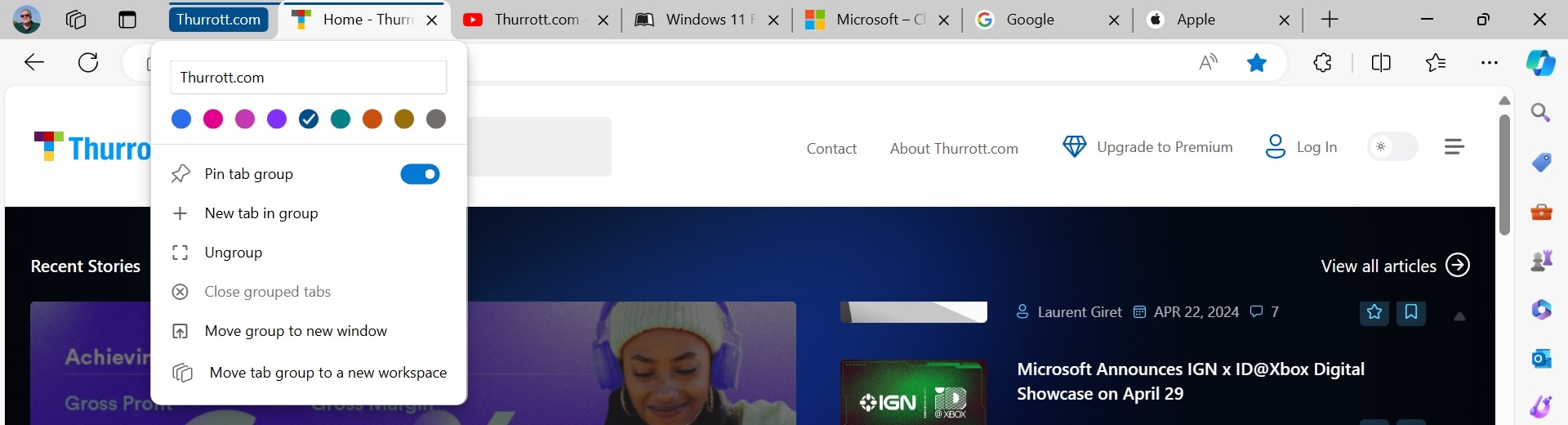
Here, the following options are available:
Group name. By default, Edge will name the group based on the name of the first tab you add to the group. But you can change that name to whatever you prefer.
Group color. Tab groups are differentiated from each other–and from standalone tabs–with a color accent. You can choose from one of several different colors.
Pin tab group. By default, each tab group is pinned so that it will appear again if you close the Edge window and then reopen it. If you don’t need your tab group to withstand restarts for some reason, you can disable that functionality here.
Pinned tab groups work similarly to Pinned tabs, but when expanded, the tabs in a tab group are normally sized.
New tab in group. Click this to immediately add a new tab to the group. This will open the New tab page in a separate tab, inside the group you’re now creating.
Ungroup. Choose this option to close the Tab group and return whatever tabs it contains to the main tab bar.
Close grouped tabs. Choose this option to close the Tab group and all the tabs it contains. (That is, the tabs in the group will not be moved to the main tab bar.)
Move group to a new window. This one is self-explanatory.
Move tab group to a new workspace. Microsoft Edge provides a Workspaces feature that helps you organize a set of tabs related to a specific project into a unique and color-coded Edge window. If you click this option, the tab group will be moved from the current Edge window into a new Workspace (and window).
You can learn more about Workspaces later in this chapter.
Oddly, there’s no option to move a tab group into an existing workspace. You can, however, move individual tabs into existing workspaces at any time. To do so, right-click the tab and select “Move tab to” and then the desired location.
From here, you can add more tabs to the group similarly. You can also expand–and contract–a tab group by clicking its colored name. To view the tab group management pane again, right-click its colored name.


You can also configure Microsoft Edge to create tab groups automatically for you. To do so, open the “Tab actions” menu and select “Organize tabs.” Edge will examine the open tabs and suggest one or more tab groups.
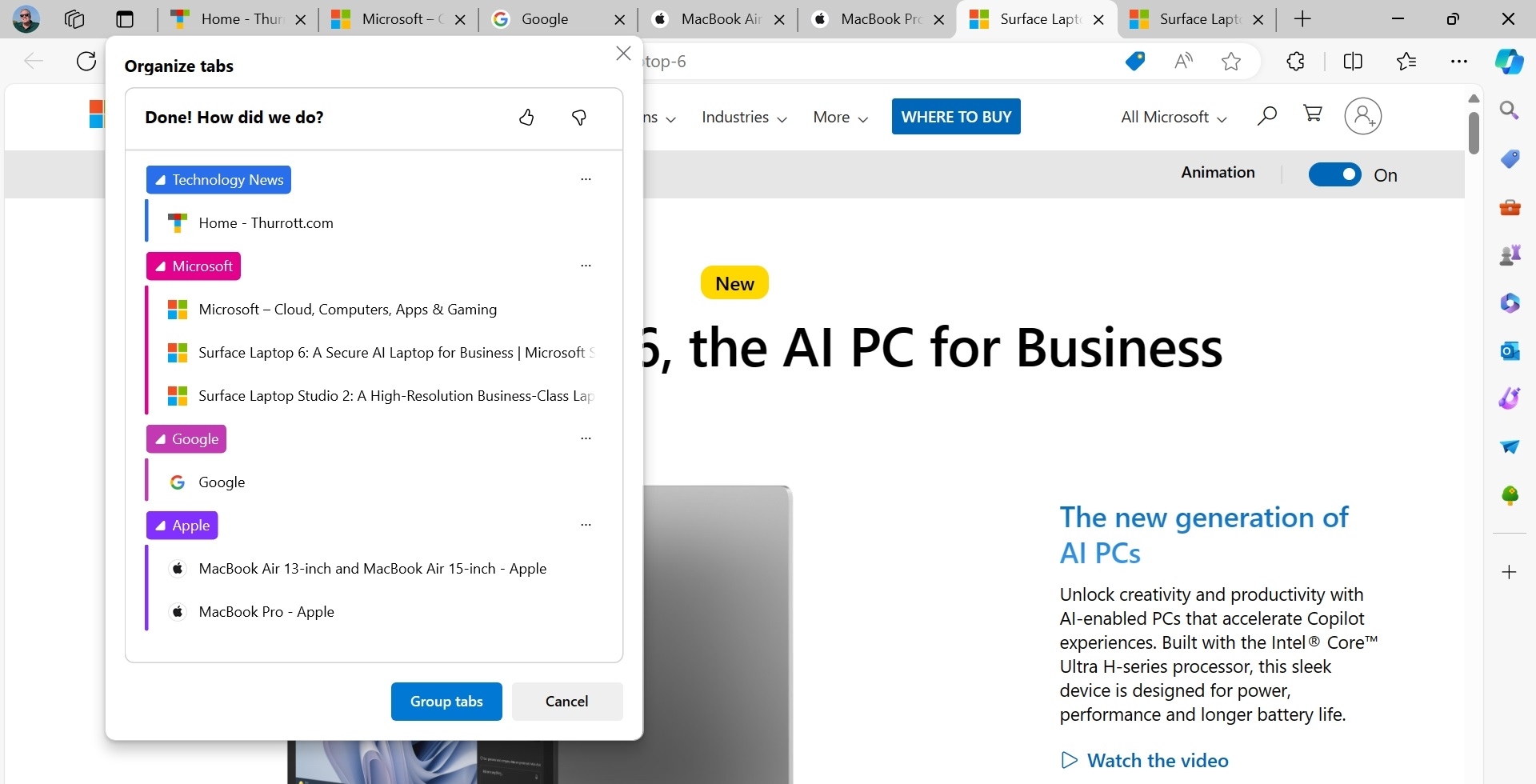
Each suggested tab group has an associated “More options” (“…”) button. When you click this, you will see options for renaming the suggested tab group, configuring a new color, or ungrouping it.
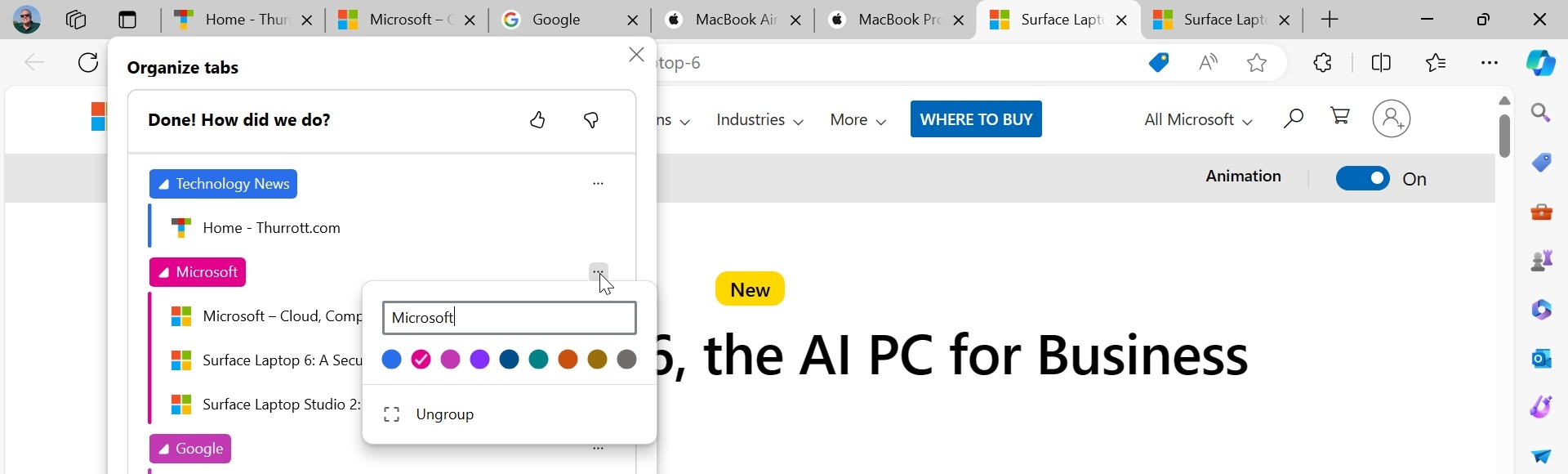
Once you’ve made all the changes you want, click “Group tabs” to create the tab groups that Edge suggested.
Additional tab configuration
There are numerous other tab configuration changes you can make. Some key options to consider include:
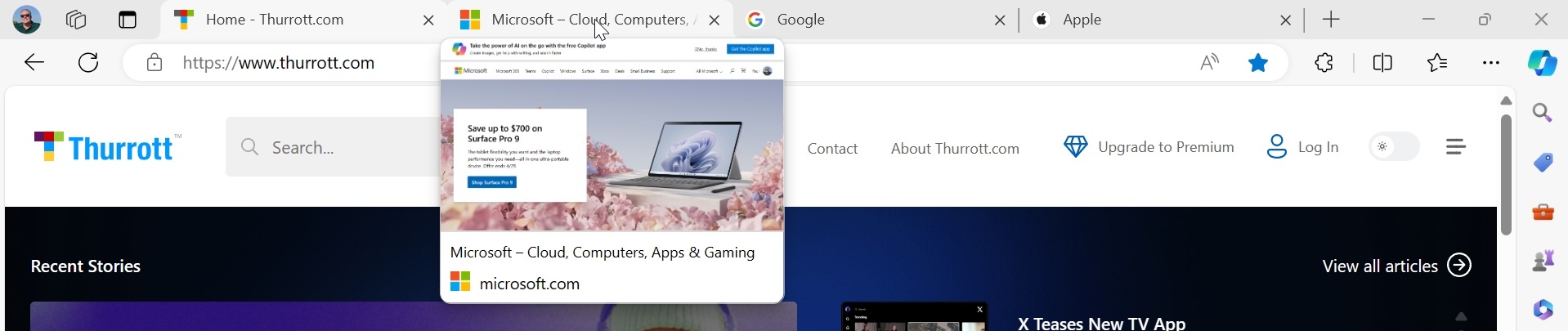
Tab thumbnail previews. By default, Microsoft Edge displays a thumbnail preview of any tab you mouse over. This can make it easy to identify the correct tab, but if you find this display distracting, you can disable it in Edge settings: navigate to Appearance > Customize toolbar and uncheck the option “Show tab preview on hover.”

Ask before closing multiple tabs. By default, Microsoft Edge will not prompt you when you close a browser window with multiple open tabs. To avoid a potential mistake, however, you can enable a prompt. To do so, open Edge settings, navigate to Appearance > Customize browser, and enable the option “Ask before closing a window with multiple tabs.”

Sleeping tabs. Microsoft Edge uses a feature called Sleeping tabs to minimize how many microprocessor cycles and how much RAM it uses. We discuss how to configure this and related features in the chapter Set Up Microsoft Edge Correctly … Whether You Use It Or Not.
Split Screen
In addition to its comprehensive support for tabs, Microsoft Edge also provides a Split Screen feature that lets you separate a tab into two resizable side-by-side views. By default, Edge displays a “Split screen” button in its toolbar for easy access. But if you don’t see this button, you can enable it in Edge settings by navigating to Appearance > Customize browser and setting “Enable Split Screen” to “On.”

There is no keyboard shortcut for toggling Split Screen, so you need to enable this toolbar button to use the feature.
To use Split Screen, choose the tab displaying the webpage you want to view on the left side of the Split screen view. Then, click the “Split Screen” toolbar button. When you do, the right view–which Microsoft Edge refers to as a “screen,” of course–displays a search box and cards for open tabs and frequently visited webpages so you can choose what will appear there.
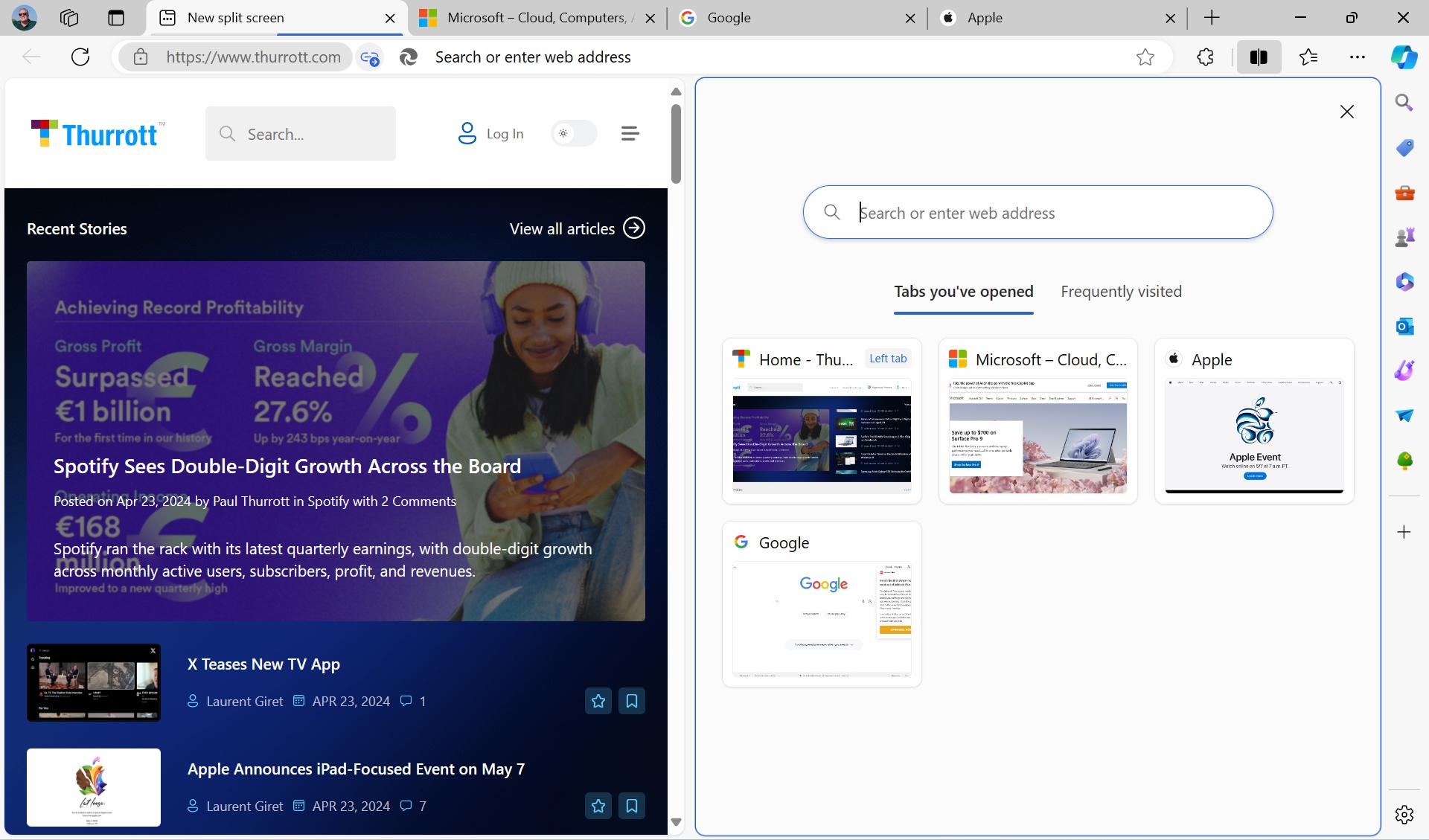
Once you’ve selected the webpage for the right view, the tab representing the original webpage–the page on the left–visually changes to indicate that it contains a split screen view. You can read or interact with each view independently, grab the separator in the middle to resize the views with your mouse, and navigate in and out of this tab normally.
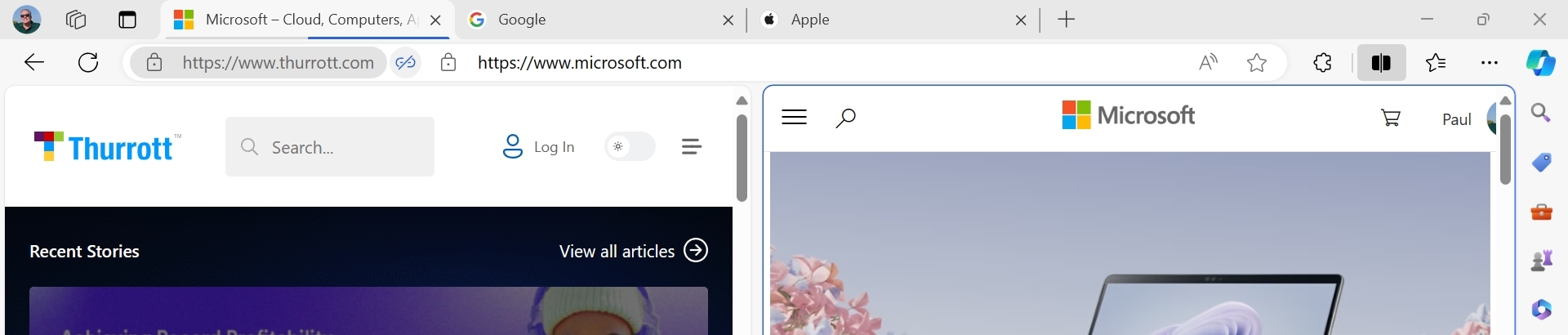

As you mouse around in either view, you will see two Split Screen icons appear over the upper-right of either side: “More options” and “Close split screen.” When clicked, the “More options” button displays a menu of Split screen options.
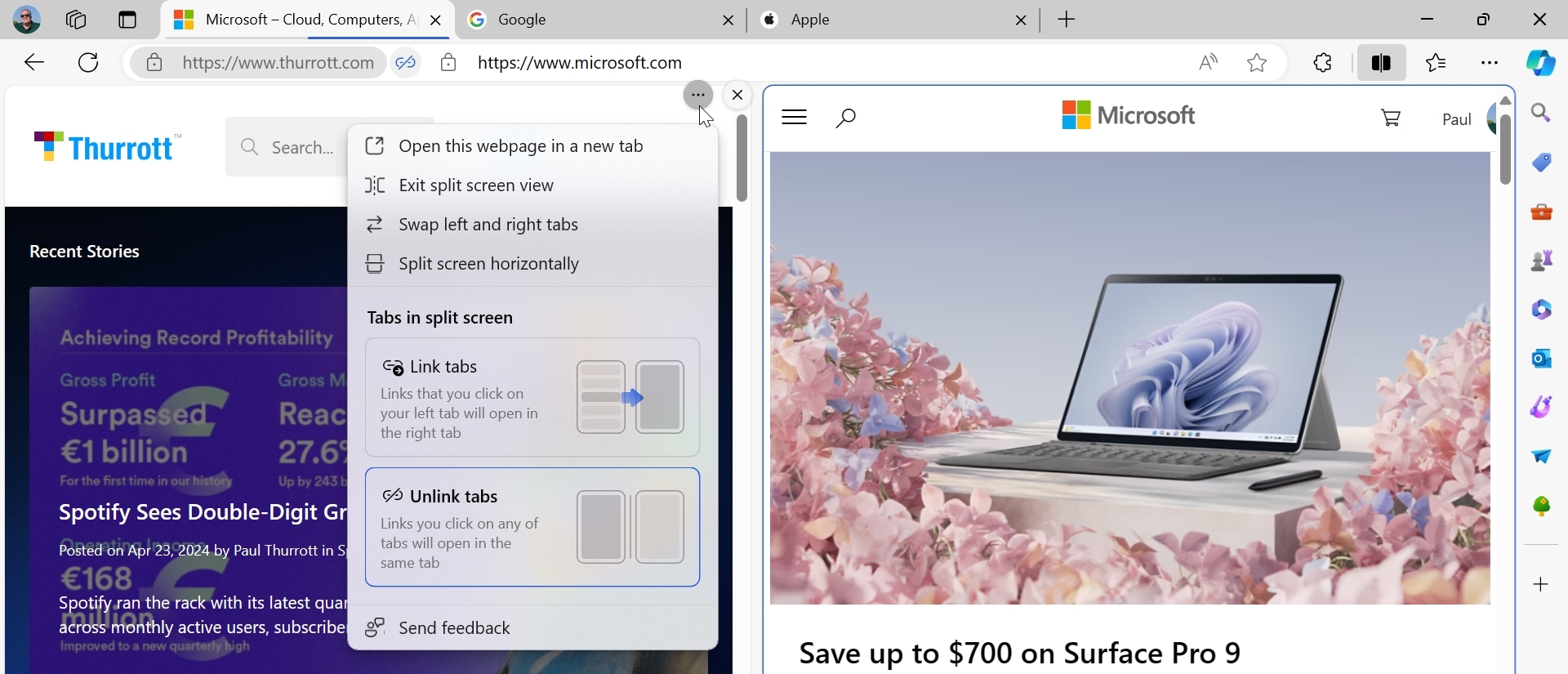
Most of these options are straightforward, but the two items under “Tabs in split screen” is particularly interesting. By default, the webpages displayed in Split Screen are separate from each other, and any links you click will open in the same view. But if you enable “Link tabs,” any links you open in the current view (left or right) will now open in the other view. This can be useful if the current page displays a list of links, and you wish to open one or more side-by-side with that page instead of replacing it.
You can choose “Unlink tabs” to go back to the default clicked link behavior.
To close the Split screen view, click the “Split screen” toolbar button or the “Close split screen” button. Each of the webpages you were viewing will once again appear in separate tabs.
Favorites
All web browsers offer a feature called Bookmarks that lets you save websites and web pages you like to a stored list so you can refer to them later. This feature, confusingly, is called Favorites in Microsoft Edge.
Other than that difference, Favorites in Edge work similarly to Bookmarks in Chrome and other browsers. You can add any page you’re currently viewing to Favorites by clicking the “Add this page to favorites” button in the far right of the Address bar.
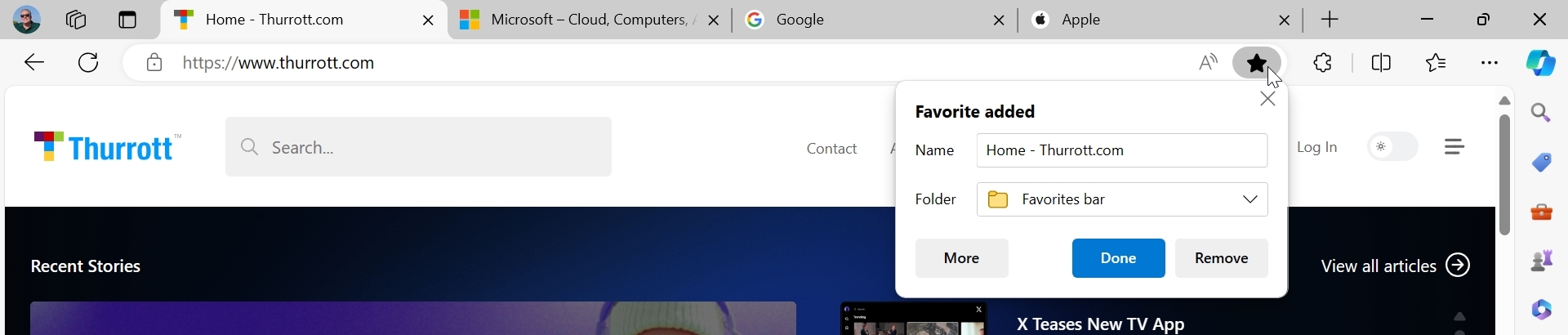
You can also add the current web page to Favorites by typing CTRL + D.
You can display your favorites by clicking the “Favorites” toolbar button.
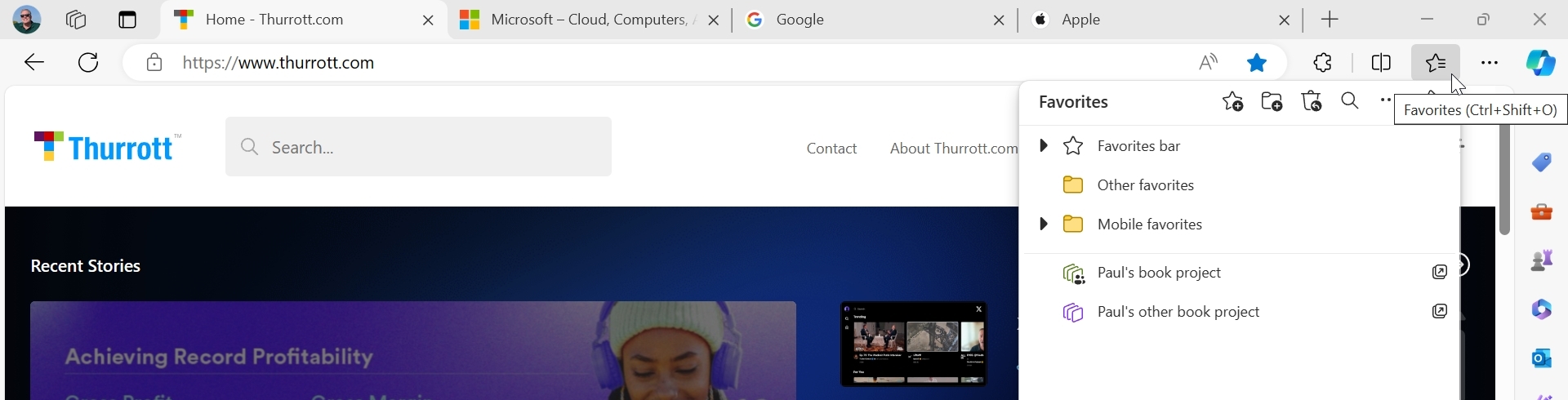
Don’t see the “Favorites” button? You can enable in Edge settings by navigating to Appearance > Customize toolbar and setting the option “Favorites button” to “On.”
You can also display Favorites by typing CTRL + SHIFT + 0.
And you can optionally display a Favorites bar below the Edge toolbar and Address bar. The Favorites bar is part of Favorites, but it also acts as a sort of alternative to Favorites since the favorites it contains can be seen at all times while using Edge.

To configure the Favorites bar, open Edge settings, navigate to Appearance > Customize toolbar, and locate the option “Show favorites bar.” It can be set to “Always,” “Never,” or “Only on new tabs,” which is the default.
History
Like other web browsers, Microsoft Edge keeps track of your browsing history, the web pages you visit each day, and it does this so you can easily find an article or other web page in the future. But Edge displays this history differently than most browsers, using a floating pane, and it optionally lets you sync your history between your PCs and other devices so you can view your history from anywhere.
To view your history, navigate to Settings and more (“…”) > History.
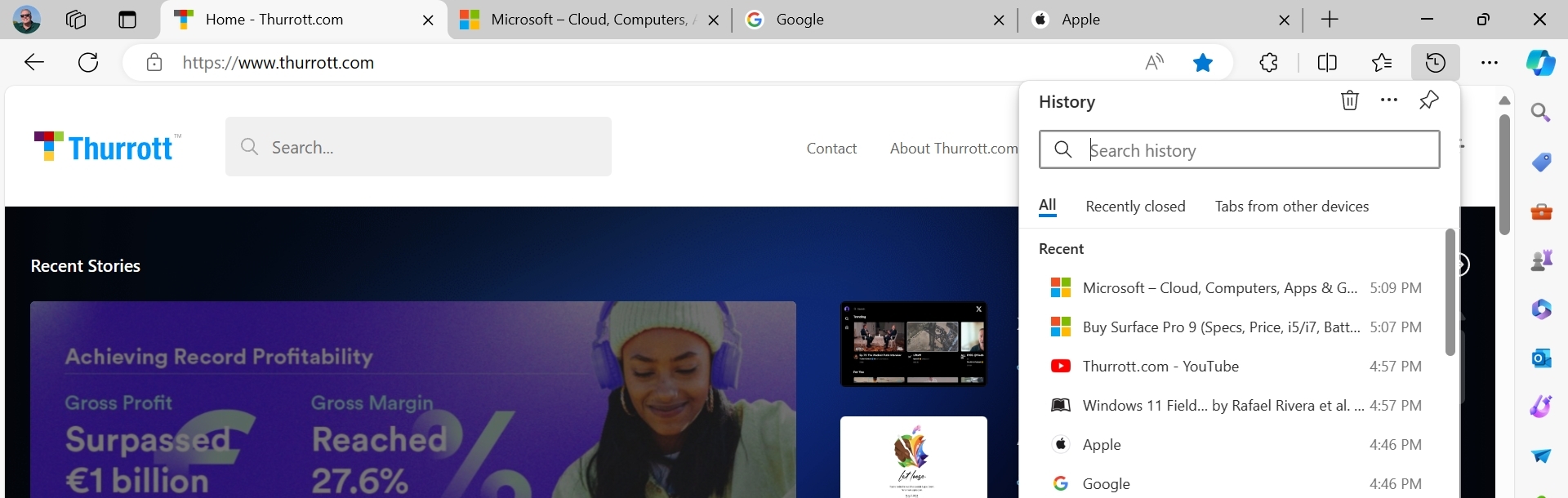
Or, type CTRL + H.
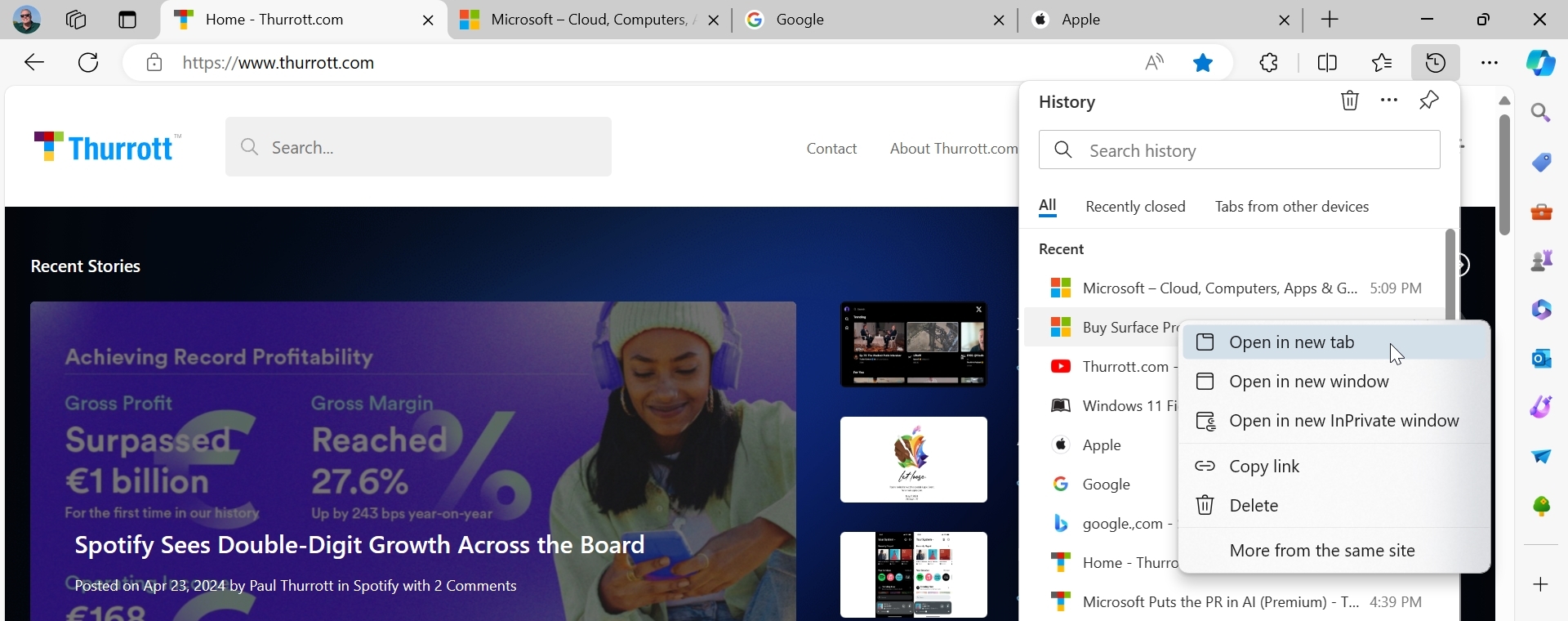
Here, your browsing history from this PC is displayed in reverse chronological order and broken up into sections like Recent, Today, and so on. You can also access recently closed tabs and, if enabled, tabs from other devices.
When you select an item in History, it opens in the current tab by default. That may not be ideal. But you can open it in a new tab by CTRL-clicking it, or by right-clicking it and selecting “Open in new tab” from the context menu that appears.
Notifications
As web technologies advance, websites have adopted capabilities that were previously only available to native applications. Among these features is the ability to send you notifications when something happens. For example, a web-based calendar service can send a notification to remind me about an upcoming event. Or a news site can send you a notification when there is breaking news.
What makes these website notifications particularly compelling in Windows is that they integrate with the Notifications pane and appear alongside–and look and behave like–native app notifications.
You can learn more about notifications and the Notifications pane in the Notifications chapter.
The first time you visit a website that can deliver notifications, you will be prompted at the top of the Microsoft Edge window. If you select “Allow,” that website will now display notifications that look and work just like any other notifications in Windows 11. A pop-up notification banner will appear in the lower right of your display.
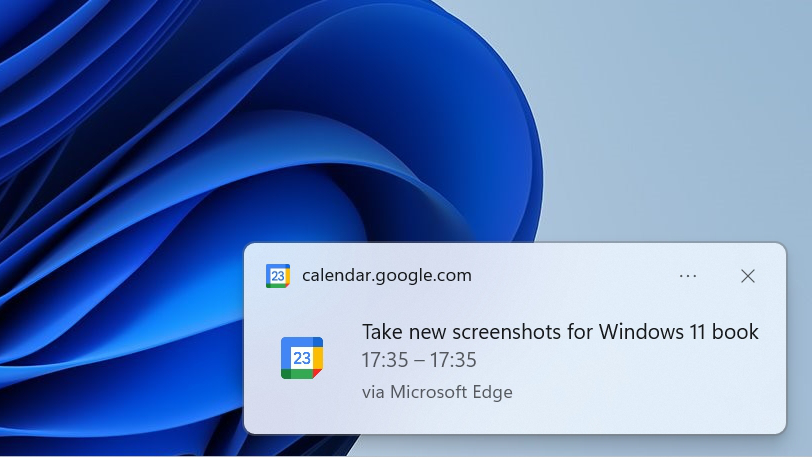
If you click this notification outside its buttons, Microsoft Edge will appear with the proper tab open so you can respond to whatever triggered the notification.
The notification will also appear in the Notification pane (WINKEY + N) so you can deal with it anytime in the future.
Microsoft Edge maintains a list of the websites for which you have accepted notifications. If you don’t find this behavior useful, you can disable notifications on a site-by-side basis. To do so, open Edge settings and navigate to Cookies and site permissions > Notifications (edge://settings/content/notifications).
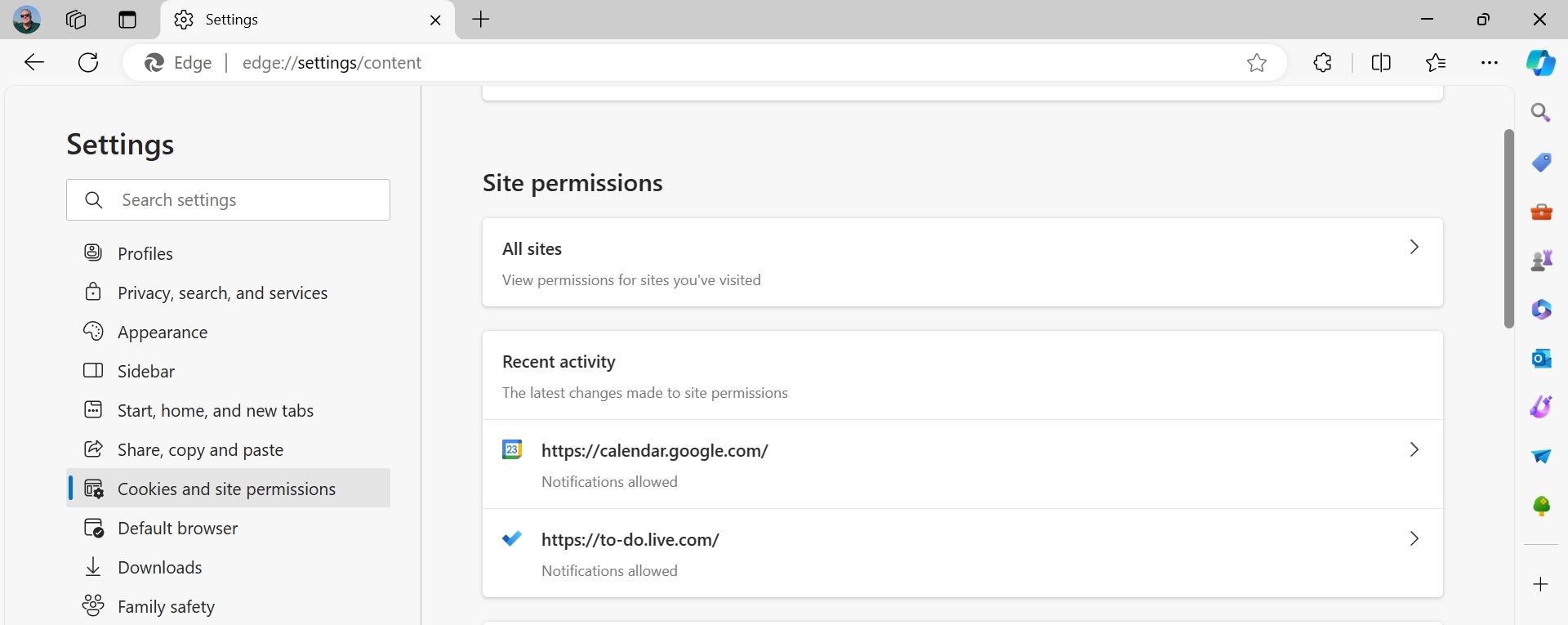
Among other things, you can configure notifications on a site-by-site basis. If you now wish to disable notifications from a particular site, select the More actions (“…”) button next to that site and choose “Block” (or “Remove”).
Downloads
Microsoft Edge handles web downloads a little differently than do other browsers. Instead of just downloading directly to your Downloads folder by default, Edge will display a prompt with “Open” and “Save as” choices. (There’s also a third choice, “Save,” hidden behind the caret next to “Save as.”)

This configuration may be ideal for those who don’t care about saving downloaded files in your Downloads folder: You can just choose “Open” and open the files as soon as they’re downloaded.
But if you would prefer for Edge to immediately download files from the web as other browsers do, you can configure it to do so. Open Microsoft Edge settings, navigate to “Downloads,” and disable the “Ask me what to do with each download” option.
Like other web browsers, Edge temporarily adds a “Downloads” button to its toolbar when you download a file so that you can access it immediately. This button displays recent downloads, including the current download, in a pane when you click it.
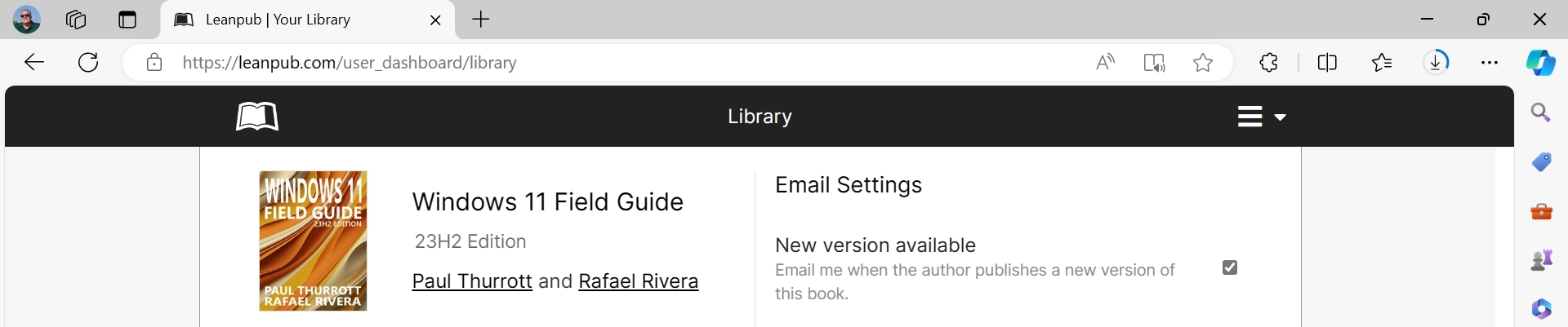
When the download is done, you can open it by clicking the “Open file” link. Or, you can open the Downloads folder or delete the download.
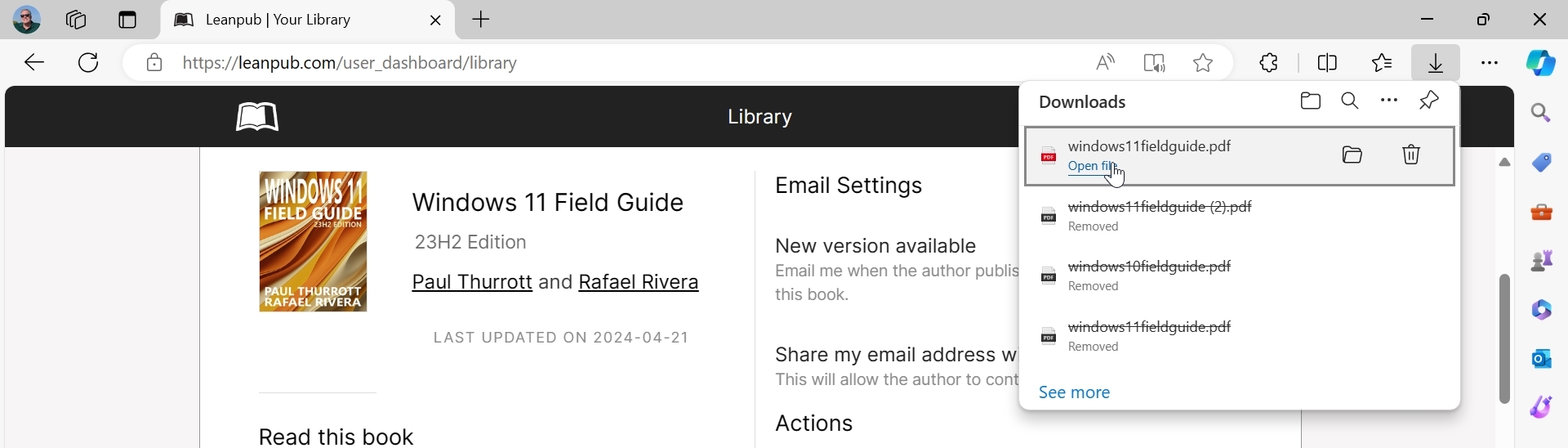
This pane also contains other related download options via the icons and “More options” (“…”) link at its top.
Page zoom
Like other web browsers, Microsoft Edge supports useful page zoom capabilities.
First, you can configure a default zoom level that will impact all the web pages you visit. To do so, open Microsoft Edge settings, navigate to “Appearance,” and locate the “Zoom” section. The drop-down box next to “Page zoom” lets you change the default zoom to one of several values between 25 and 500 percent.
You can also arbitrarily change the zoom level on the fly at any time. You need to use keyboard shortcuts for this.
They are:
Zoom in: CTRL + –
Zoom out: CTRL + +
Return to default zoom: CTRL + 0
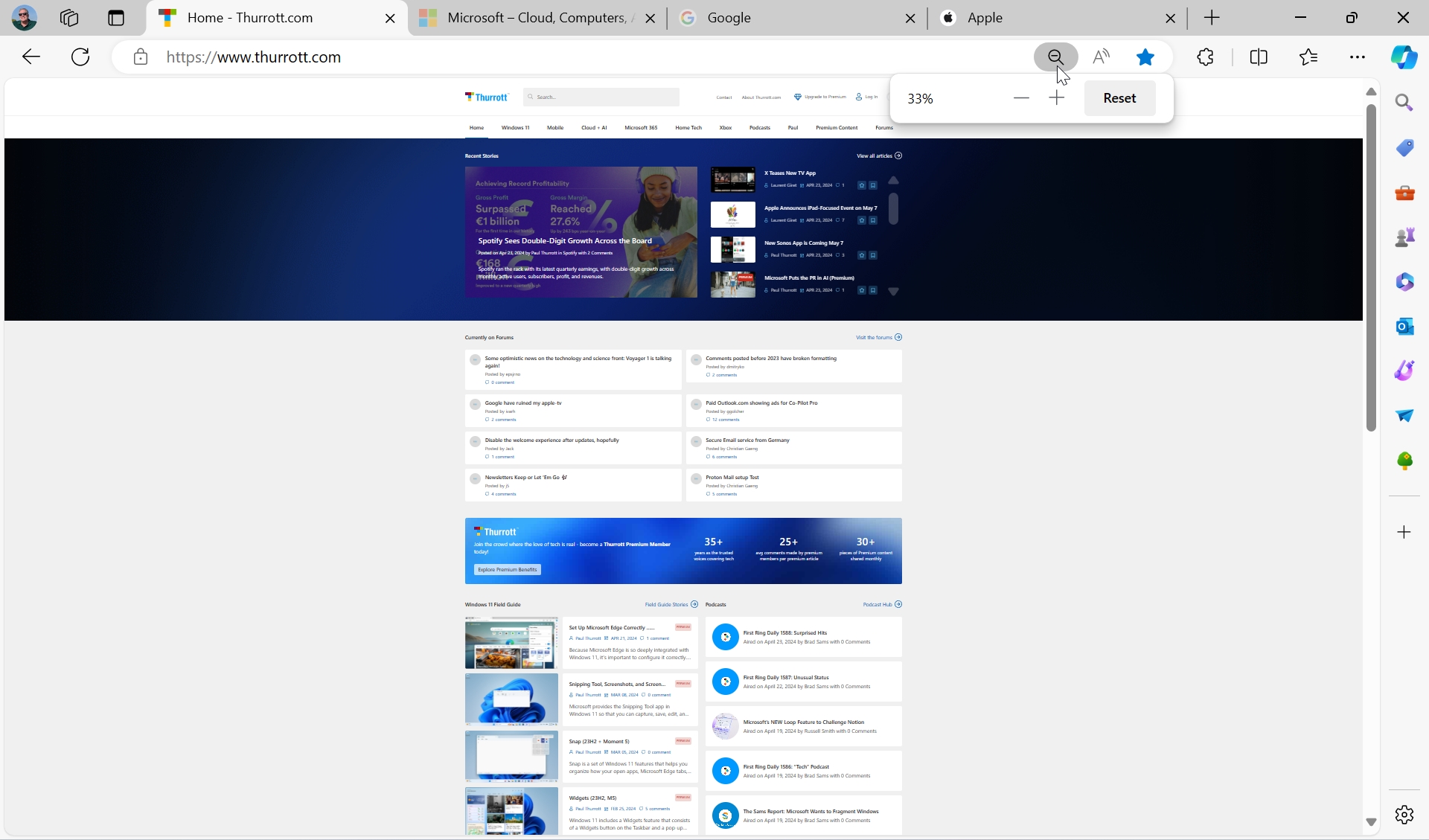

If your mouse has a scroll wheel, you can also use the CTRL key with the scroll wheel to zoom up and down.
Find on page
Like other web browsers, Microsoft Edge helps you find text on the page you’re currently viewing. To do so, select Settings and more (“…”) and then “Find on page.” A Find box appears just below the Edge toolbar.
Or, just type CTRL + F.

To find a specific term, start typing. As you do, the Find box will indicate how many items on the page match, and each matching item will be highlighted on the page.
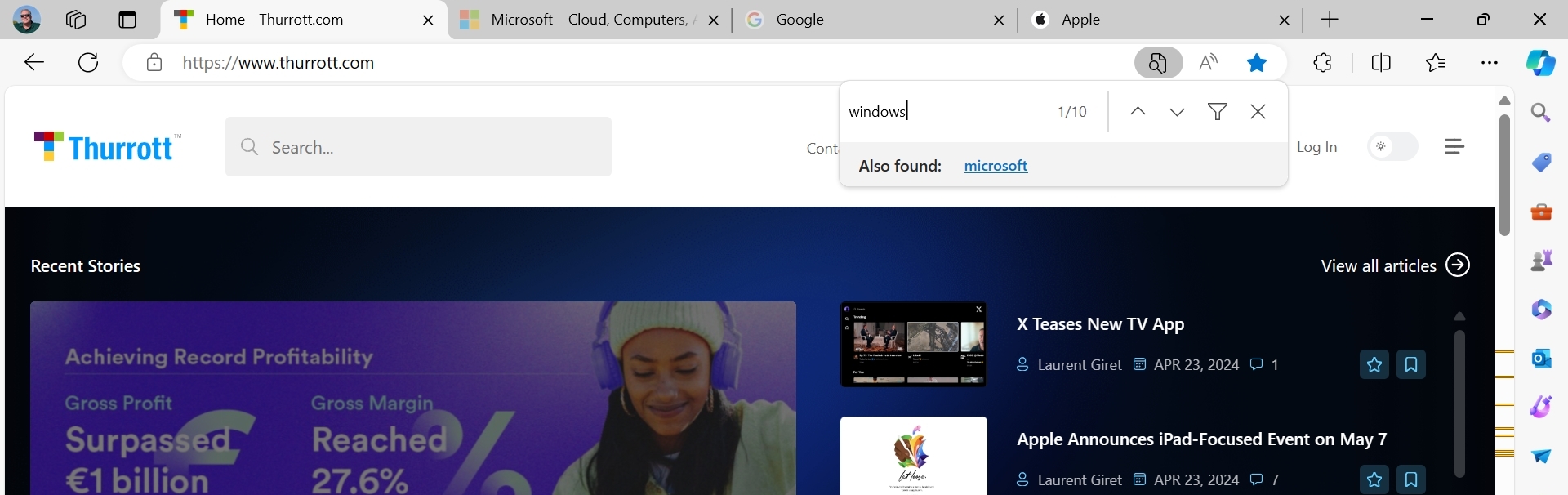
You can use the “Previous Result” and “Next Result” buttons in the Find box to navigate between each matching item on the page. Click “Close” (“X”)–or type ESC–to close the Find box.
Sidebar
Like other web browsers, Microsoft Edge includes a Sidebar that lets you access a set of built-in tools called Sidebar apps alongside the websites and web pages you are visiting. The Sidebar is visible on the right but collapsed by default, and it offers a comprehensive selection of built-in apps that let you interact with Copilot, Microsoft Designer, Bing, Outlook.com, Microsoft 365, and other Microsoft services. You can, of course, customize which apps appear in the Sidebar and choose from a growing selection of additional Microsoft and third-party apps too.
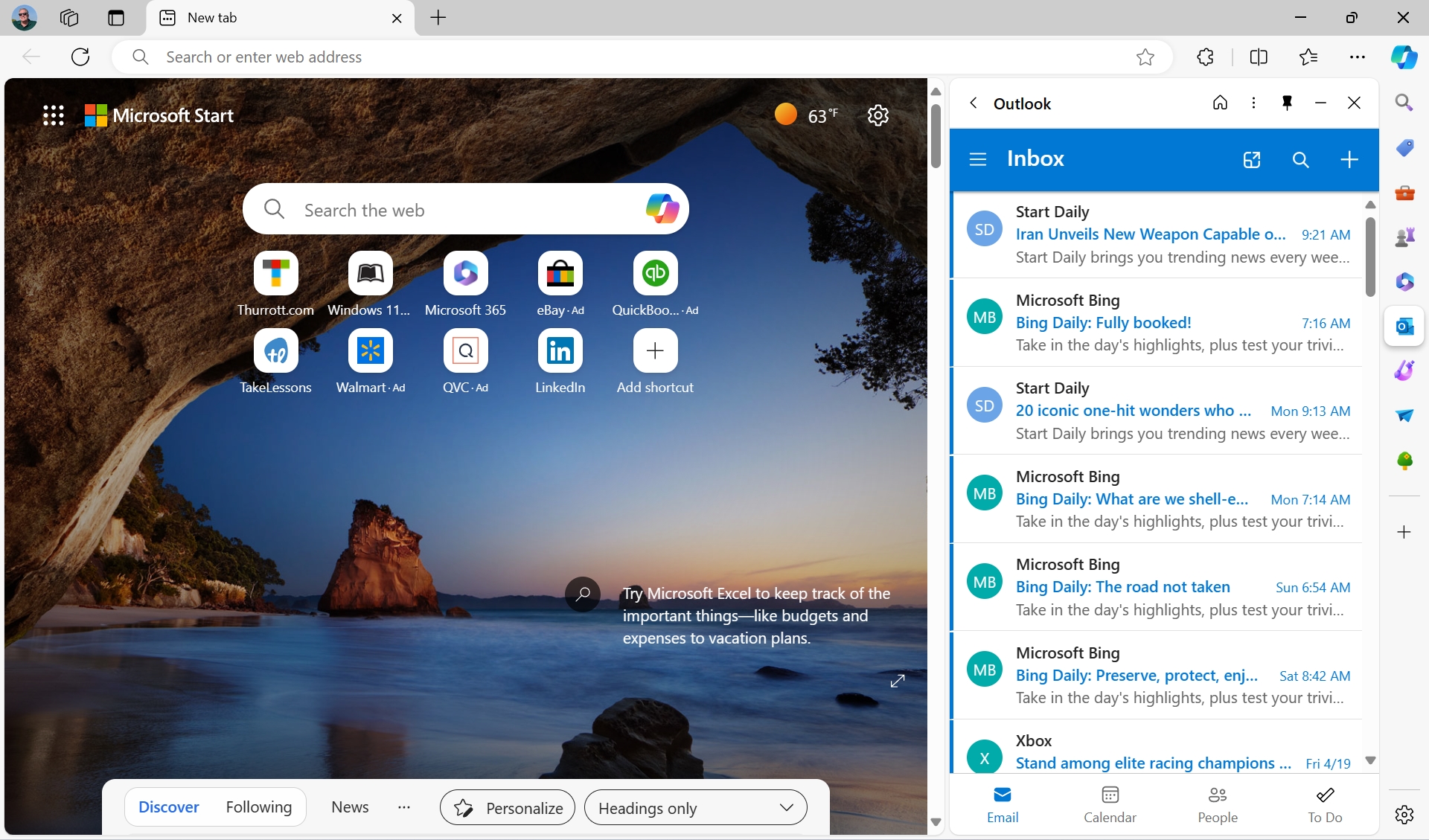

The Sidebar can also be hidden, but you can always toggle its display by clicking the prominent “Copilot” button in the far right of the toolbar.
You can also toggle the Sidebar by typing CTRL + SHIFT + /.
By default, the Sidebar displays icons for several Microsoft and partner apps in its collapsed view. These include:
Copilot. This Sidebar app lets you interact with Microsoft’s AI-powered Copilot capabilities right in Microsoft Edge and without needing to find or navigate to the Copilot website. Copilot has three main views–Chat, Compose, and Insights–each representing a key capability. Chat is the interface for the Copilot chatbot, which offers a conversational, text-based interface in which you can ask it questions–even complex questions like planning a trip, or similar–and get answers quickly. Compose is an interactive creation tool that helps you write a paragraph, email, blog post, or other content in a variety of styles and lengths. And Insights gives you more information about the webpage you’re currently viewing.
You can also open Copilot in the Edge Sidebar by typing CTRL + SHIFT + +.
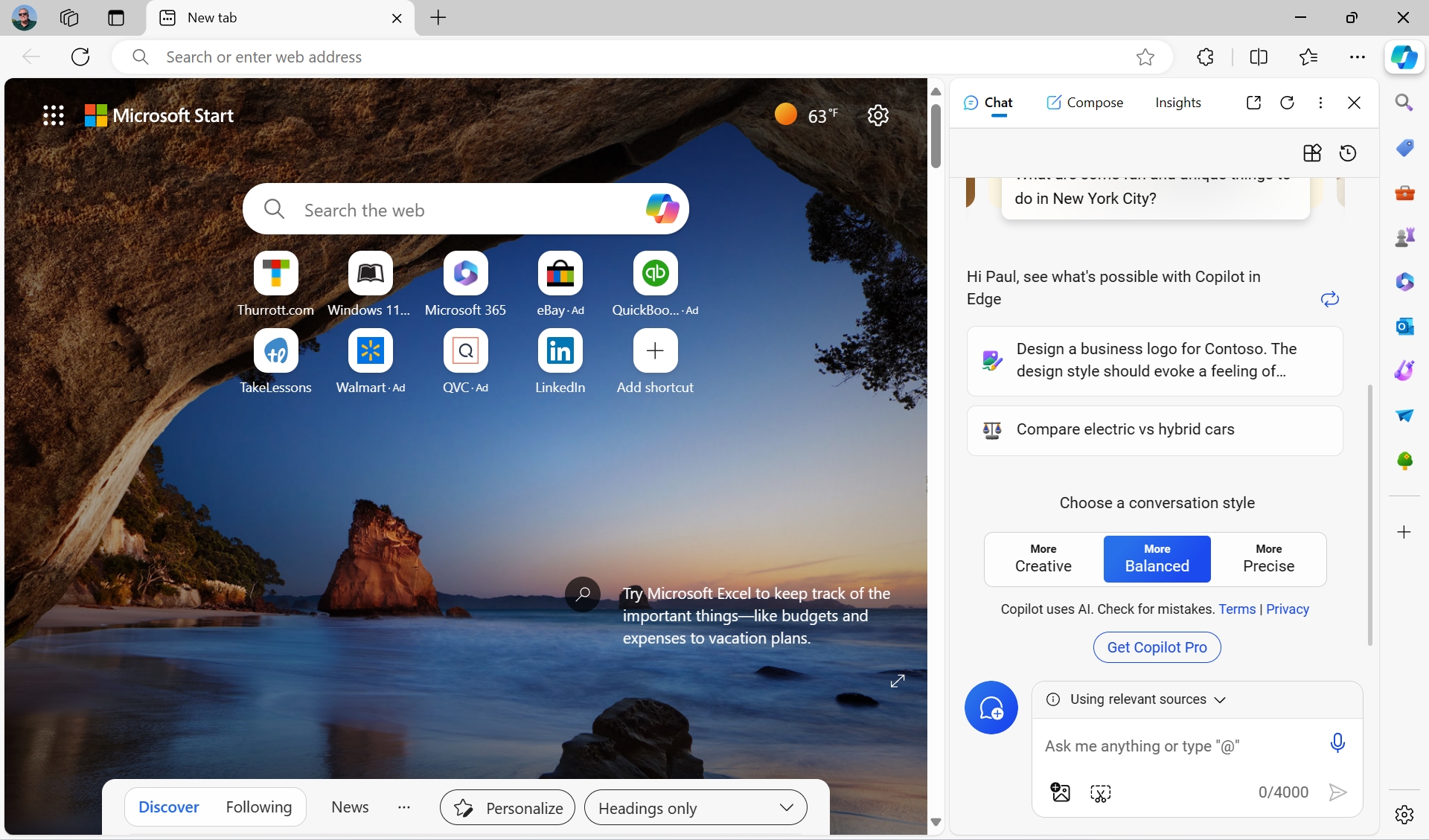
In addition to Copilot in Microsoft Edge, Windows 11 offers a Copilot feature of its own, and that feature offers a superset of the functionality you find here. For more information, be sure to check out the Copilot chapter.
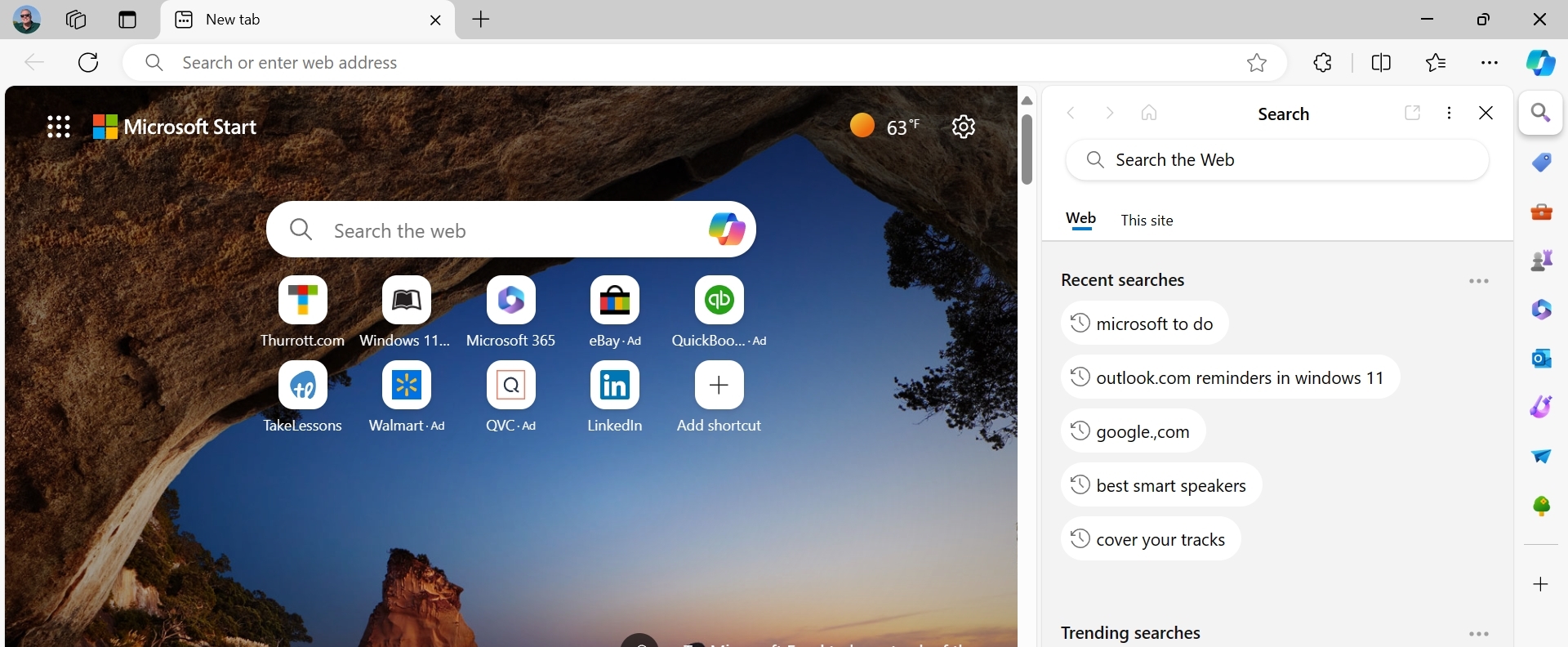
Search. The Search app lets you search the web using Microsoft Bing without leaving the webpage you are reading.
Microsoft Shopping. This Sidebar app helps you save money while you shop online.
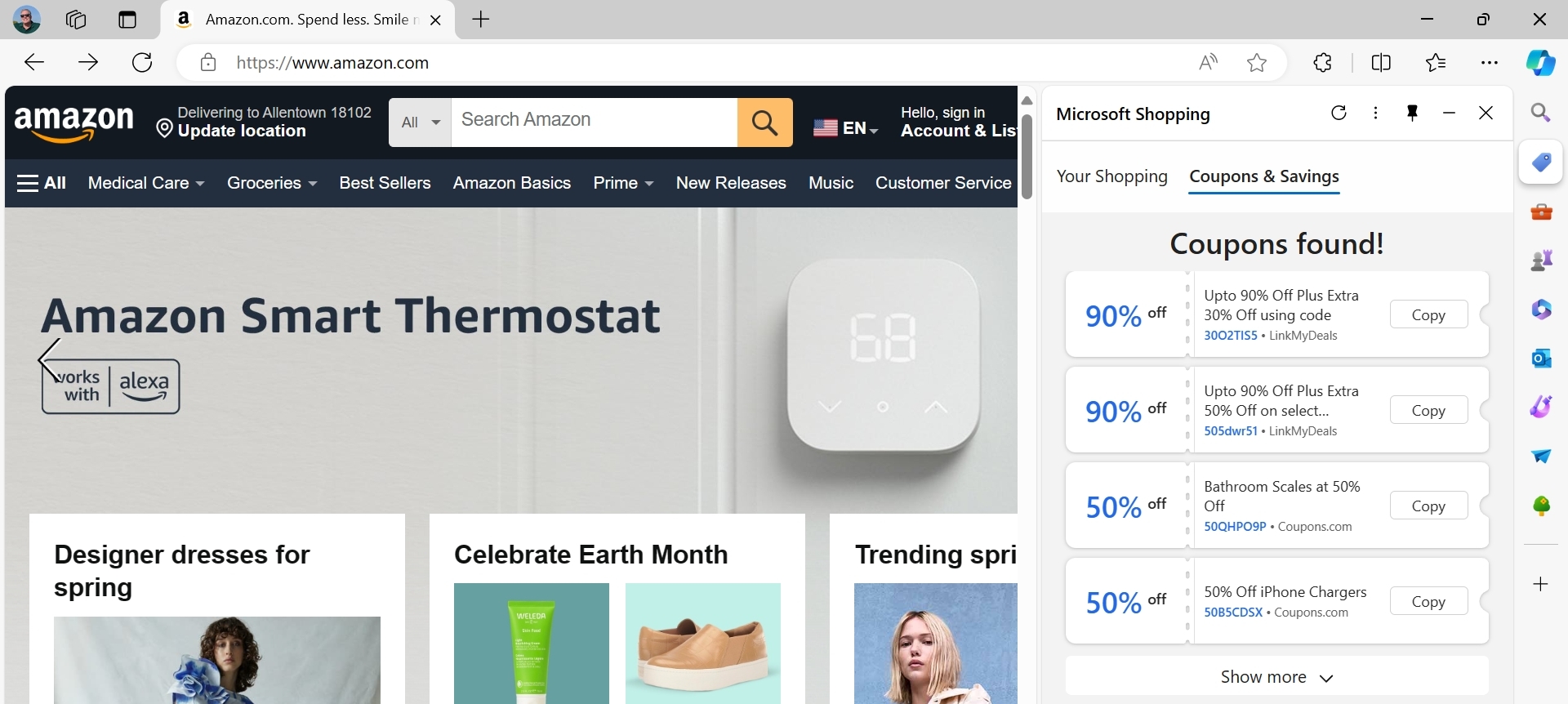
You can learn more about the shopping features in this browser in the Shopping with Microsoft Edge chapter.
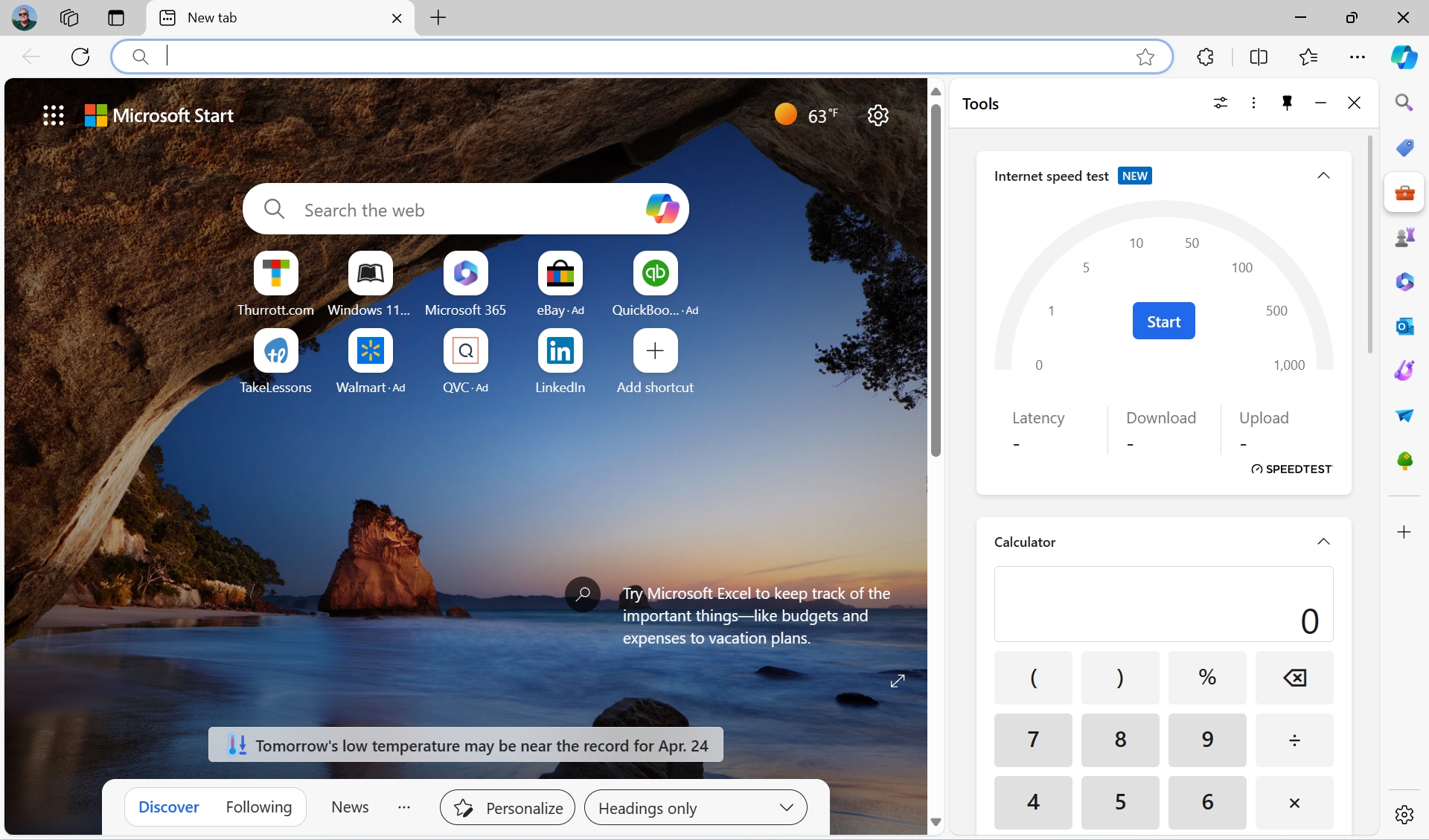
Tools. The Tools app provides a suite of useful utilities like Calculator, Dictionary, Translator, Unit converter, World clock, and several others.
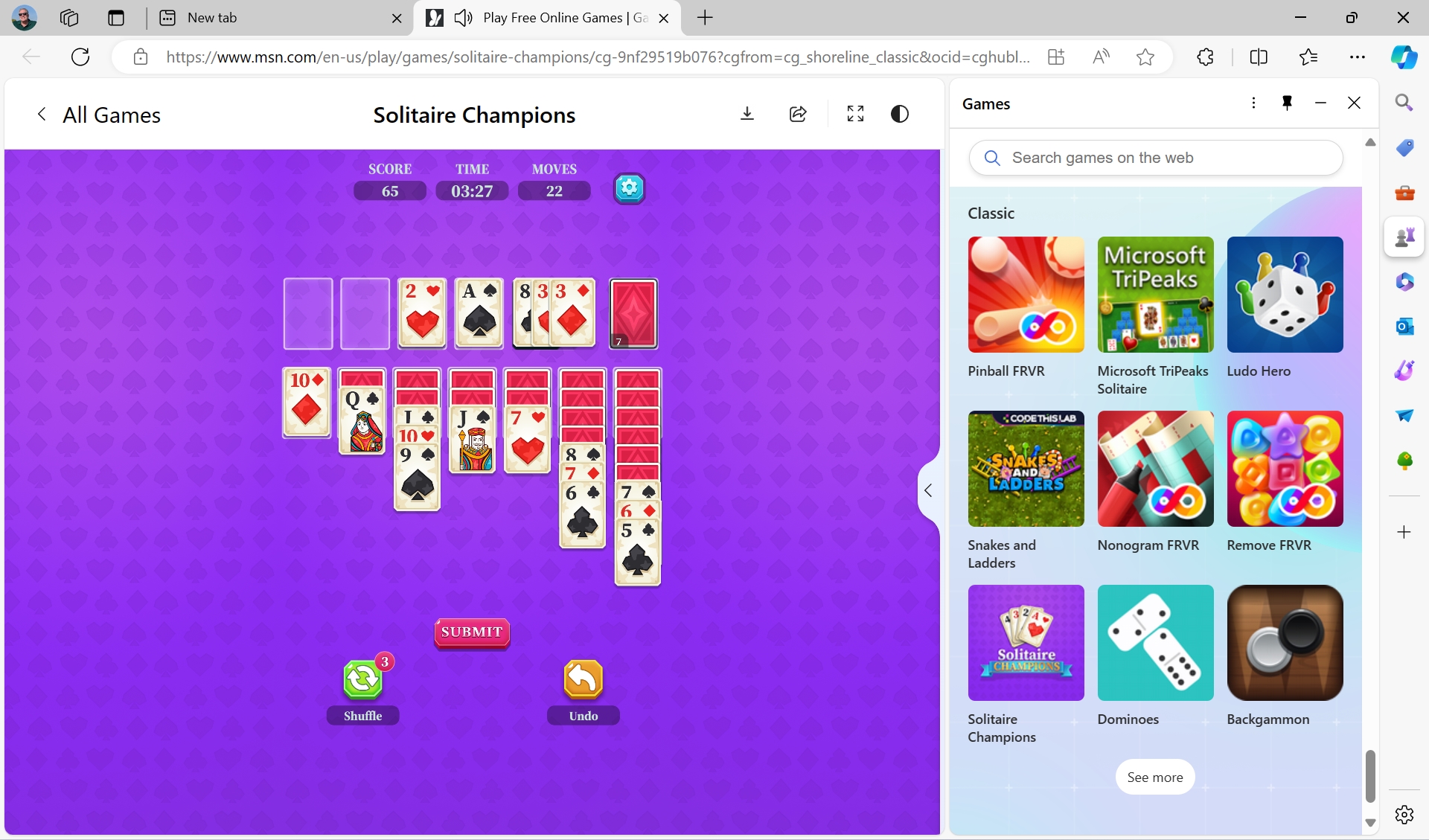
Games. Here, you will find a wide range of free online games like Microsoft Mahjong, Microsoft Solitaire Collection, Microsoft Sudoku, Microsoft Minesweeper, and many others. When you select a game, it appears in the main browser window and not in the Sidebar.
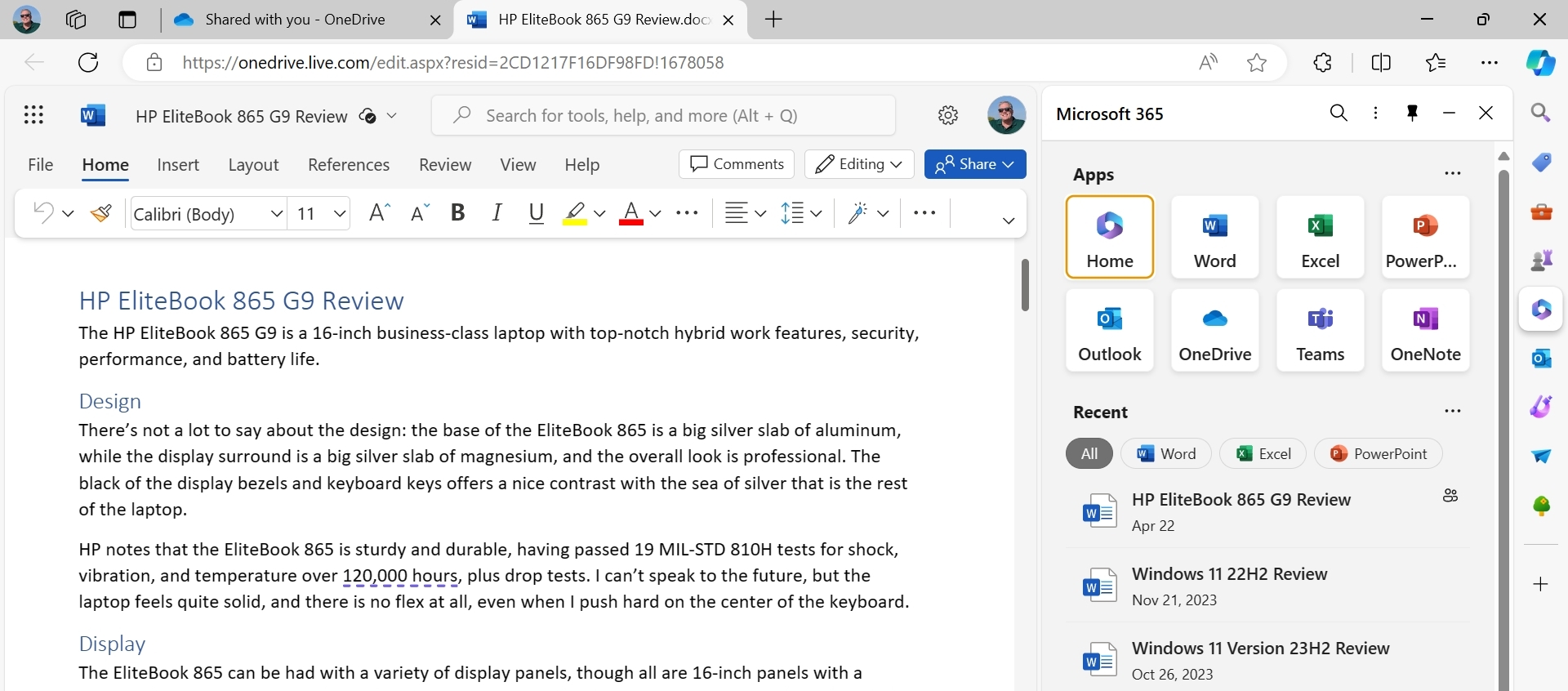
Microsoft 365. This app is a light front-end to the Microsoft 365 web app and the web versions of Word, Excel, PowerPoint, and other familiar Office apps. You can create new OneDrive-based documents here and access your most recent documents.
Outlook. This app provides a smartphone-like view of your Outlook.com email, calendar, People (contacts), and To Do (tasks), so you can keep up on this important information while you’re browsing the web.
Image Creator from Designer. This Sidebar app is a front-end to the AI image creation capabilities in Microsoft Designer. Just describe the image you want by typing in the text box–something like “a photo of a purple unicorn flying in space” or whatever–and click “Create” to see what the AI comes up with. The results will appear below the text box under the “Creations” tab and above your other recent creations. Select an image from the results to view a larger version in the browser and then share, save, download, or customize it further from there.
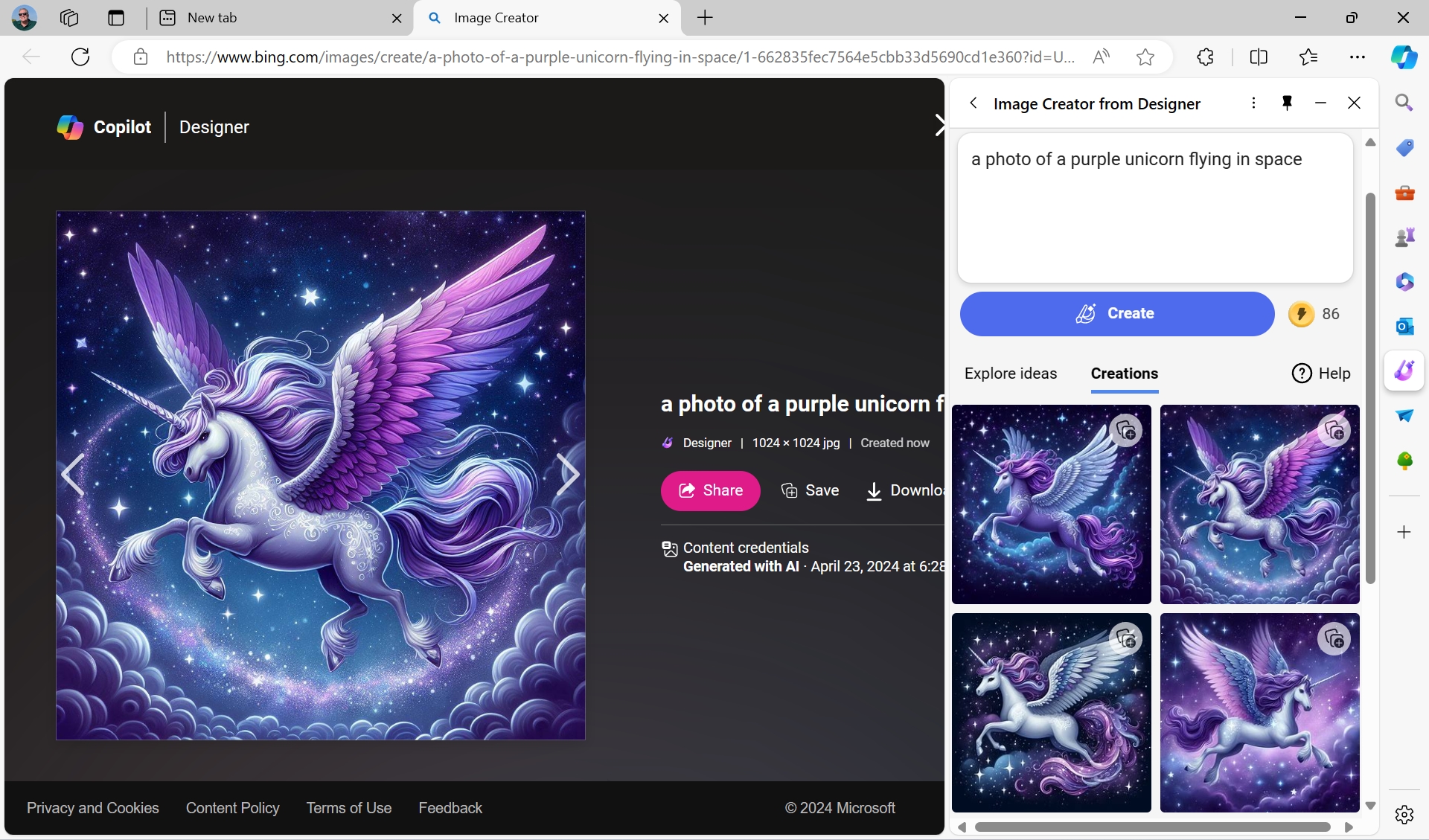
Because this image creation functionality also falls under the Copilot umbrella, we discuss this topic further in the Copilot chapter.
Drop. This useful sidebar app lets you share files and messages between your PCs and smartphones using Edge as the conduit and your OneDrive as the storage location. Just drag any file onto the Drop page to upload it. Or write a message in the “Write a note to yourself” text box to add some text. These items will then be available via Microsoft Edge on any of your other devices, where they can be opened, copied, or deleted.
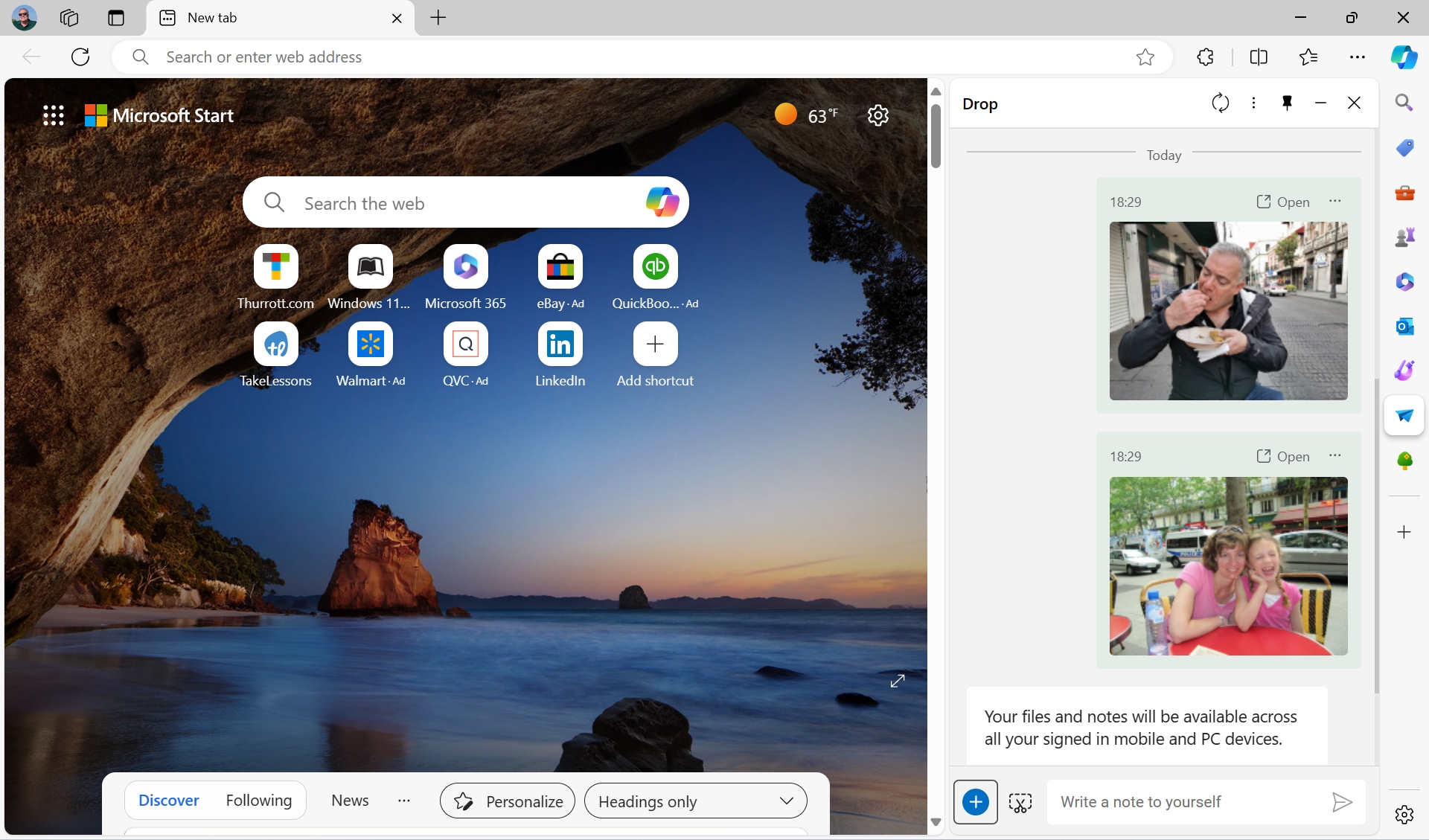
Because Drop uses OneDrive, you will notice a new Microsoft Edge Drop Files folder in the root of your OneDrive when you use this feature.
E-tree. This well-intentioned Sidebar app gamifies sustainability by offering you rewards for completing daily tasks that water a virtual tree called an etree. Once your etree is fully grown, a Microsoft partner will plant a real tree in Kenya to help reverse the widespread environmental degradation it’s experienced from logging, charcoal burning, and illegal farming.
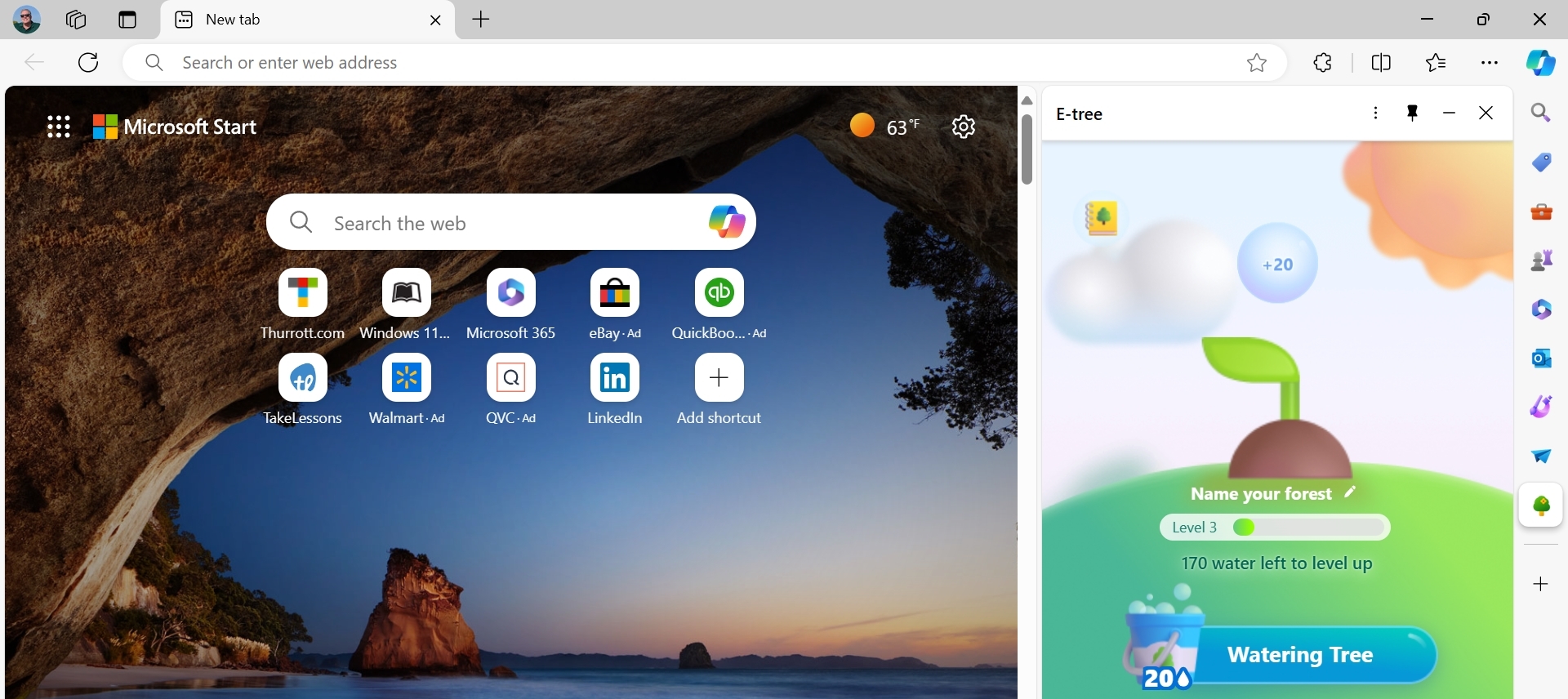
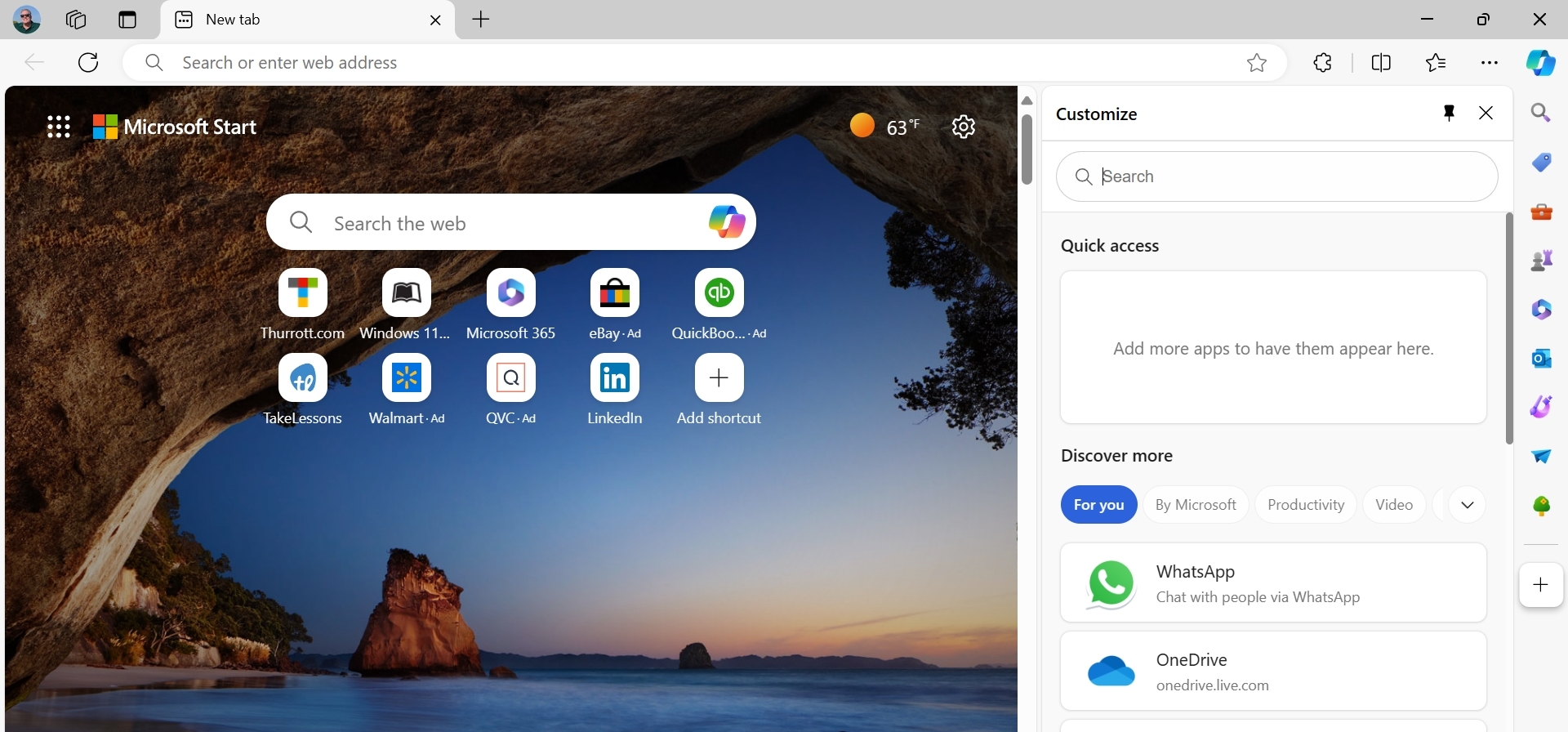
Aside from Copilot, you can remove any Sidebar app you don’t need, and you can add other apps, or any arbitrary website, to the Sidebar as well. To configure the Sidebar, click the “Customize” (“+”) button in the Sidebar.

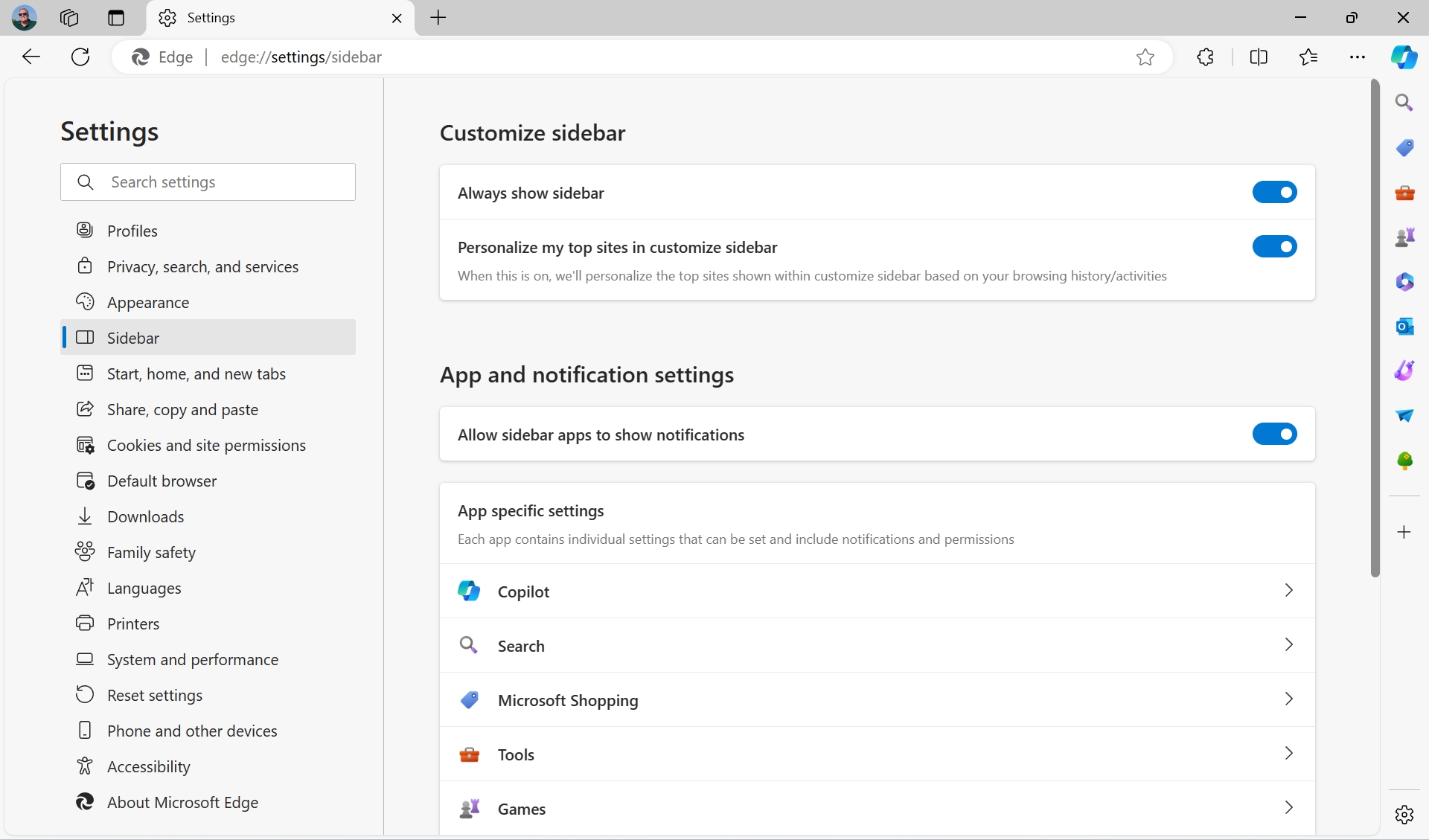
Or, just open Edge settings and navigate to “Sidebar.”
Search engine
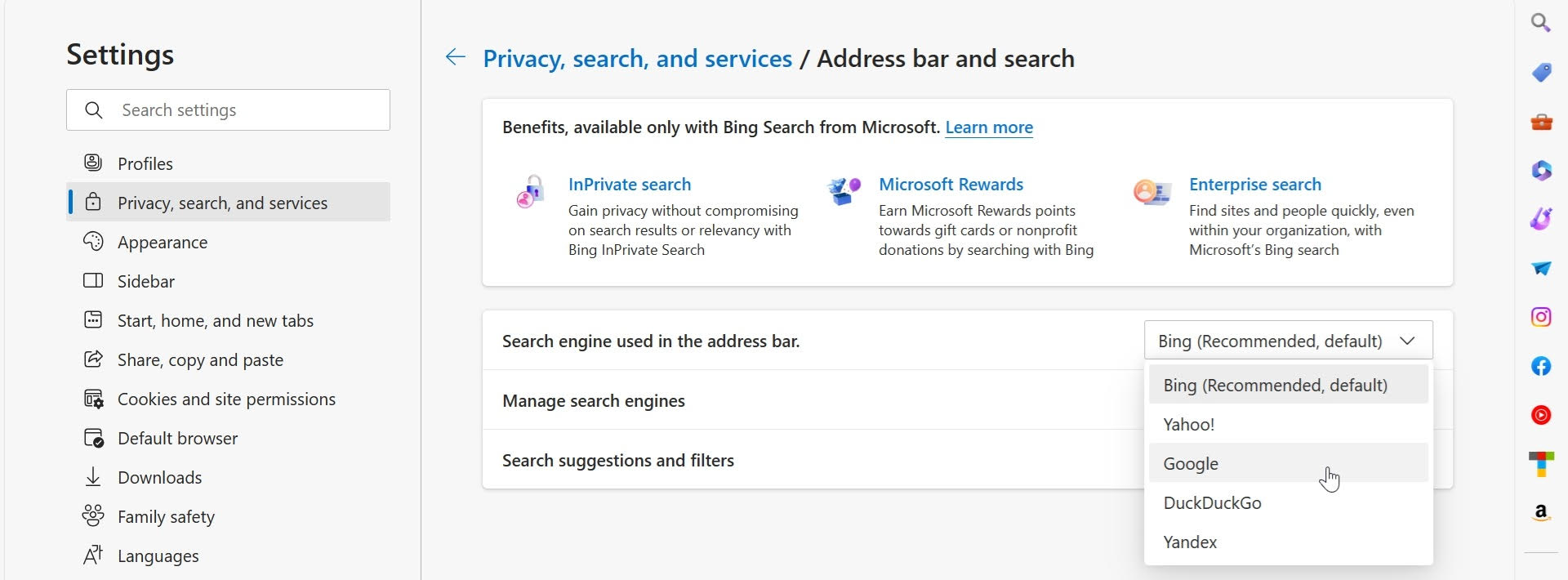
Microsoft Edge is configured by default to use Microsoft Bing as its search engine. Fortunately, you can change it to Google Search or whatever web search engine you prefer, though the interface for doing so is well-hidden.
To make this change, open Microsoft Edge settings and navigate to “Privacy, search, and services.” Then, scroll all the way down to the very bottom to the last section, “Services,” and click the very last option, called “Address bar and search.” Address bar and search settings appears. Click the drop-down next to “Search engine used in the address bar” and change the search engine to your favorite web search service.
Themes
You were prompted to configure a theme for Microsoft Edge when you first set up the browser. But you can change the theme–and the related “overall appearance” for Light and Dark mode choices–at any time.
To do so, open Microsoft Edge settings and navigate Settings > Appearance.
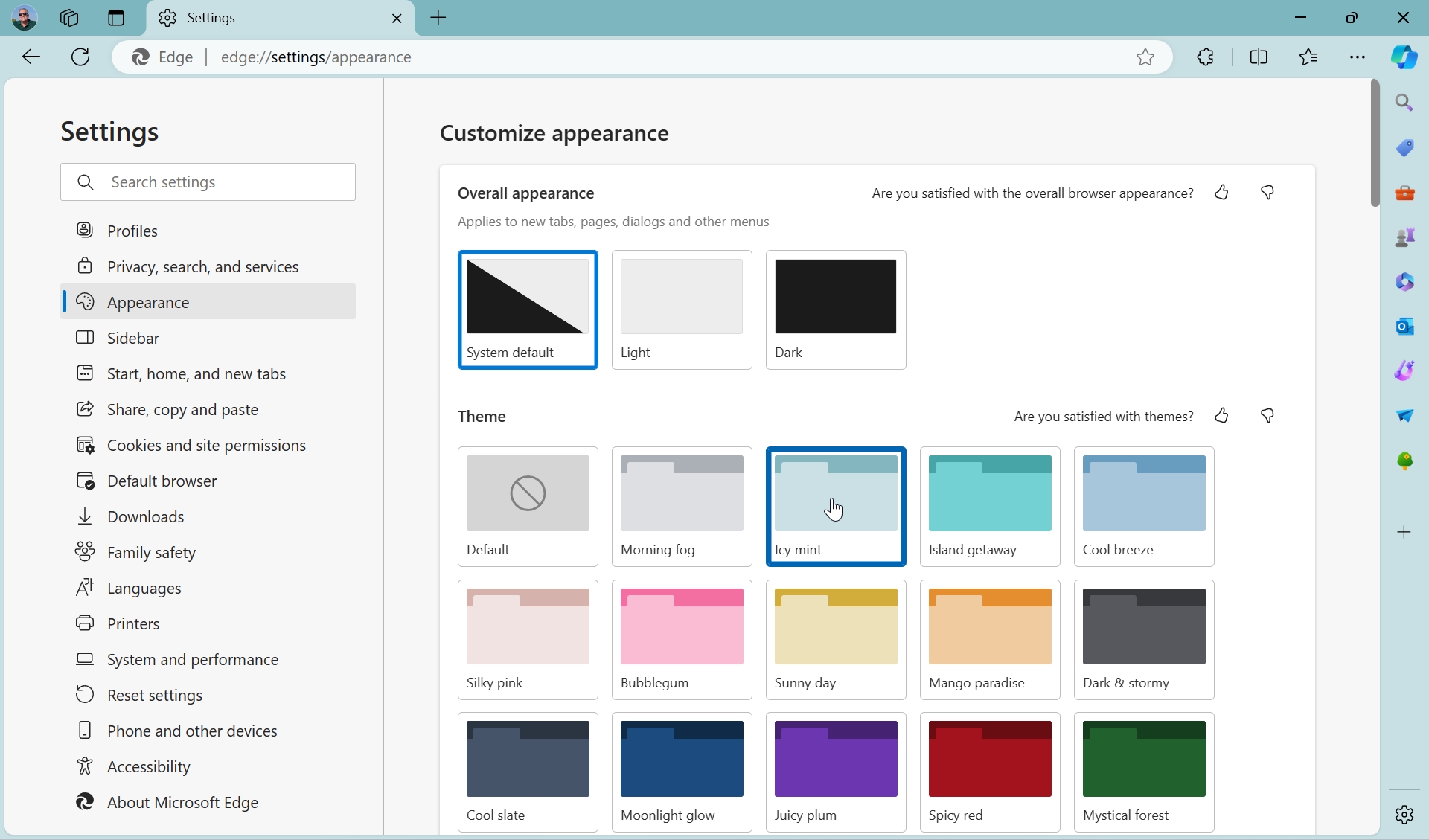
You’re not limited to the themes Microsoft provides in Edge. Below the built-in themes, you’ll see a “Discover more themes” card that displays the Themes page on the Edge Add-ons website when clicked.
You can also download additional themes from the Chrome Web Store. That’s right: Microsoft Edge and Google Chrome themes are interchangeable. There’s a link to the store in Appearance settings below the theme choices.
Media
Microsoft Edge works normally with popular media-playing websites like Spotify and YouTube. But this browser also offers a few unique media-related features you should be aware of.
Open media in Picture-in-picture or the Sidebar
Microsoft Edge supports a wide range of multitasking capabilities that work entirely within the app and go beyond traditional and familiar tabs features. Key among these is Split Screen, which lets you view two webpages side-by-side, and the Sidebar, which displays a Sidebar app or any other webpage or app within its frame so you can do two things at once.
Media playback–which might involve watching a video or accessing music playback controls–is one key scenario for these features. But in addition to using Split Screen or installing a Sidebar app for media playback, Microsoft Edge also provides two features–Open in Sidebar and Picture in Picture–that let you do so on the fly. Each works similarly, and each can be accessed by right-clicking a tab that is playing media.
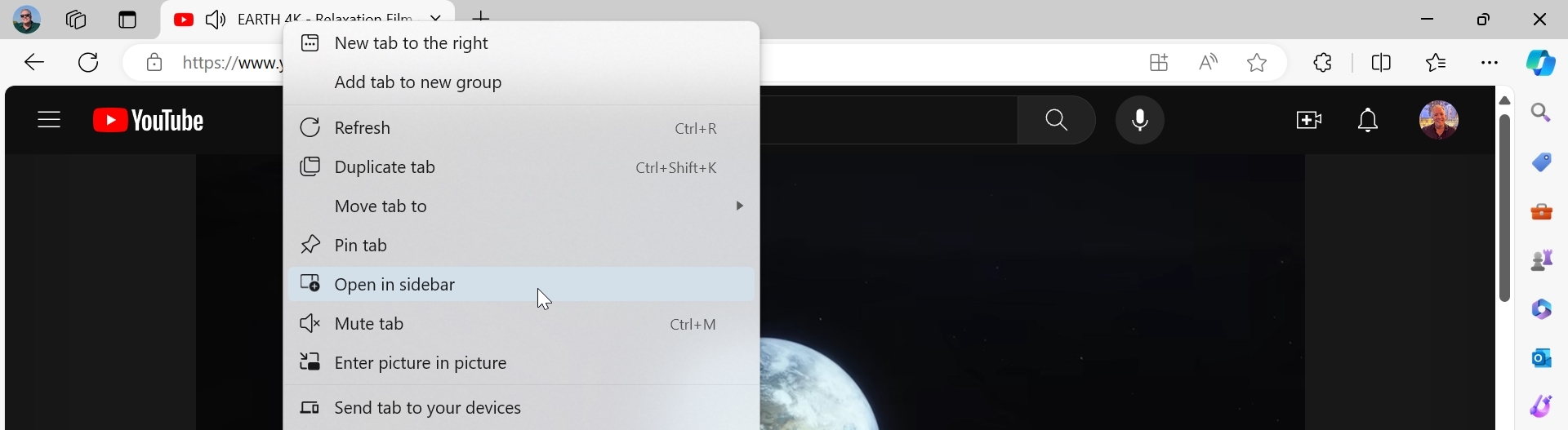
When you select “Open in Sidebar,” the current tab opens in the Edge sidebar temporarily, without installing the webpage as a Sidebar app. This allows you to play a video with YouTube or a playlist in Spotify–or other services, of course–while you work normally in the browser.
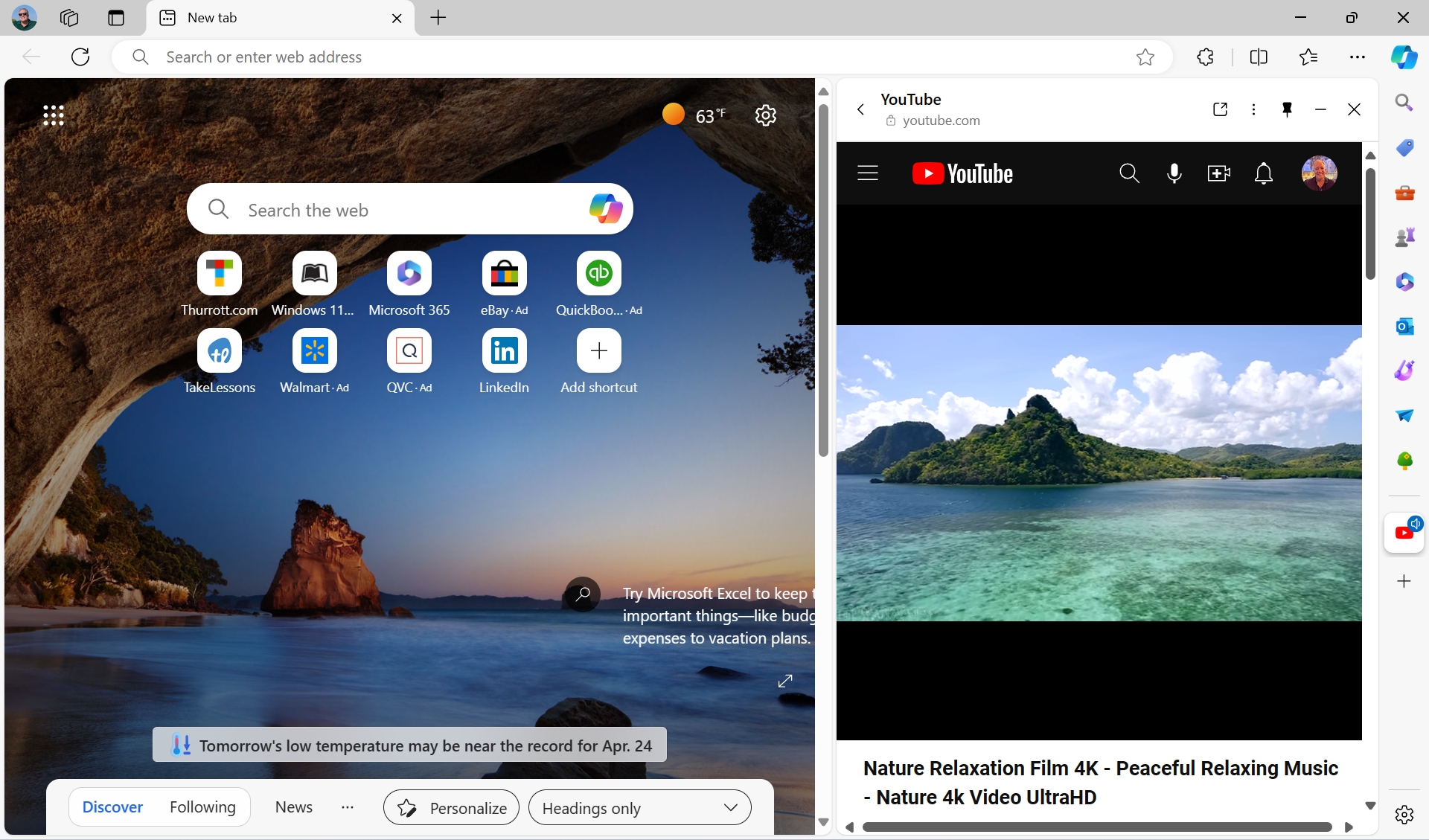
You can pin/unpin the Sidebar–the latter displays it as a floating pane–and access some unique features, like the “Show Desktop View”/”Show Mobile View” toggle, from its “More Options” (vertical “…”) menu. When you’re done playing media, just close the Sidebar.
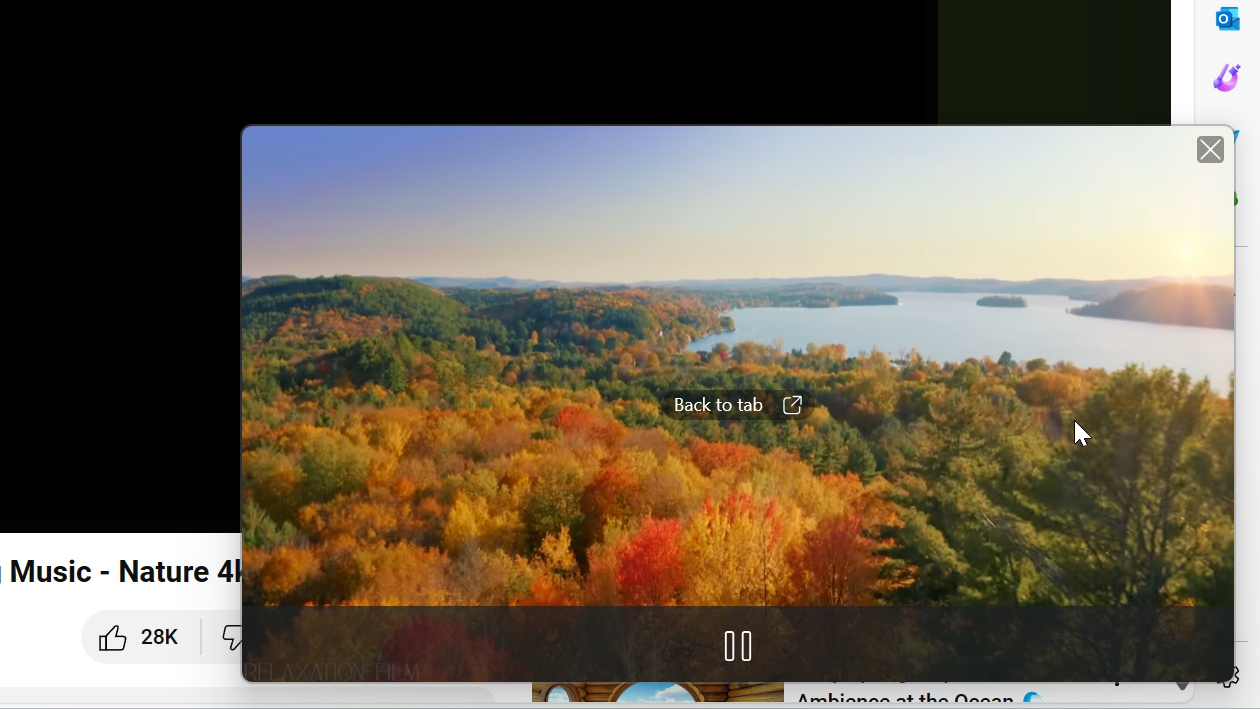
Picture in Picture works only with YouTube and other video services, and this option only appears when you are playing a video. Here, you select “Enter Picture in Picture” from the tab’s right-click menu, and the video appears in a small picture-in-picture window in the lower right of the display.
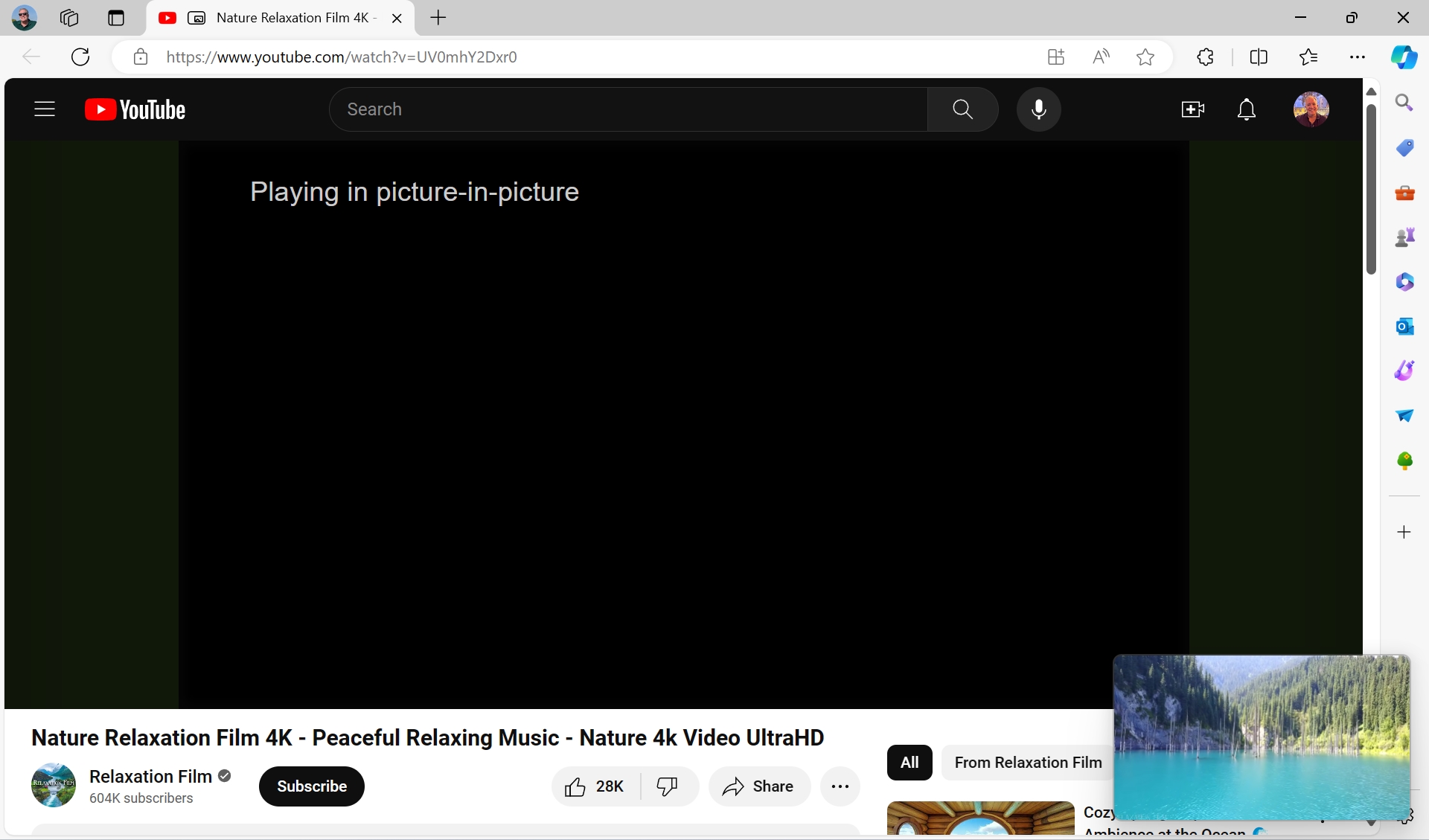
You can resize this picture-in-picture window as needed, and it stays on top of Microsoft Edge and other apps and windows, so you can multitask beyond the browser. Beyond that, the feature is limited to a Play/Pause toggle, and “Back to tab” and “Close” buttons, both of which close the picture-in-picture window.
Mute tab
When a web page is playing media, its tab displays a speaker icon so you can quickly find the source of that sound. But you can also mute any media coming from a tab: Just right-click the tab and choose “Mute tab” from the context menu that appears.
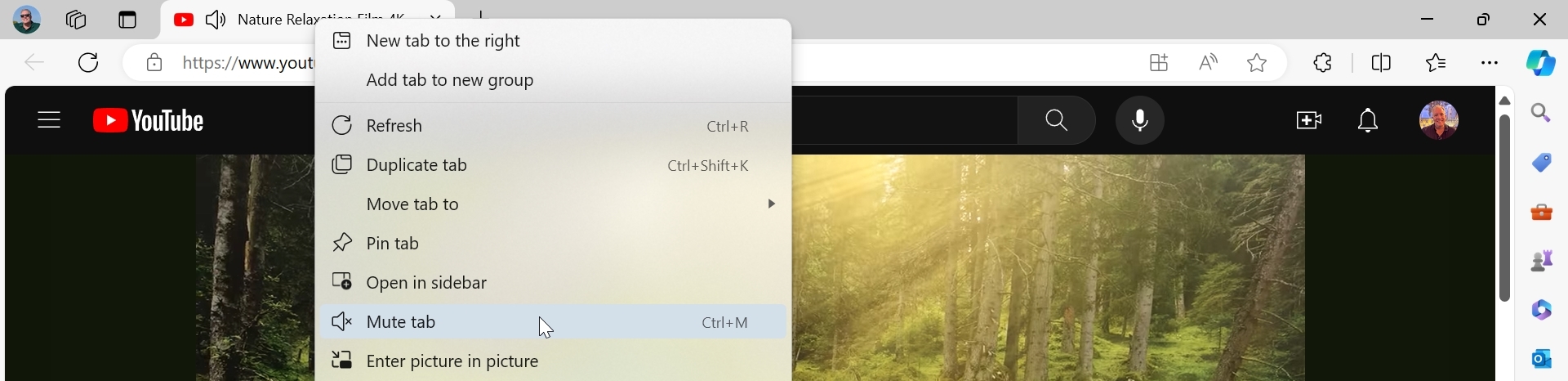
When you do so, the audio mutes and the speaker icon on the tab turns into a muted speaker icon. You can now right-click the tab and choose “Unmute tab” to disable mute.

You can also toggle mute on the current tab by typing CTRL + M.
Block autoplay media
Many websites annoyingly autoplay media content, especially video, as you browse. Microsoft Edge tries to limit this behavior by default by monitoring how you interact with autoplaying content on a site-by-site basis. That is, if you stop the playback, Edge should remember that and prevent autoplay on future visits. At least in theory.
That’s fine when it works. But you can configure Microsoft Edge to block autoplay media instead, and that may be a better option if you’re bothered by this behavior. To do so, Open Edge settings and navigate to Cookies and site permissions > Media autoplay (under Site permissions).
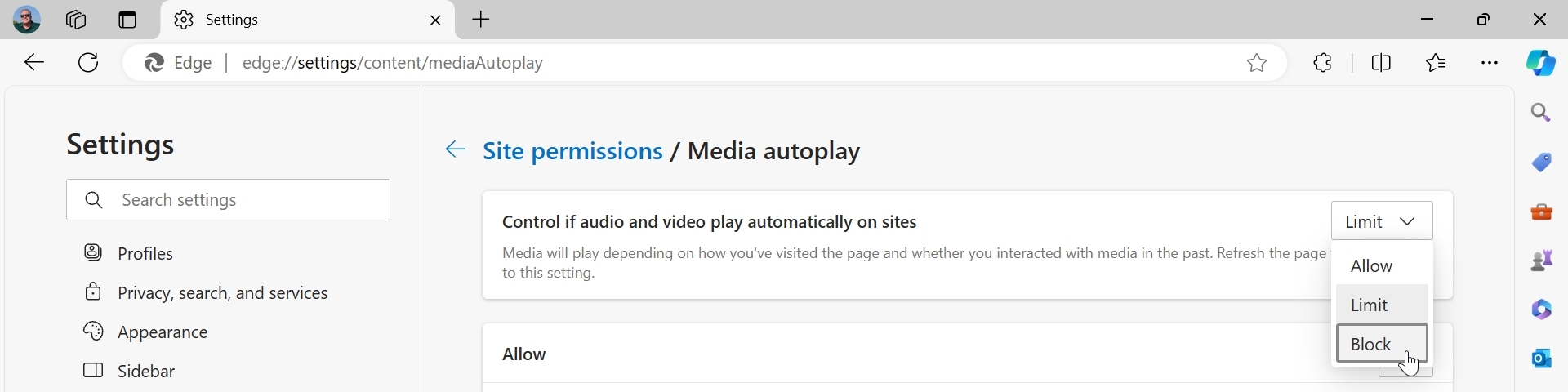
The option “Control if audio and video play automatically on sites” is set to “Limit,” by default, so change it to “Block.” You can also add any website to a list of sites that are explicitly allowed to autoplay media if needed.
Edge’s defenses against autoplay media aren’t particularly well-designed. If you’re still bothered by autoplay media regularly, we recommend using a browser extension like Disable HTML5 Autoplay.
Extensions
Most web browsers deliver a basic set of functionality natively but allow users to add optional features via so-called extensions. And though Microsoft Edge includes more built-in functionality than other mainstream web browsers, it also supports extensions. Indeed, it uses the same Chromium extensions platform as Google Chrome, so you can find and download new extensions from both the Edge Add-ons website and the Google Chrome Store.
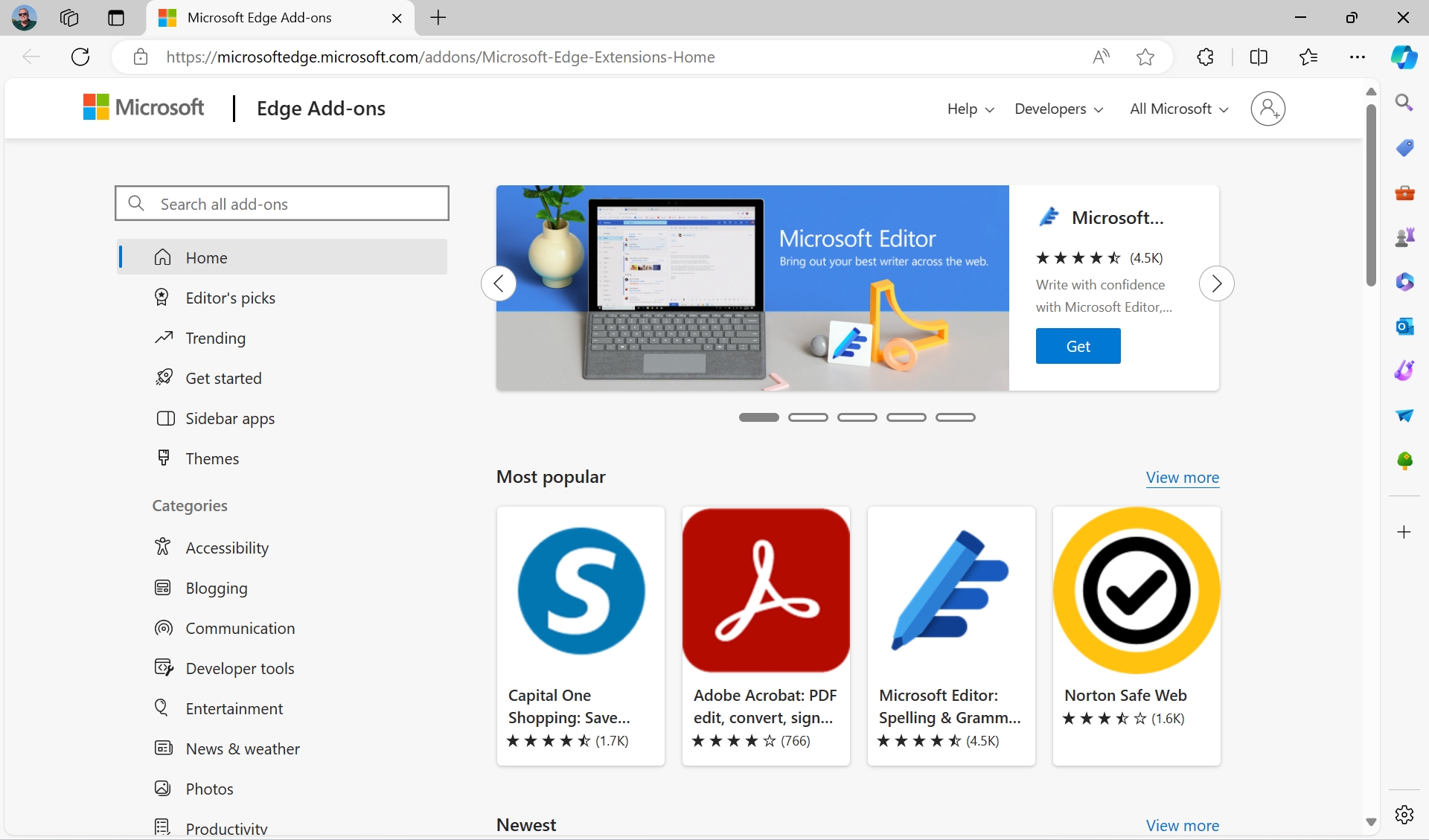
Once you install one or more extensions, Edge displays an “Extensions” toolbar button (it resembles a puzzle piece) so that you can easily interact with and manage them via the button’s drop-down menu.

You can do the following from the Extensions menu:
Interact with an extension. Click an extension to view and interact with its user interface.
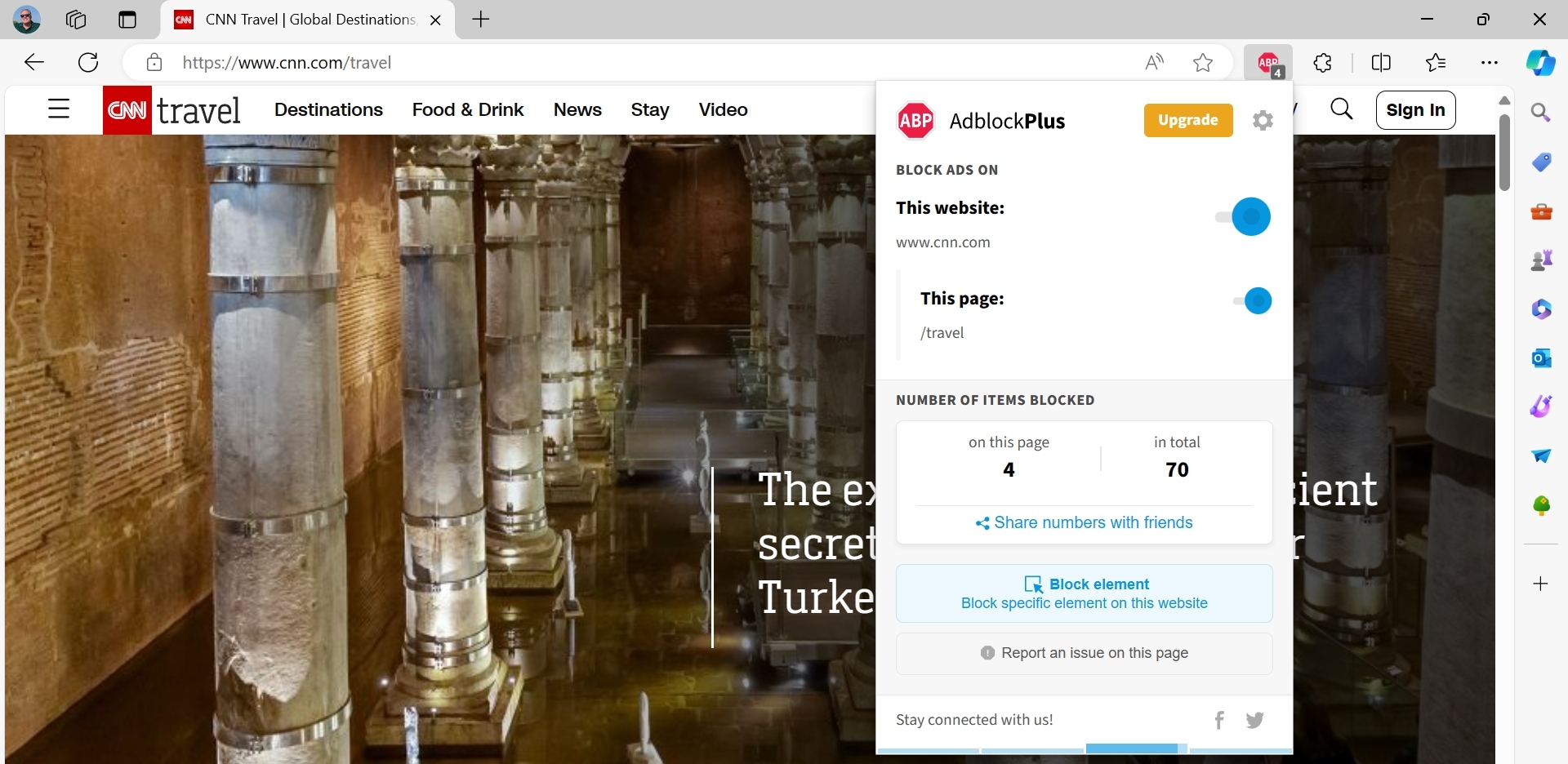
Show in toolbar. If you find yourself interacting with an extension a lot, you can avoid an extra step by selecting its “Show in toolbar” button, which places the extension’s button directly on the Edge toolbar.
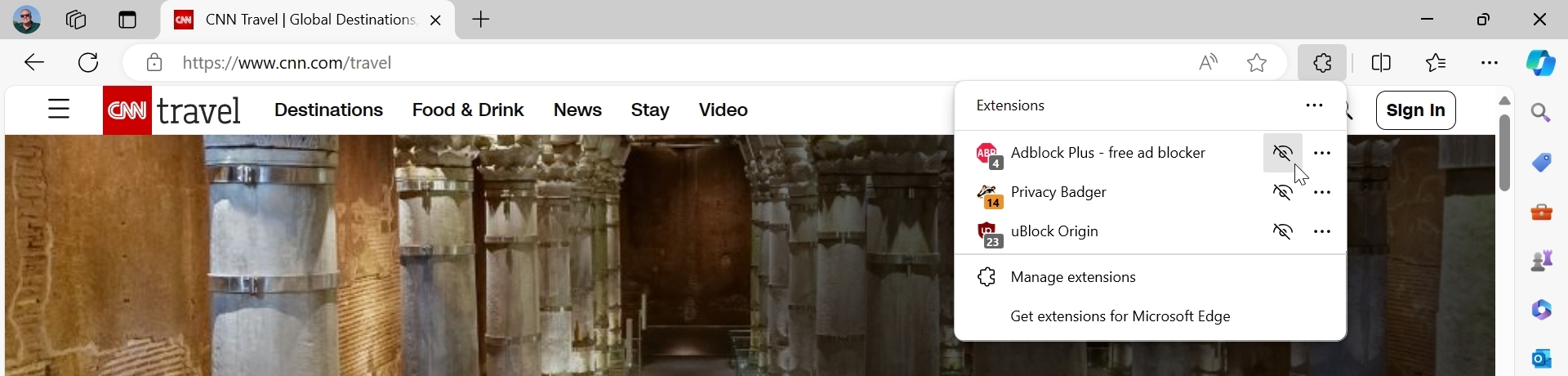
Once an extension button is on the toolbar, you can drag and drop to move it to a new position among the other extension buttons. You can also use the new “Hide in toolbar” option in the extensions menu to hide it again if needed.
More actions.* Select this button (“…”) next to any extension in the menu to access the extension’s options, remove it from Edge, and access other related settings.
You can further manage your extensions by clicking “Manage Extensions” at the bottom of this menu. Or you can open Extensions settings (edge://extensions) via the Extensions item in the “Settings and more” (“…”) menu.
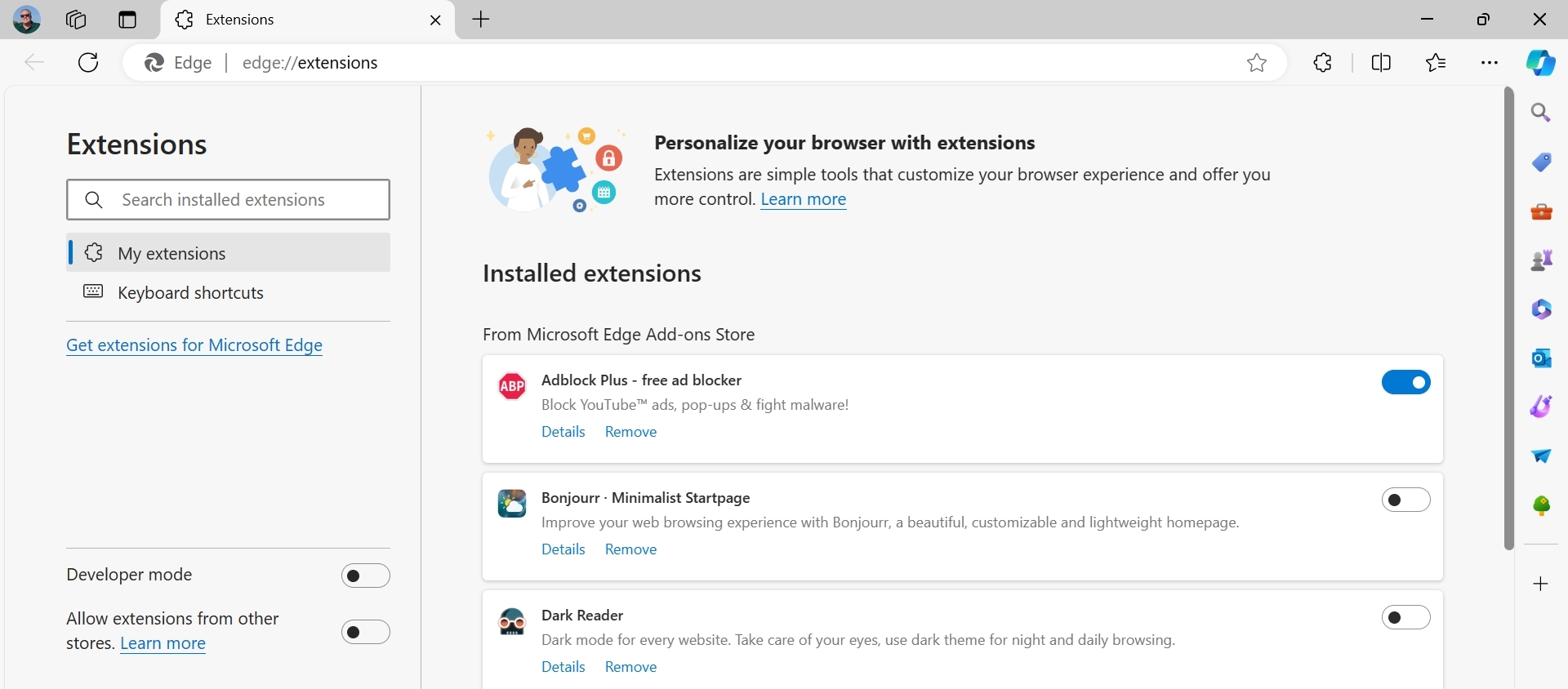
Here, you can easily toggle individual extensions on and off, view the options for each extension, and remove any extensions you don’t find useful.
Finally, there are a few other Edge settings related to extensions:
Extensions toolbar button. By default, the Edge Extensions toolbar button will not appear unless you install an extension. But you can configure this behavior in Edge settings by navigating to Appearance > Customize toolbar. The “Extensions button” option can be set to “Show automatically” (the default), “Never show,” or “Always show.”
Continue running background extensions and apps when Microsoft Edge is closed. This option, found in Edge settings by navigating to System and performance > System, allows background extensions and web apps you’ve installed with Edge to continue running in the background when there is no main Edge application window open. It’s enabled by default and should remain so if you are using the Microsoft Edge web app capabilities.
Sharing
Microsoft Edge offers a variety of ways for you to capture and share content you find on the web.
Share
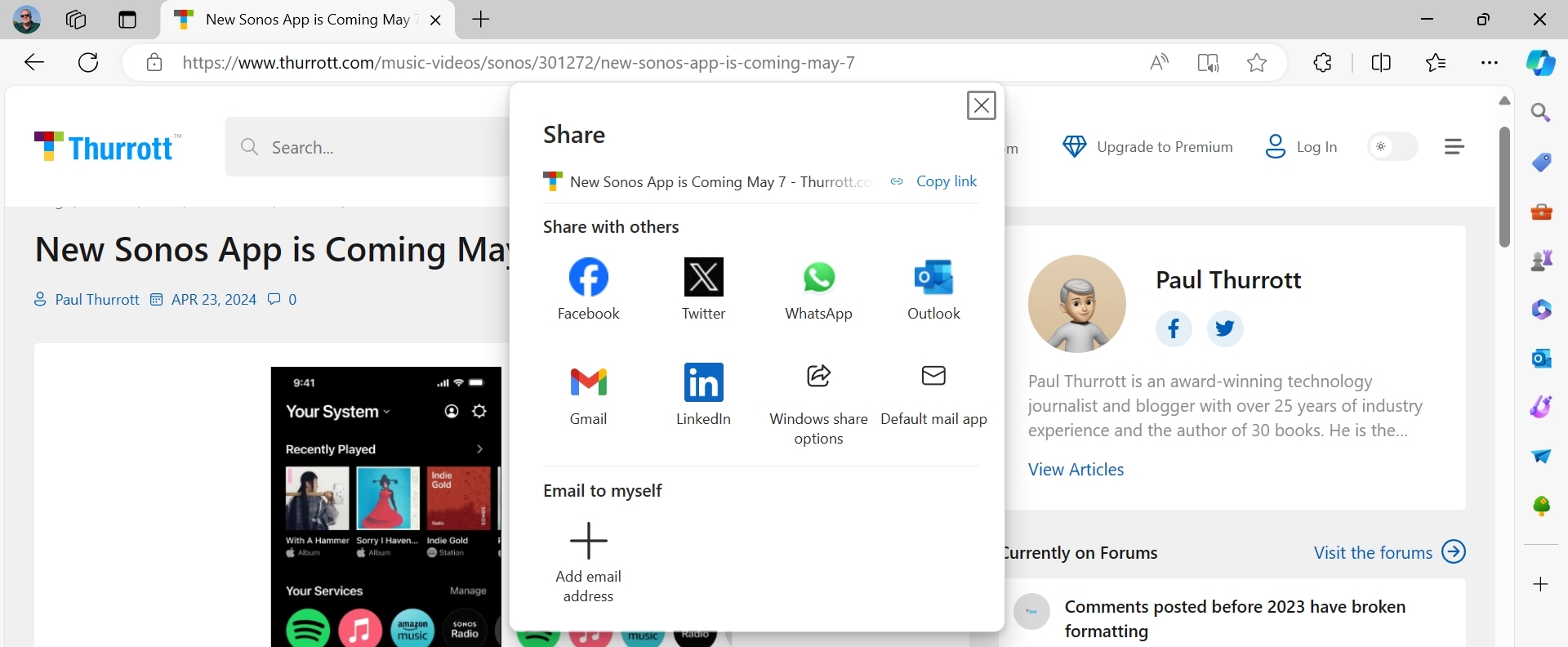
Microsoft Edge supports Windows 11’s system Share feature so you can share the link (URL) for the currently viewed webpage by copying it to the Clipboard, share it with others via a compatible app, or email it to yourself.
To access this interface, open the Settings and more (“…”) menu and navigate to More tools > Share.
Save page as
Microsoft Edge lets you save the webpage you’re viewing to your PC, and this feature–called Save page as–uses the same familiar “Save As” dialog as other document-based apps like Microsoft Word and Notepad. But because of the unique nature of webpages–which display the underlying HTML document, separate image files, and other resources together in a single view–this feature works a bit differently in Microsoft Edge.
That is, by default, Microsoft Edge will offer to save the page in what’s called the “Webpage, complete” type. This is technically not a file type but is, rather, an HTML document (.html file type) with a corresponding folder of the same name that contains multiple images and other files.
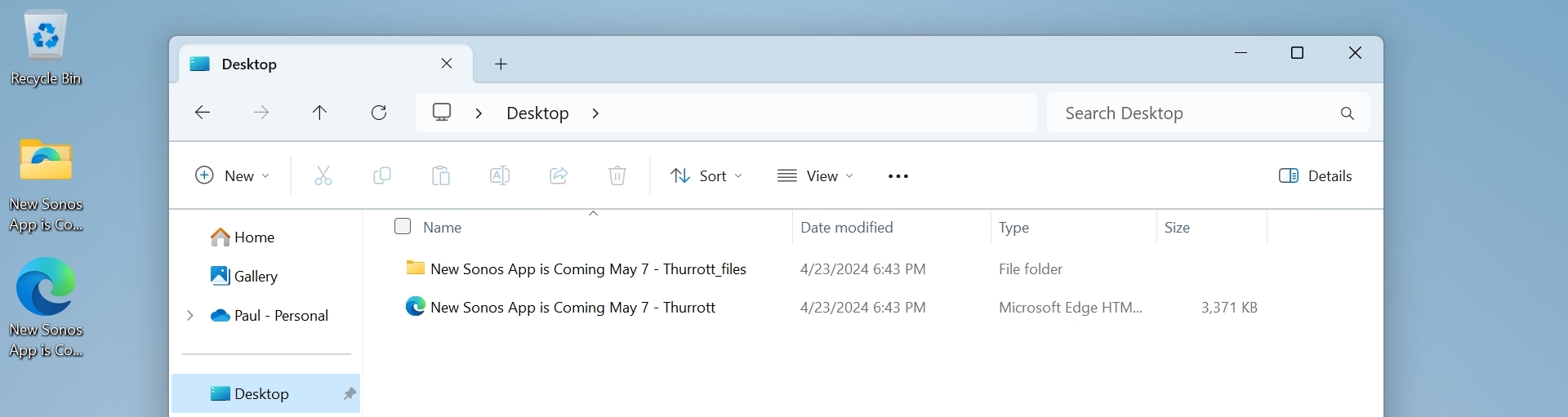
This “Webpage, complete” file type is fairly sophisticated: If you copy, move, or delete the HTML document or its associated folder, the other will go along with it. But you can optionally change the file type at save time by via the “Save As” dialog’s “Save as type” drop-down. The other choices–Webpage, HTML and Webpage, single file–result in a single file, the former without images and the latter (a Microsoft Edge MHT document, or .mht file) with the images embedded inside.
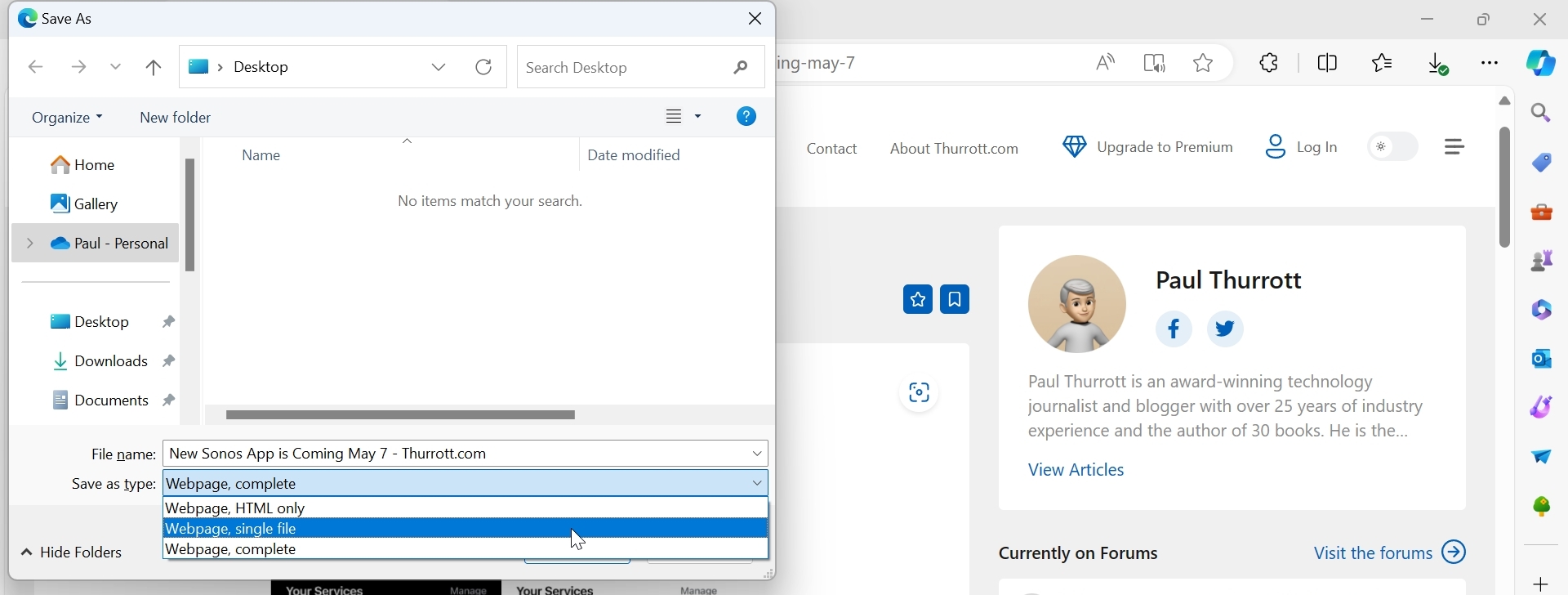
You can also type CTRL + S at any time to invoke the “Save as” dialog.
Screenshot
Microsoft Edge’s Screenshot tool is available from the Settings and more (“…”) menu. When selected, it prompts you to capture an area of the currently displayed web page or the entire page.
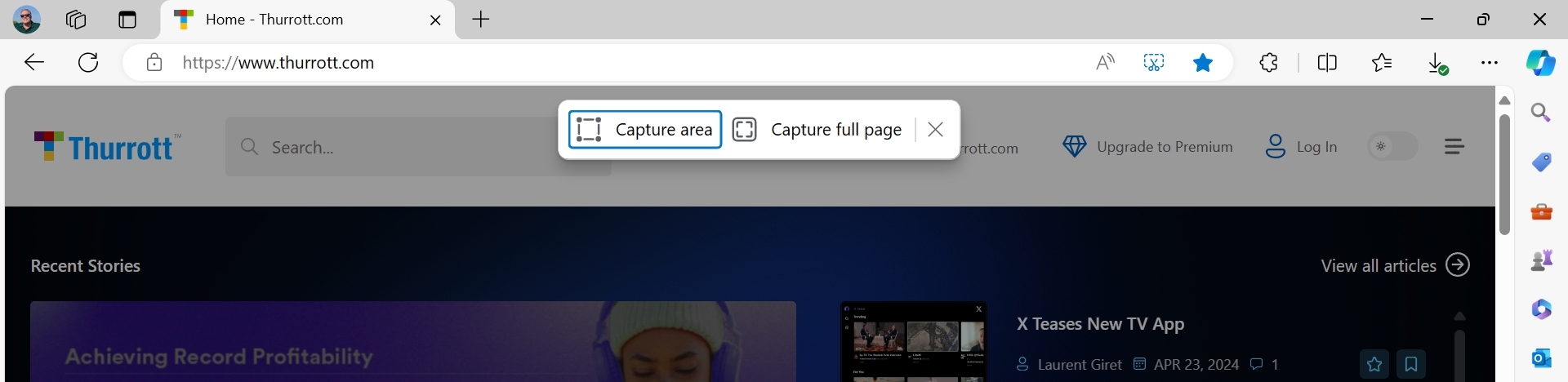
And then it provides a preview window with basic drawing and erasing tools for annotations. You can share the image via the system Share functionality, copy it to the Clipboard, or save it as a JPEG image file to your Downloads folder.
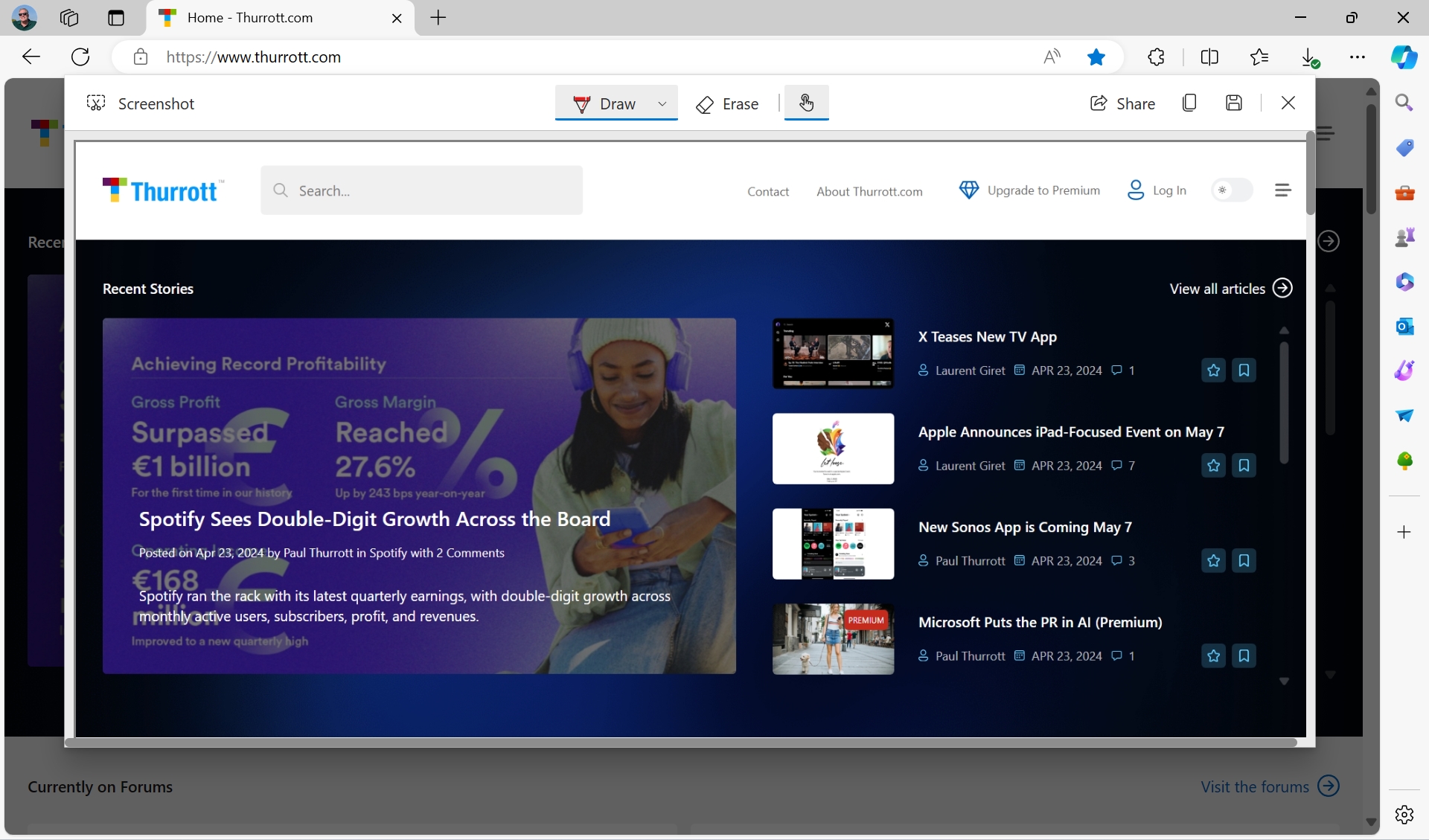

You can also open Screenshot by typing CTRL + SHIFT + S.
Where did it go?
Microsoft Edge previously offered a related feature called Web select that let you capture an arbitrary selection of text on the current page and then copy it to the Clipboard. This feature is no longer available.
Printing
Like other web browsers, Microsoft Edge supports sophisticated printing capabilities, which are typically accessed by selecting “Print” from the Edge Settings and more (“…”) menu. By default, printouts are configured to include headers and footers and, most crucially, to omit background graphics. And because this is Windows 11, you can always choose to create a PDF version of the current page by selecting “Microsoft Print to PDF” as the printer.

You can quickly print the current web page by typing CTRL + P.
Profiles and workspaces
If you sign in to Windows 11 with a Microsoft account, you will automatically sign in to Microsoft Edge with that same account, and the browser will be configured to use that as its only user profile. But Edge supports multiple profiles, each with its own personalized browser settings, extensions, and Favorites. And you can switch between these profiles at any time.
Microsoft Edge also supports a unique workspace capability that allows a group of individuals–consumers with Microsoft accounts or people in an organization with Microsoft work or school accounts–to collaborate together by accessing the same synced set of tabs.
We take a quick look at each here.
Use profiles to separate your personal and work/school browsing
There are two key scenarios where using multiple Edge profiles can make sense.
The first is a family with small children where the parents don’t wish to give children their own Windows login but would still like to keep their web browsing separate from that of the parents.
The second is when you have separate personal and work/school accounts (using a Microsoft account and a Microsoft work or school account, respectively) but only use one of those accounts to sign in to Windows 11. Using Edge’s profiles feature, you can switch between your home and work accounts in the browser on the fly.
You typically access Edge profiles using the Profiles button in upper left corner of the browser window, to the left of the tabs. This will usually display the user picture you configured as part of your Microsoft account.

Note that you can move your profile picture to the Edge toolbar–to the right of the address bar and other buttons, and to the left of the Settings and more (“…”) menu–so this picture and its associated menu could be in a different place. You make this configuration change in Edge settings by navigating to Appearance and disabling the “Show profile icon in the title bar” option in the “Customize toolbar” section.
When you click the Profile button, a pane appears displaying any configured profiles.
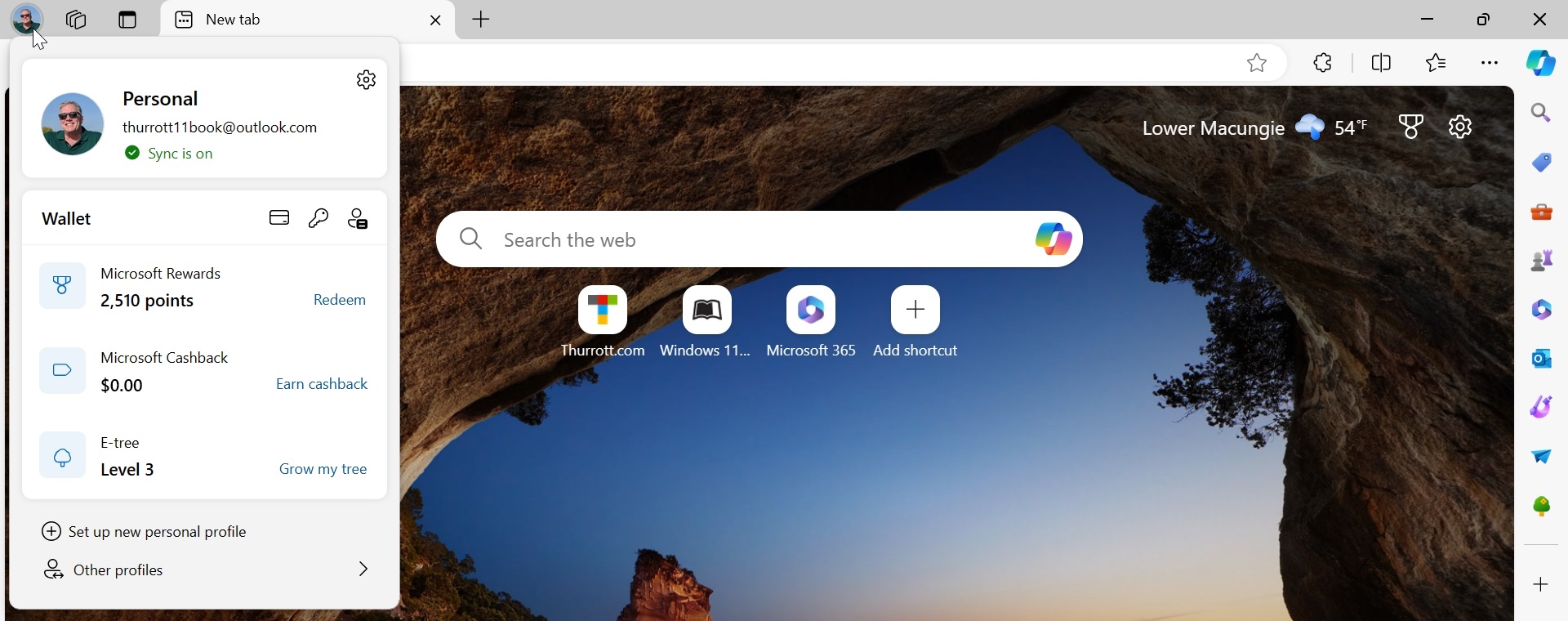
To create a new personal profile (for a Microsoft account), select “Set up new personal profile.” Or, you can select “Other profiles” to browse as a guest without an account or set up a new work (or school) profile.
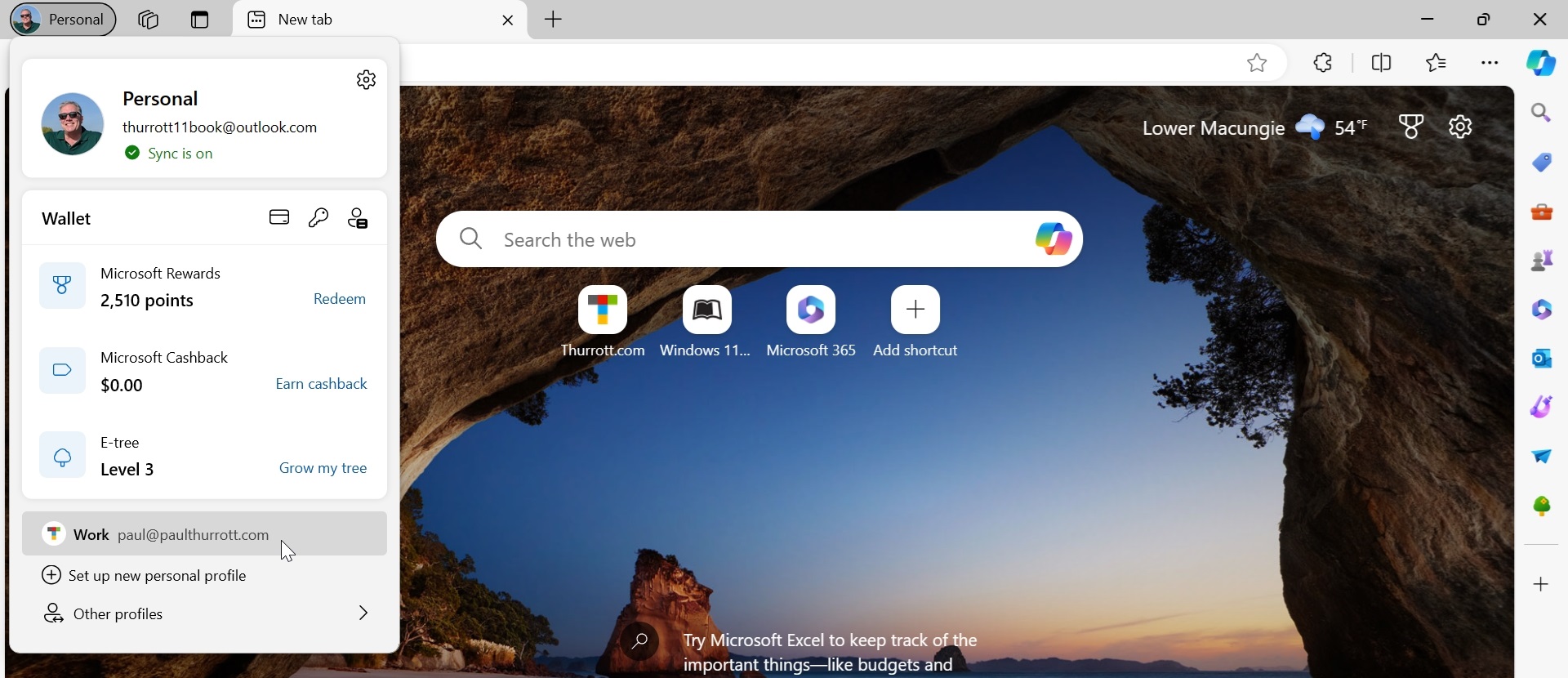
Once you configure two or more profiles, you can switch between them here as well.
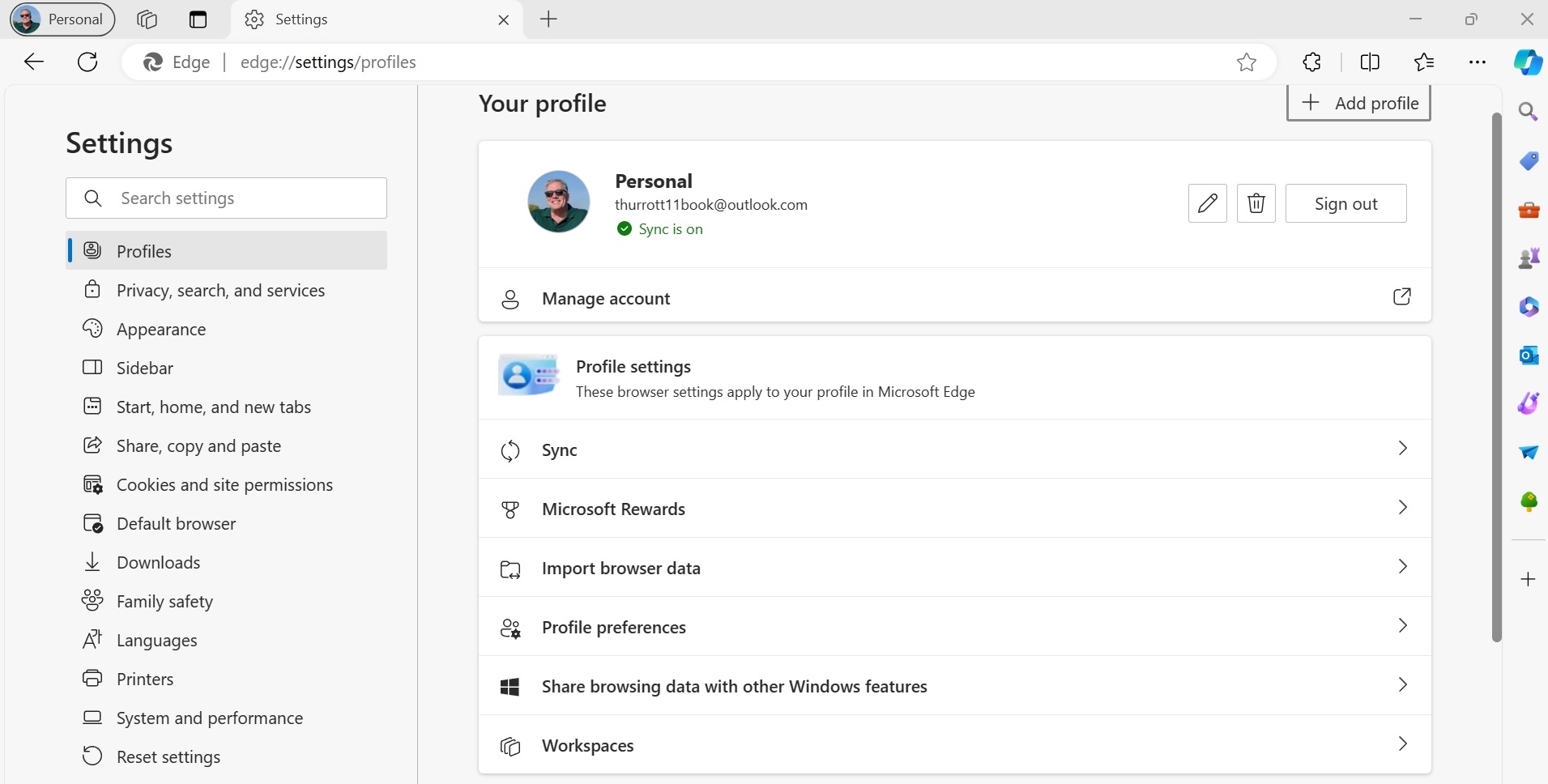
You manage profiles in Edge settings: Navigate to Profiles to view or edit the current profile, or add a new profile. (You can only manage the current profile.)
When you add a new profile, you are prompted to sign in to your personal or work or school account. Then, when you use this profile, it appears as a separate shortcut on the Windows 11 Taskbar and each behaves independently of each other.

Use a workspace for projects or to collaborate with others
Microsoft Edge lets you create a workspace when you wish to create a project or collaborate with others on a shared project. Each workspace gets its own Edge window with a customizable name, color scheme, tabs, and favorites. Workspaces sync through your Microsoft account (or Microsoft work or school account) so they’re always up-to-date.
To get started, click the “Workspaces” button in the upper-left of the Microsoft Edge app window. By default, this button can be found to the right of the “Profile” button and to the left of the “Tab actions menu” button.
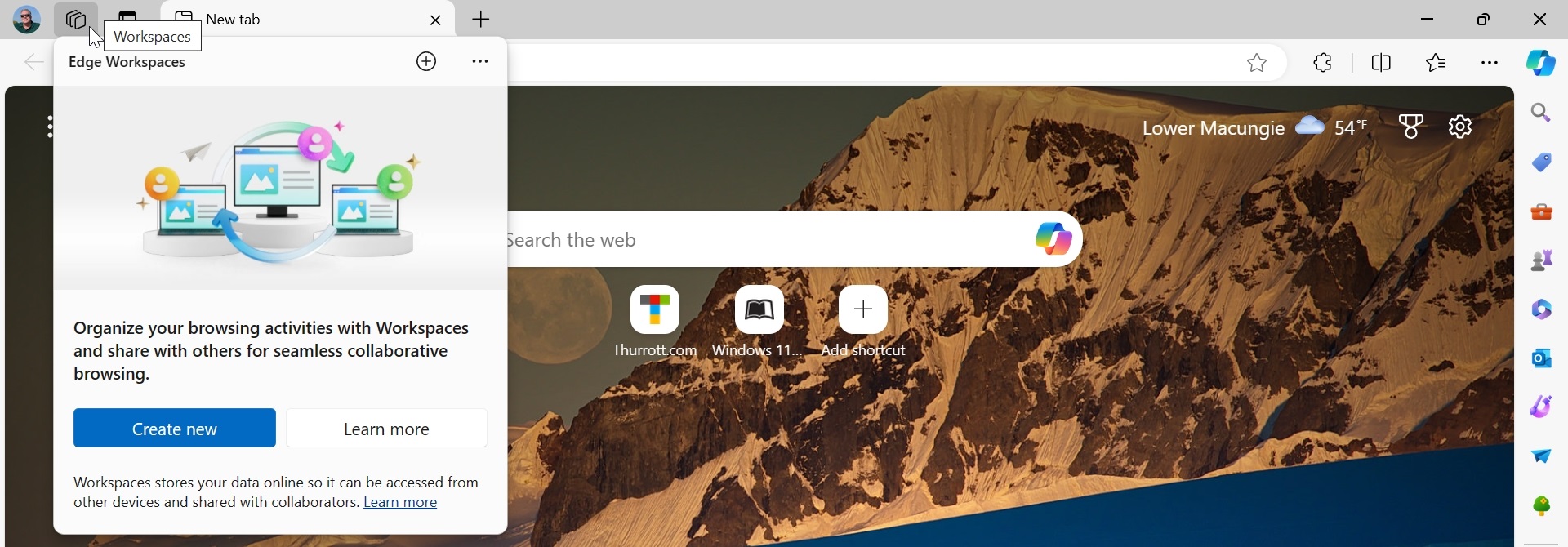
Don’t see a “Workspaces” button? You can enable it in Edge settings by navigating to Appearance > Customize toolbar and configuring the “Show Workspaces” option to “On.”
Click “Create new” to create a new workspace that will operate within your profile but separately from your other Edge windows. Here, you are prompted to choose a name and color scheme for the workspace.
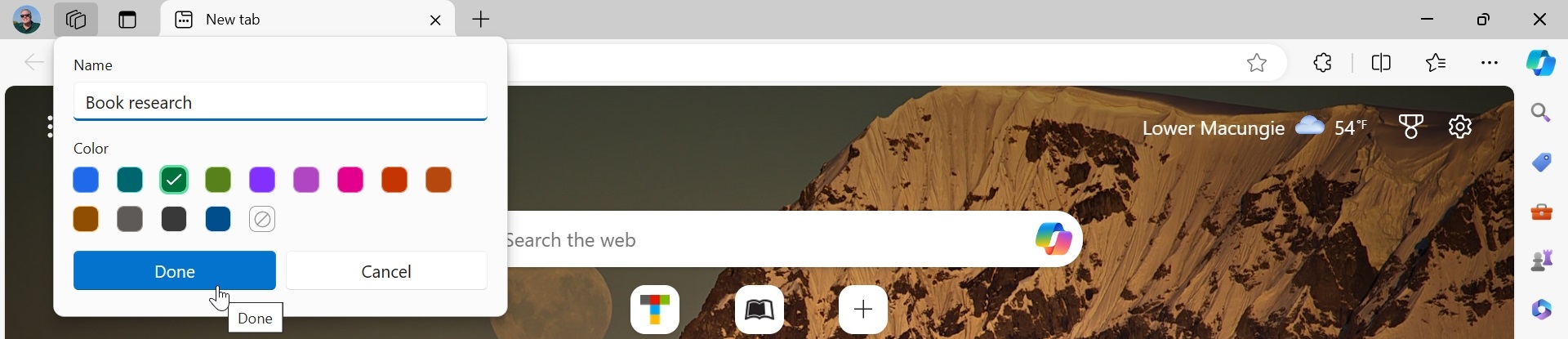
When you click “Done,” Microsoft Edge creates the workspace and opens it in a new browser window. The workspace window displays the name of the workspace instead of the default “Workspaces” button, though it works similarly when clicked while offering a few workspace-related options. And the workspace window is themed using the color scheme you selected.
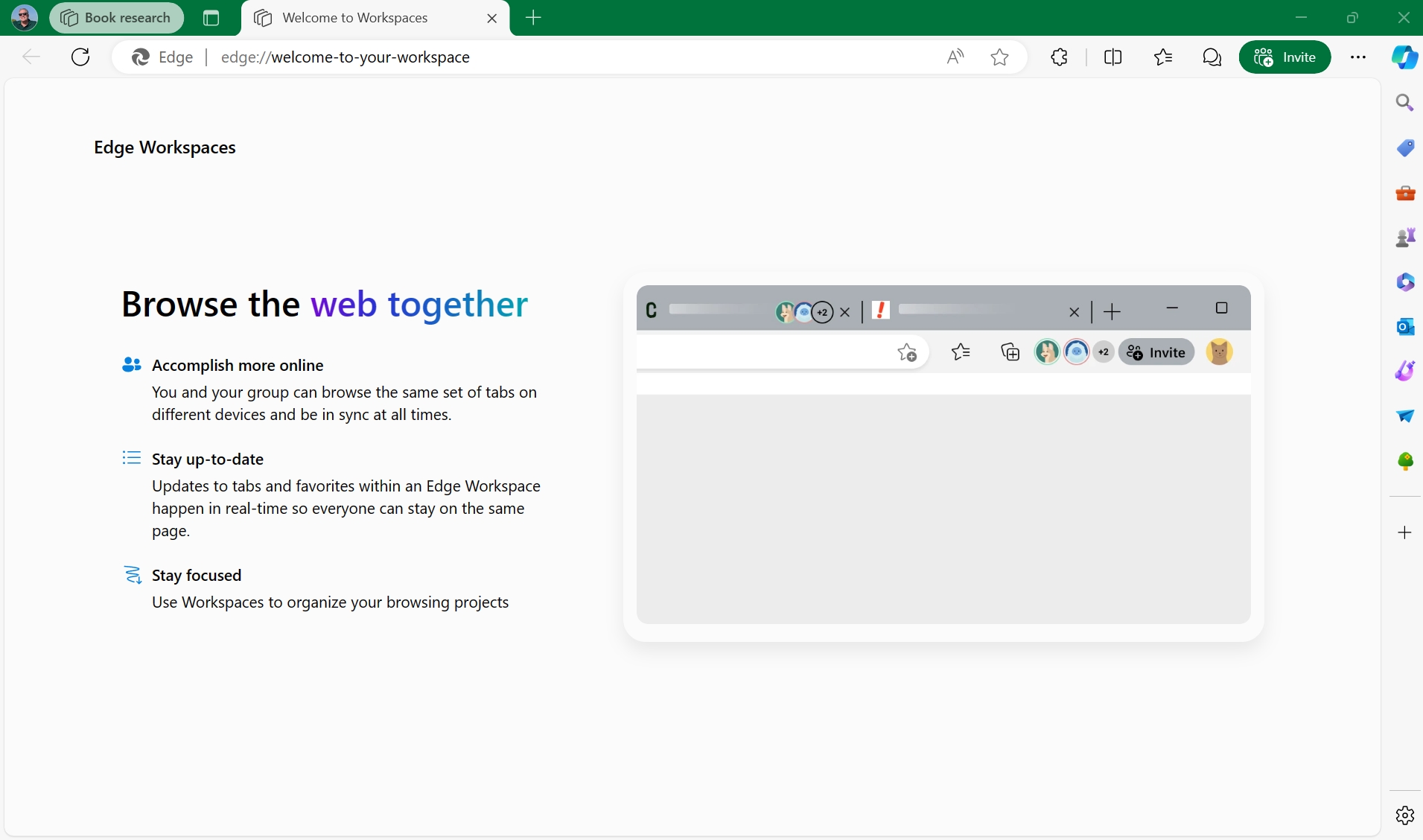

From here, you can do the following:
Work normally. Microsoft Edge workspace windows work like any other Edge windows and support all the standard Edge features like tabs, the Sidebar, and so on. But any tabs and favorites you create in the workspace will be retained separately from–but also be accessible with–the other Edge windows associated with your profile. For example, when you save a webpage as a favorite, it will be saved to the appropriate workspace folder in your favorites by default.
Invite collaborators. While workspaces provide anyone with a nice way to separate projects and other work from the standard web browser experience, this feature is meant to be collaborative. Which means that you can invite other people to join the workspace using the “Invite” toolbar button. Those who join will be given (most of) the same rights and capabilities as the person who created the workspace, and whatever activities each collaborator performs–new tabs, favorites, and so on–will sync between each.
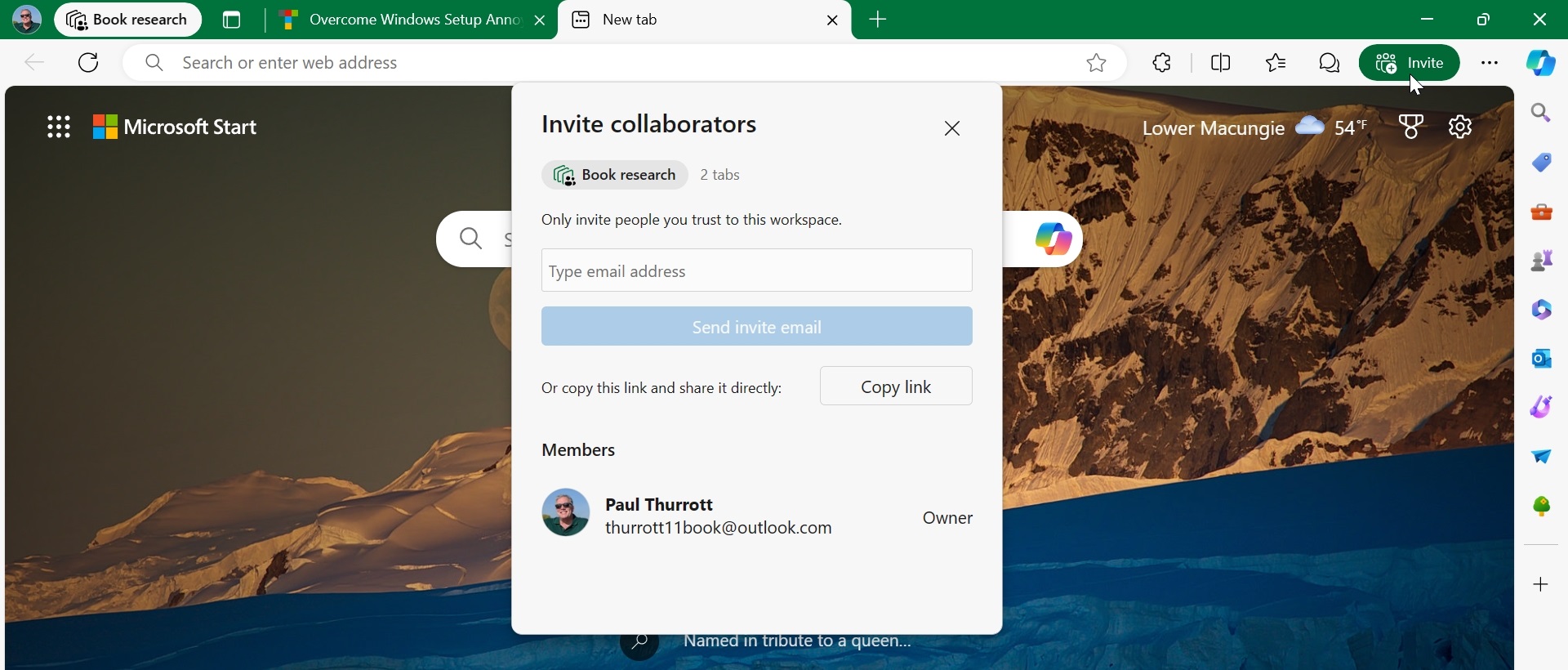
You can also invite a collaborator by clicking the custom “Workspaces” button and then selecting “Invite to workspace” in the pop-up menu that appears.
Go to a collaborator’s tab. When another member of a workspace is active, a tab with that member’s profile image will appear in the Edge toolbar so you can access the tab they’re in.

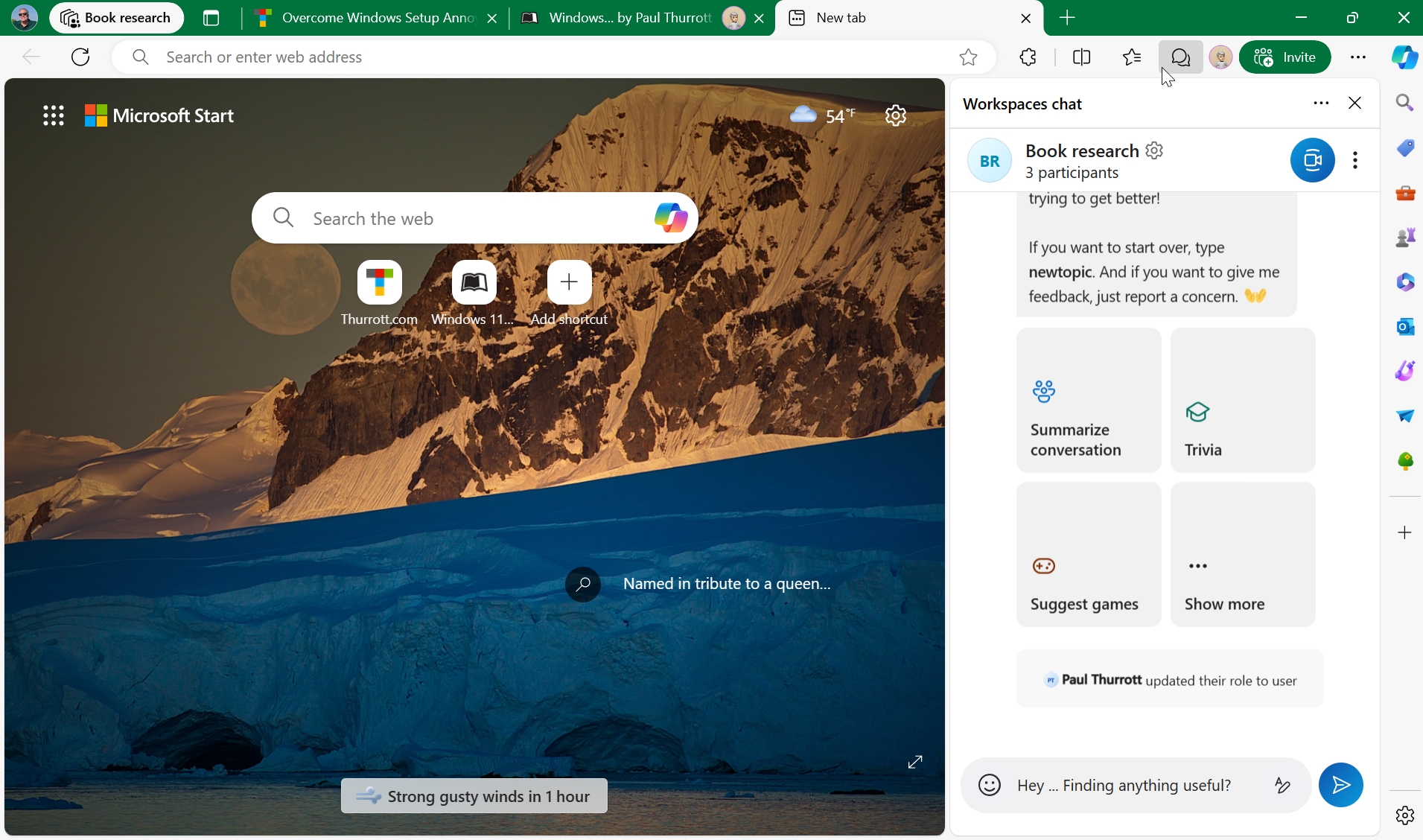
Chat with other members. You can use the “Workspaces chat” button that appears to the left of the “Invite” button on the Edge toolbar to open a Skype-based chat window and chat with the other workspace members (and, confusingly, Copilot, which is integrated in Skype as it is in Windows 11 and Microsoft Edge). These chats are available in any Skype client, including the mobile apps and the standalone Skype app for Windows. So you don’t have to be actively working in an Edge workspace to collaborate with other members.
Edit the workspace. If you’re unhappy with the workspace name or color scheme, you can change either at any time from the Workspaces pop-up menu.
Leave the workspace. Once the workspace has two or more members, anyone can leave the workspace at any time–including its creator–non-destructively. That is, the workspace will remain in place for the other collaborators. You do so via the Workspaces pop-up menu.
Delete the workspace. A workspace creator can likewise delete the workspace from the same menu. Note that doing so will delete it you and any other member, along with the browsing history and favorites.
Create another workspace. You can create multiple workspaces. Just click “Create new workspace” (“+”) in the Workspaces pop-up menu.
Don’t worry about closing the workspaces window(s), as you can always access your workspaces again from the “Workspaces” button in Edge. And depending on how you have configured the browser, these workspace windows may open automatically alongside a normal browser window when you start Edge.

Gain unlimited access to Premium articles.
With technology shaping our everyday lives, how could we not dig deeper?
Thurrott Premium delivers an honest and thorough perspective about the technologies we use and rely on everyday. Discover deeper content as a Premium member.