Set Up Microsoft Edge Correctly … Whether You Use It Or Not
- Paul Thurrott
- Apr 21, 2024
-
1
Microsoft Edge is the default web browser and PDF reader in Windows 11, and a modern and capable successor to the Internet Explorer browser of yesteryear. It’s built on the same Chromium web platform that Google uses for Chrome, and it integrates more deeply with Windows and Microsoft online services–most notably Copilot–than other browsers. But Microsoft Edge is also a vector for some of the worst behaviors in Windows 11. For this reason, it’s important to configure Microsoft Edge correctly, whether you expect to use it regularly or not.
The problem with Microsoft Edge
Microsoft Edge is the most important in-box app included with Windows 11 because web browsers are, by far, the most often-used app on our PCs. But they’re also the gateway to two massive and lucrative markets that Microsoft strategically wants to a play a major role in. The first is paid subscription services, like those for productivity (Microsoft 365), storage (OneDrive), gaming (Xbox Game Pass) AI (Copilot Pro), and others. The second is online advertising: Microsoft, like Amazon, Google, and Meta, tracks our activities online, harvests our personal data, and sells it to third-parties so they can exploit you.
These markets are so important to Microsoft that it configures Windows 11 to ensure that you are exposed to its offering on both sides of this strategy as often as possible. It promotes its paid services throughout the system, via full-screen advertisements, banner notifications, in-app promotions, and more. And it uses dark patterns, deceptive designs, and helpful-sounding suggestions to coerce users to use Microsoft Edge and then to configure it in ways that are optimal for its own needs. And when users make specific configuration choices that contradict Microsoft’s best interests, Windows 11 will go so far as to ignore those choices to ensure you are exposed to tracking and Microsoft online advertising as frequently as possible.
More specifically, Windows 11 and Microsoft Edge secretly engage in the following activities:
Microsoft Edge tracks you online. Microsoft Edge tracks your online activities so Microsoft can harvest your personal data, target you with advertising, and sell that information to other data brokers and online advertisers that will expand this abuse.
Microsoft Edge ignores your default browser choice. If you configure another web browser as the default, Microsoft Edge will still appear when you perform certain actions in Windows 11, ignoring your choice. These instances include clicking a widget or news feed article in Widgets, clicking a web link in Search highlights, clicking a web link in the Get Help in-box app, and using Copilot in Windows 11.
Microsoft Edge ignores your browser customizations. If you customize certain Microsoft Edge features, it will harass you to change them back to the defaults that benefit Microsoft. This happens when you change the default search engine away from Bing, disable certain features in the default New Tab page (which displays content from Microsoft Start and other Microsoft services), change the New Tab page to a third-party option, and more. In some cases, Edge will even change the configuration back to the Microsoft default without informing you.
Microsoft Edge harasses you to enable optional features that will further expose you to more Microsoft tracking and advertising. Even if you make no configuration changes to Microsoft Edge, the browser will still harass you. It will occasionally prompt you to make configuration changes that it claims are for your benefit but are designed only to ensure that you are exposed to more online tracking, data harvesting, and Microsoft advertising. These suggestions use language like “Make Microsoft Edge better for you and others” to misrepresent the true intent of the configuration changes it wishes you to enable.
We recommend not using Microsoft Edge and taking steps to minimize its creepy stalking behaviors. But we also cover the unique functionality this browser offers exhaustively over the next several chapters of the book. Right. Unlike Microsoft, we respect your choice.
Get the initial Microsoft Edge configuration right
The first time you launch Microsoft Edge, it displays a full-screen experience that steps you through the initial configuration of the browser. It’s important to pay attention in each step of this process, because some of the language Microsoft uses is purposefully confusing and it will try to push you into adopting first-party services and features you may not want.
Is Edge already configured?
If you’ve already configured Microsoft Edge and are worried that you made the wrong decisions during its initial configuration, don’t be: In the descriptions of each step in this initial configuration below, we explain how you can later change each related Edge setting later. None of the choices you may have made before are irreversible.
Let’s jump in.
Welcome to Microsoft Edge, the best performing browser on Windows
In this first screen, you’re told that Microsoft Edge syncs your browser data and privacy preferences through your Microsoft account. But new to Windows 11 version 23H2, this screen also notes a new Edge feature, its ability to import your data from other web browsers you installed, and that this new feature is enabled by default.
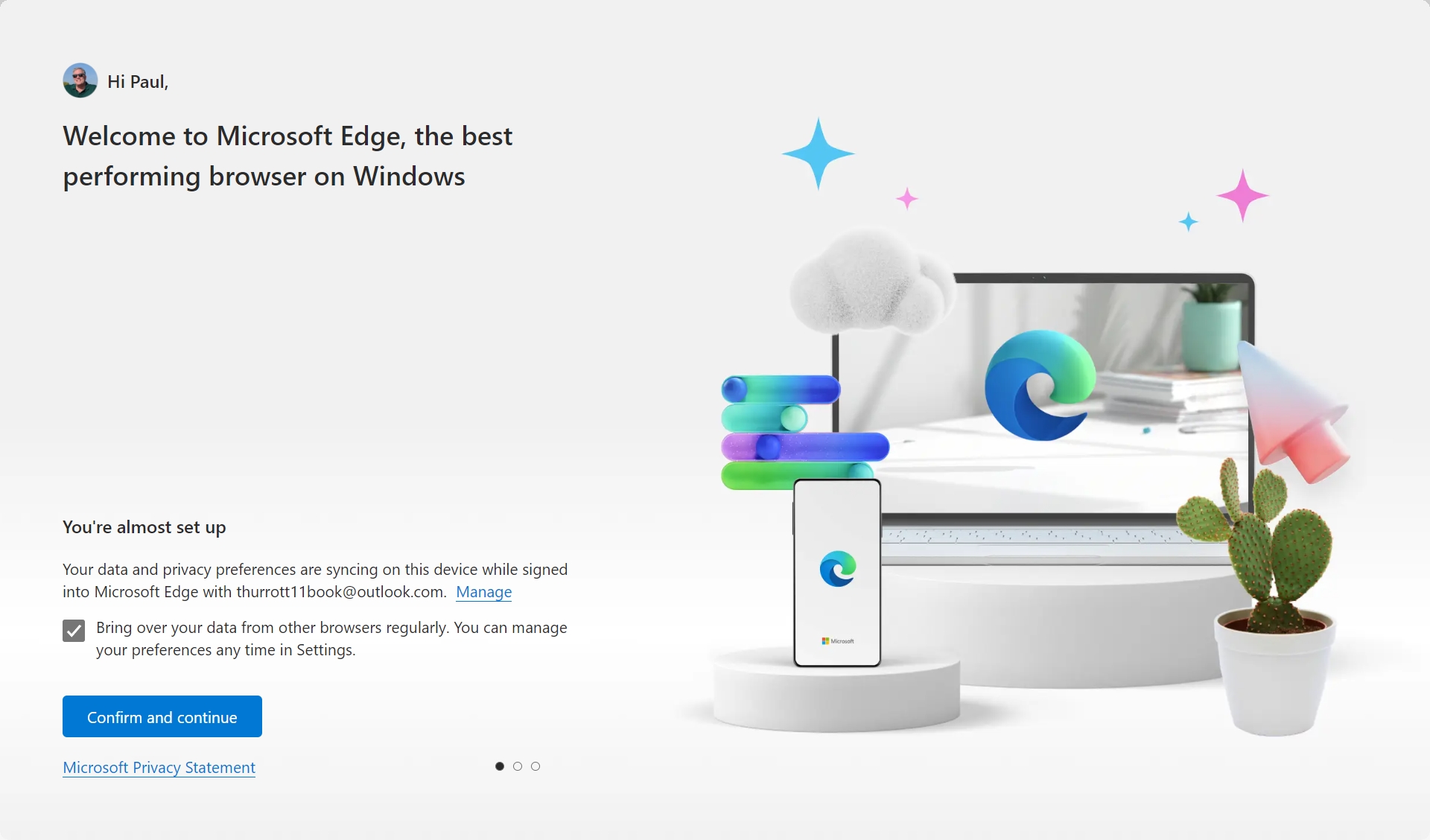
Each of these options should be assessed independently.
All web browsers offer some form of browser data and preferences sync so that you can use the same web browser across any PCs, Macs, tablets, and smartphones you own and access the bookmarks (what Edge calls favorites), passwords, browser extensions, and other items you saved and configured everywhere. The most popular web browsers–Google Chrome, Apple Safari, Microsoft Edge, and Mozilla Firefox–do so using an online account. This capability is convenient and desirable, and is not in any way nefarious.
Those who intend to use Microsoft Edge are probably best served by allowing the browser to sync all the data it can through their Microsoft account. But you can also individually configure which items sync. To do so during the initial browser configuration, click the “Manage” link to display an optional “Sync settings” page.
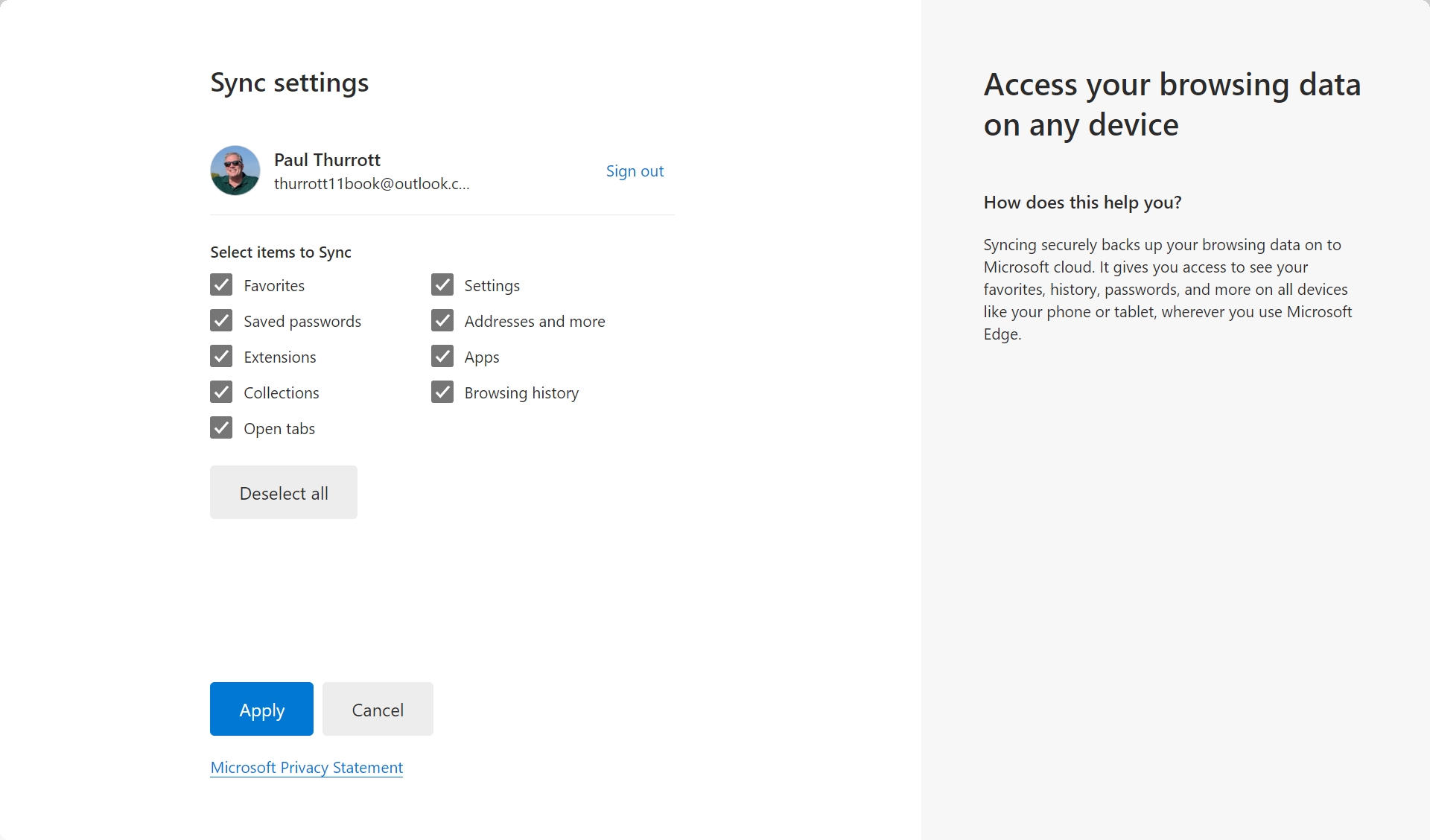
Here, you will find a list of the items that Edge can sync. Each is enabled by default, but you can click individual items to uncheck them and prevent that data from syncing.
Configure browser data and preferences sync later
You can configure Microsoft Edge data and preferences sync at any time. To do so, open Edge settings–most obviously by clicking the “Settings and more” toolbar button (“…”)–and navigating to Profiles > Sync. There, you will find a list of these items, and each can be individually configured to be enabled or not.
The other capabilities, denoted by the checked item under “You’re almost set up–“Bring over your data from other browsers regularly. You can manage your preferences any time in Settings”–is more problematic. In part because the description is vague and somewhat inaccurate.
Here’s what it really does.
If you leave this option enabled, Microsoft Edge will import browsing data from Google Chrome every time you run Edge. It doesn’t (currently) support other web browsers. Microsoft also doesn’t document which data it imports, doesn’t let you configure a different schedule for this action, or make any other changes. It’s just enabled or it isn’t.
This behavior may be desirable depending on your needs. Perhaps you are assessing Microsoft Edge on one PC but use Google Chrome elsewhere. Maybe you routinely move between different browsers, or use Edge on your PC but Chrome on your smartphone.
But Microsoft enables this functionality by default because it benefits Microsoft by giving it a more complete record of your online activities, data that it can use against you with targeted ads and by selling it to third-party data brokers and online advertisers. And so our advice is clear. And we recommend disabling this option.
To do so, click the checkbox next to “Bring over your data from other browsers regularly. You can manage your preferences any time in Settings” to uncheck it before moving on.
Configure automatic data import from other web browsers later
You can configure whether Microsoft Edge automatically imports browser data from other web browsers–Google Chrome, really–at any time. To do so, open Edge settings and navigate to Profiles > Import browser data. Then, click “Edit preferences” next to “Import browsing data at each browser launch” (under “Import data from Google Chrome). Then click “Turn on” (or “Turn off”) next to the “Import browser data from Google Chrome on each launch” option that appears.
Yes, this feels purposefully hidden to us as well. It’s almost impossible to find with Edge settings search too.
We can help you import your browsing data from Google
In this second Edge initial configuration screen, Microsoft is trying to facilitate you switching from Google Chrome, by far the most popular web browser, to Microsoft Edge. And it can do so without requiring you to first install that rival web browser: Just click the “Sign in to Google to continue.”
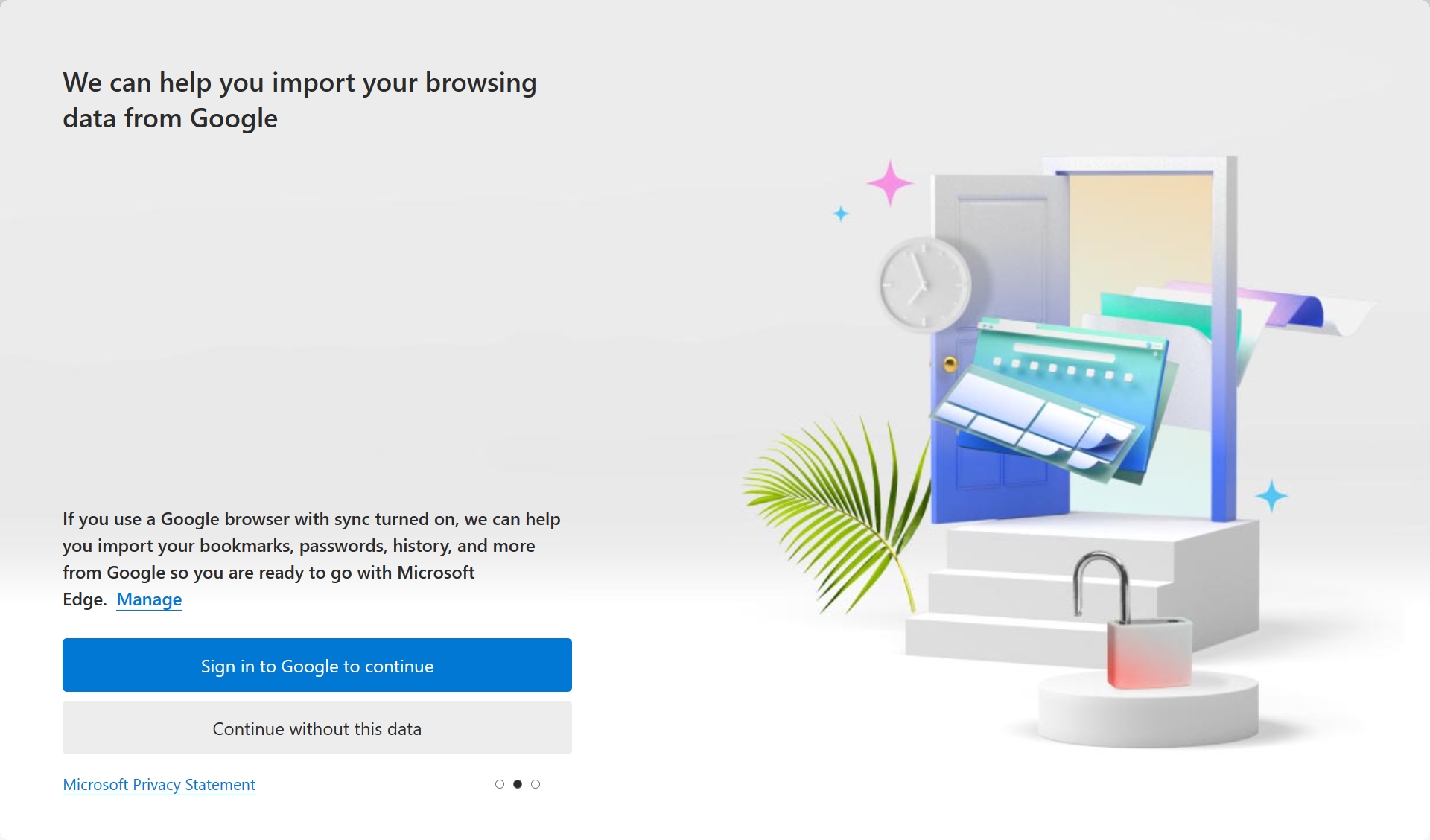
To configure which browser data items you can import from Google, click the “Manage” link.
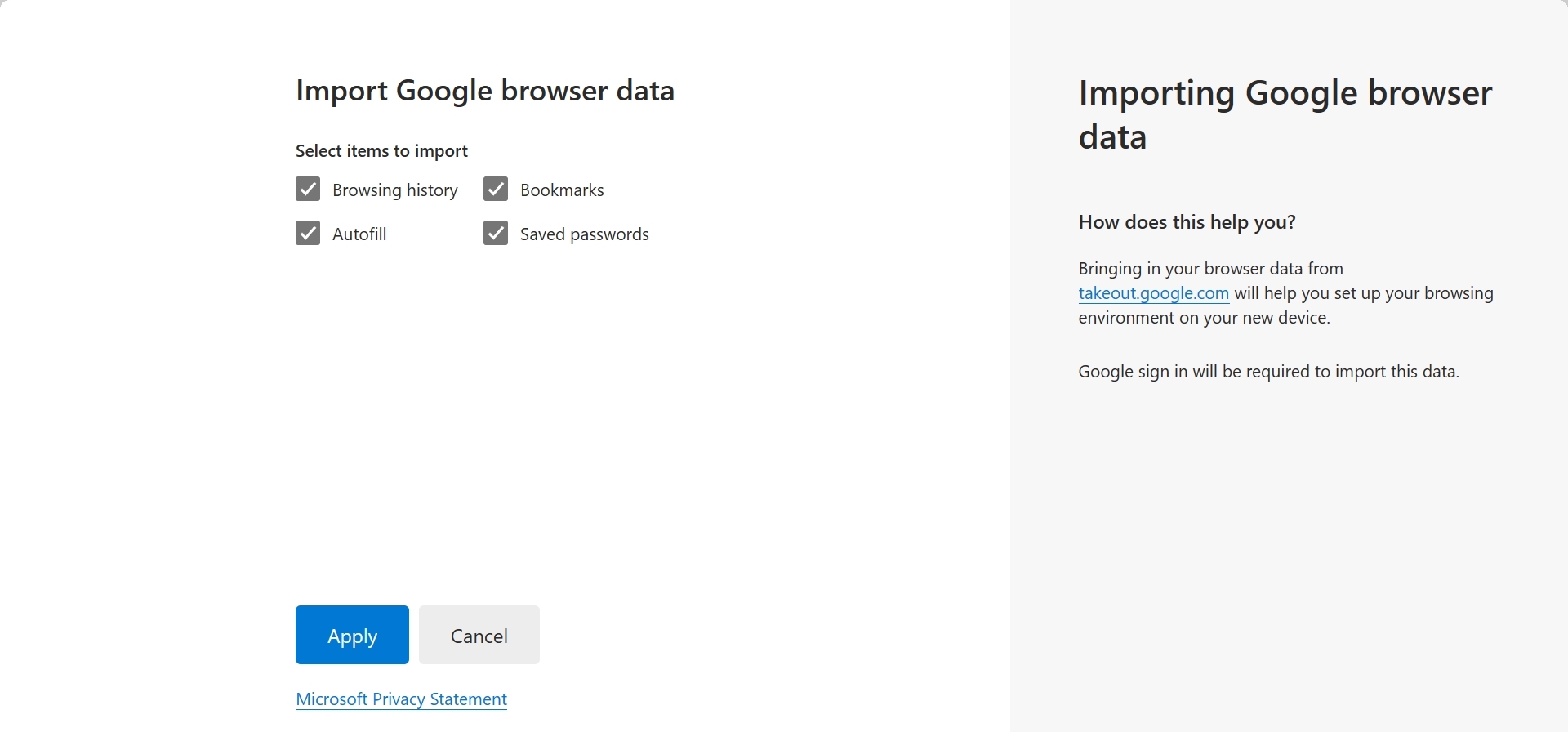
This option is obviously beneficial to Microsoft–ideally, you never install a rival web browser–but you may find it beneficial as well. That said, you can import data and preferences from Google Chrome or any other web browser at any time in the future. So our advice here is to click “Continue without this data” to continue. And then import browser as needed at a later time.
Import your browsing data and preferences from Google Chrome or any other web browser later
To import your browsing data from Chrome or other web browsers later, open Edge settings and navigate to Profiles > Import browser data. This interface supports multiple browsers and even third-party password managers. Oddly, it also imports more types of data from Chrome than does the initial Edge configuration screen shown above.
Help us make Microsoft experiences more useful to you
This nefarious screen is purposefully worded in a way that makes the configuration it enables by default seem beneficial to you, but the sole aim is to advance Microsoft’s strategies by exposing you to more online tracking, data harvesting, and Microsoft advertising.
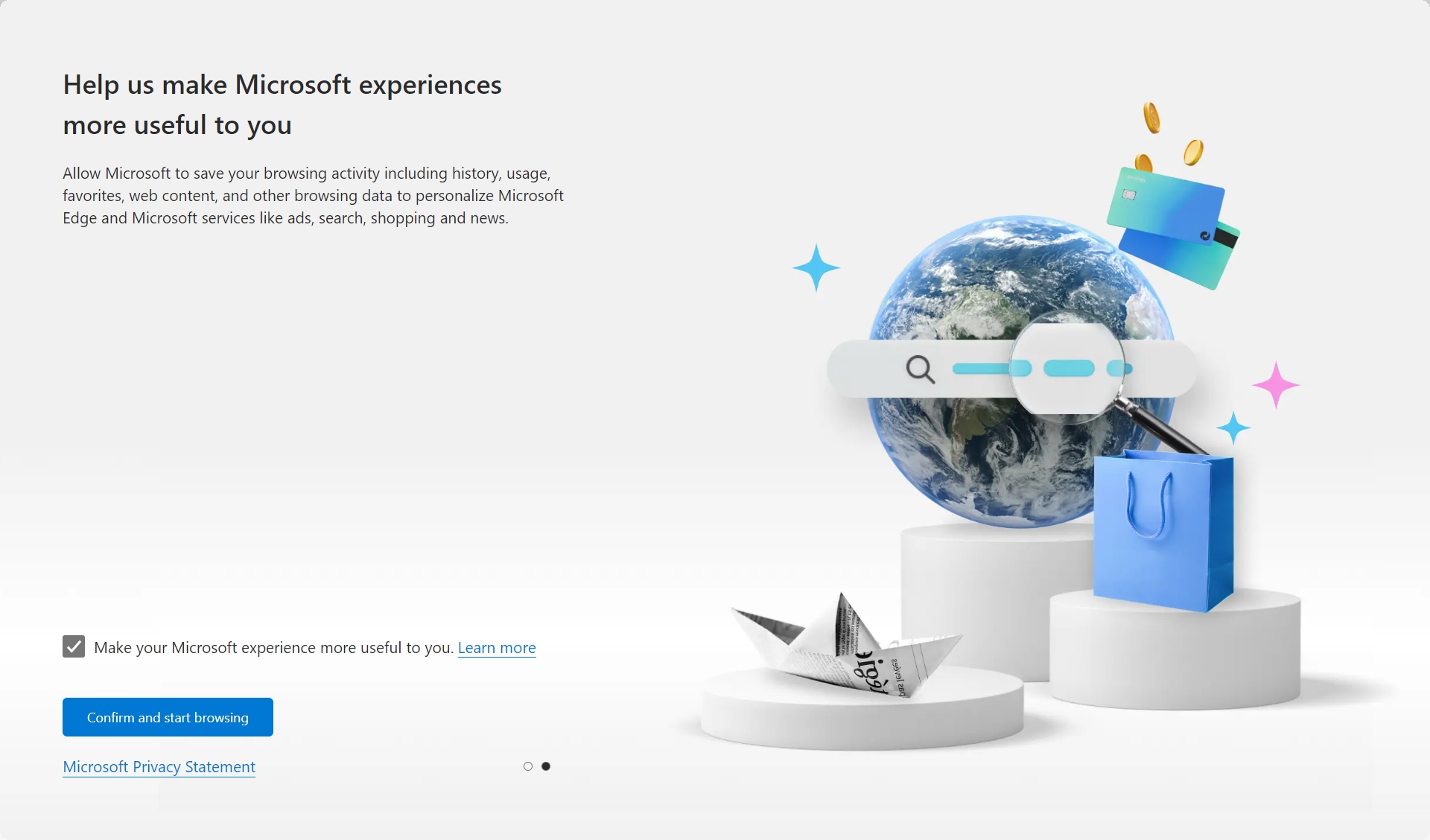
You can find this out for yourself by clicking the “Learn more” link. When you do so, Edge displays Microsoft’s explanation for this data collection and usage, and that it includes your browsing history, your favorites and collections, data about how you use the browser, the webpages and other content you view, and data about the PCs and other devices on which you use Edge.
We strongly recommend unchecking “Make your Microsoft experience more useful to you” before continuing.
Determine whether Microsoft Edge can collect and use more of your browsing data later
You can configure whether Microsoft Edge works on Microsoft’s behalf to collect and use more of your personal data. To do so, open Edge settings and navigate to Privacy, Search, and Services and scroll down to the “Personalization & advertising” section. There, you will find a single option, “Allow Microsoft to save your browsing activity including history, usage, favorites, web content, and other browsing data to personalize Microsoft Edge and Microsoft services like ads, search, shopping, and news.” Be sure this is not selected, and is thus disabled.
Express yourself by customizing Microsoft Edge with themes
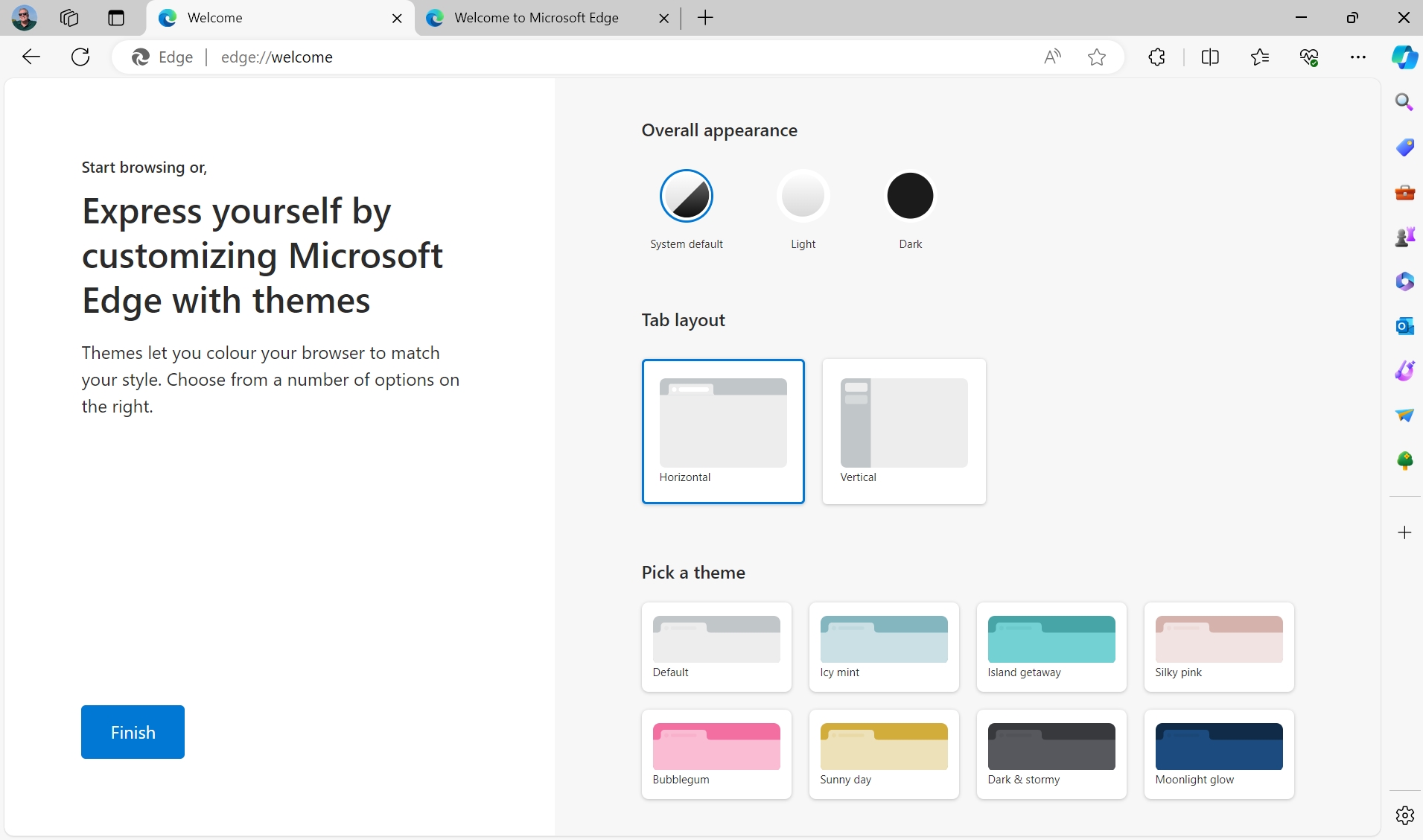
At this point, Microsoft Edge displays its normal user interface with two tabs, the built-in Microsoft Edge Welcome experience and Welcome to Microsoft Edge (on the Microsoft website), respectively. You can skip both easily enough, but both of these tabs are worth examining, especially if you intend to keep using Microsoft Edge.
If you previously installed extensions and are syncing Microsoft Edge data and preferences through your Microsoft account, other tabs related to certain extensions may open as well. You can learn more about extensions in the Microsoft Edge Basics chapter.
The Welcome experience lets you personalize Edge by choosing an appearance (system default, light, or dark), the tab layout (horizontal or vertical), and a color theme (default plus a small selection of other choices).
Configure the appearance of Microsoft Edge later
These choices are straightforward and familiar, but you can change the appearance of Microsoft Edge, using a wider range of choices, at any time. To do so, open Edge settings and navigate to Appearance. There, you will find the overall appearance option, more themes choices plus a link to find even more in the Microsoft Store, and a laundry list of other appearance-related features (including a “Show vertical tabs for all current browser windows” option). There’s a lot there.
When you click “Finish,” Edge navigates to its New tab experience. It’s likely you will want to configure or, better still, replace it. We discuss both options later in the chapter.

Where did it go?
The Welcome experience used to include a second page, “Get to the sites you love right from your Windows taskbar,” that explained that you can pin web apps and websites to the Windows 11 Taskbar alongside your pinned apps, along with several sponsored example sites for you to pin. But this page no longer appears in the Welcome experience.
You can learn about pinning web apps and websites to the Taskbar in the Microsoft Edge and Web Apps chapter.
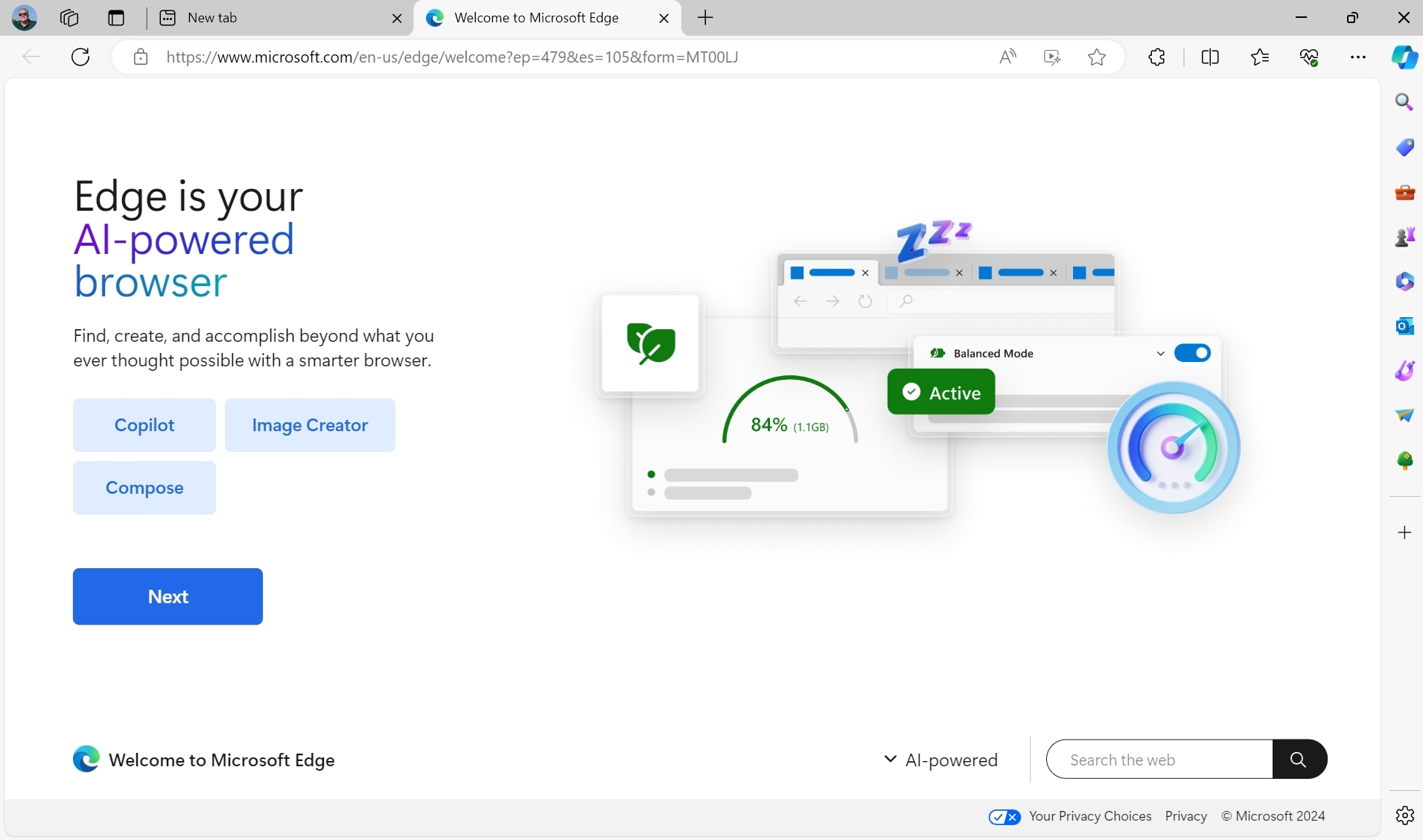
The second tab, Welcome to Microsoft Edge (on the Microsoft website), provides a nice overview of the unique features that differentiate this web browser from its rivals. As noted, it’s worth examining, especially if you’re curious about Microsoft Edge or intend to use the browser full-time.
Further configure Microsoft Edge to make it more useful, private, and efficient
The initial Microsoft Edge configuration presents you with just a few basic configuration choices. If you intend to use Microsoft Edge regularly, you have many, many more options to consider. Here, we focus on the most important of those.
If you don’t use Microsoft Edge, you can skip this section and jump forward to the section Configure a different web browser as the default and minimize your interactions with Microsoft Edge.
Configure what you see when you start Microsoft Edge
Like other web browsers, Microsoft Edge uses a New tab page as its default Home view, which is what you see when Edge starts. But its default New tab page is quite busy, with many onscreen elements vying for your attention, and it’s designed to expose you to Microsoft’s online services, tracking and data harvesting, and advertising. Fortunately, you can configure what you see when start Microsoft Edge, which can include customizing Microsoft’s New tab page to your liking or, better still, replacing it with an extension that provides its own New tab page.
Configure the Home view
You don’t have to use the New tab page as your Home view in Microsoft Edge. Instead, you configure a different Home view. Available choices include:
- Tabs from the previous session. This is the ideal choice for many users: Now, each time you run Edge, it will reopen whichever tabs you were using the last time you were using the browser.
- One or more custom web pages. You can configure Edge to open one or more web pages of your choosing.
To make this change, open Microsoft Edge settings and navigate to Settings > Start, home, and new tabs. You’ll see the available choices in the “When Edge starts” section at the top.
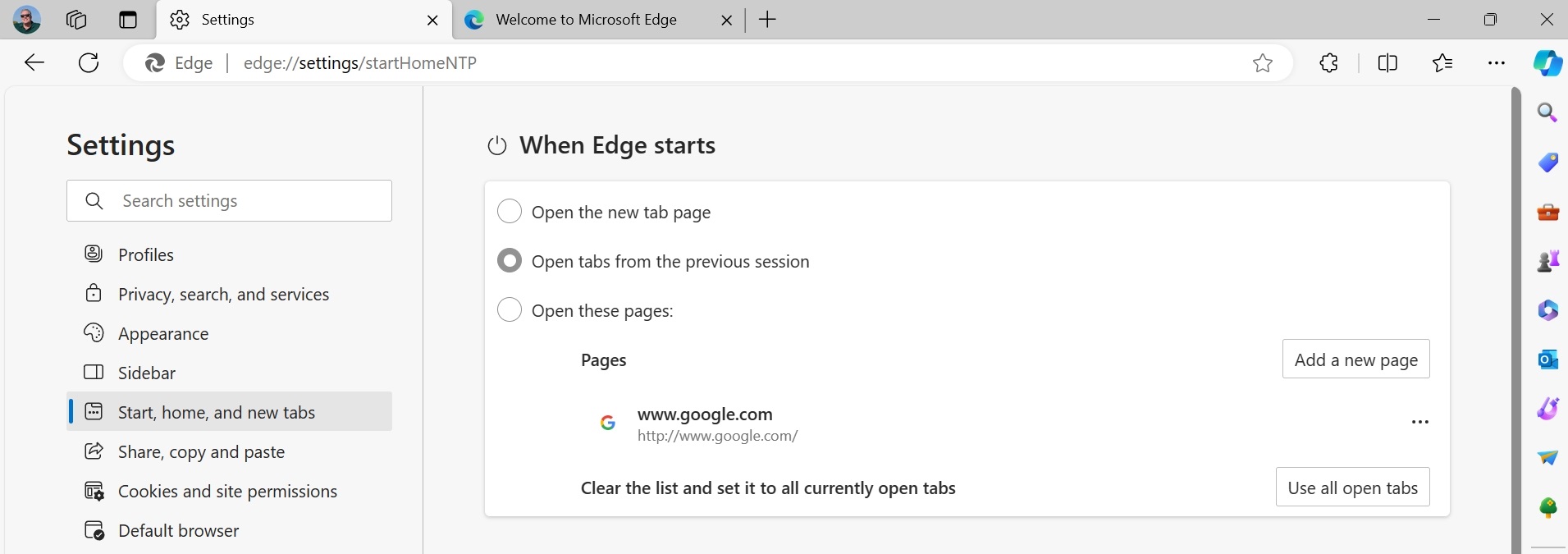
If you want to use two or more custom tabs, you can configure that more easily by loading the web pages you want into tabs, visiting this interface, and clicking the “Use all open tabs” button next to “Clear the list and set it to all currently open tabs.”
Customize the New tab page
To start customizing the New tab page, click the Page settings icon in its upper-right (it resembles a gear).
In the Page settings pane that appears, you can customize the following options:
Region & language. This will default to the region and language used by Windows 11, but you can change it to a different region and language using a long list of other possibilities if desired.
Quick links. By default, Microsoft Edge displays a single row of Quick link icons, which are shortcuts to websites and pages. There are three types of Quick links icons–those provided by Microsoft, sponsored links (which are third-party sites that paid Microsoft to be promoted here), and those you add yourself. You can configure the Edge New tab page to display two rows of Quick link icons, if needed, and use the “Show sponsored links” option to disable the display of sponsored links, which we recommend. Or, just remove this content entirely.


To add a Quick link, display the New tab page and click the “Add shortcut” (“+”) button to the right of the Quick links icons. You can give it a custom name, which is nice.
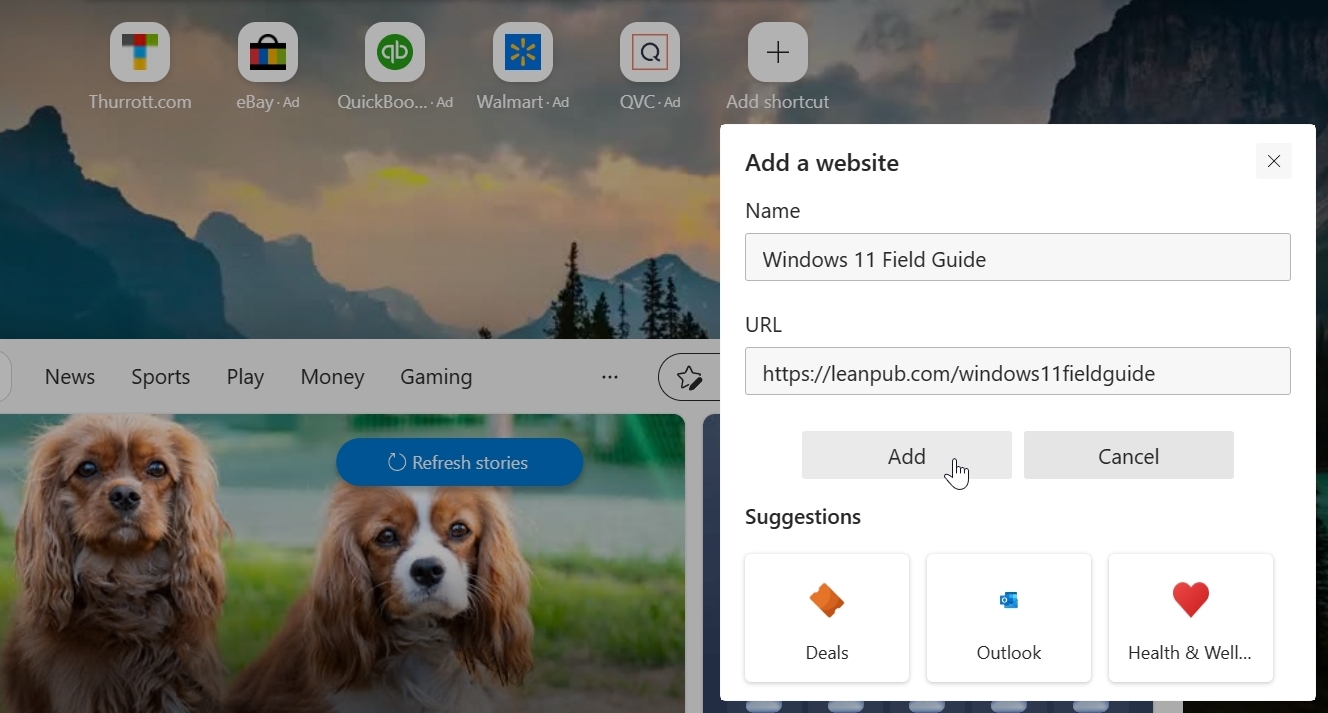
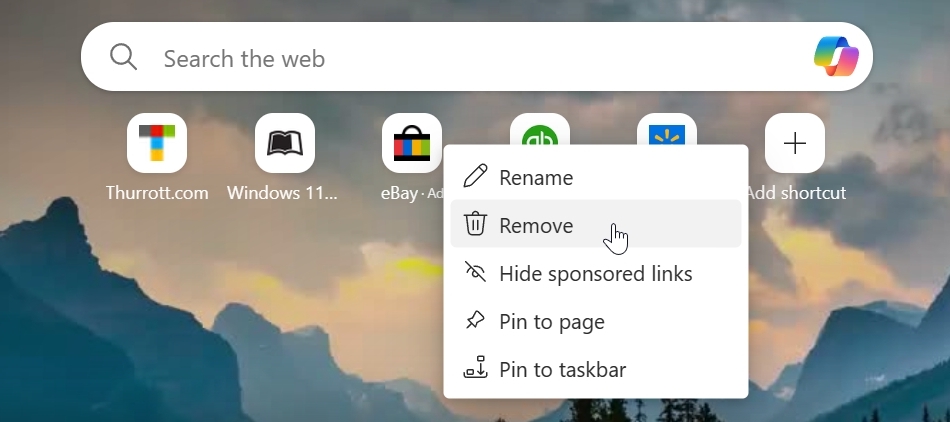
To remove a Quick link, including one provided by Microsoft or a third party, display the New tab page, mouse over the Quick link, click the “More Options” link (“…”) that appears, and choose “Remove.”
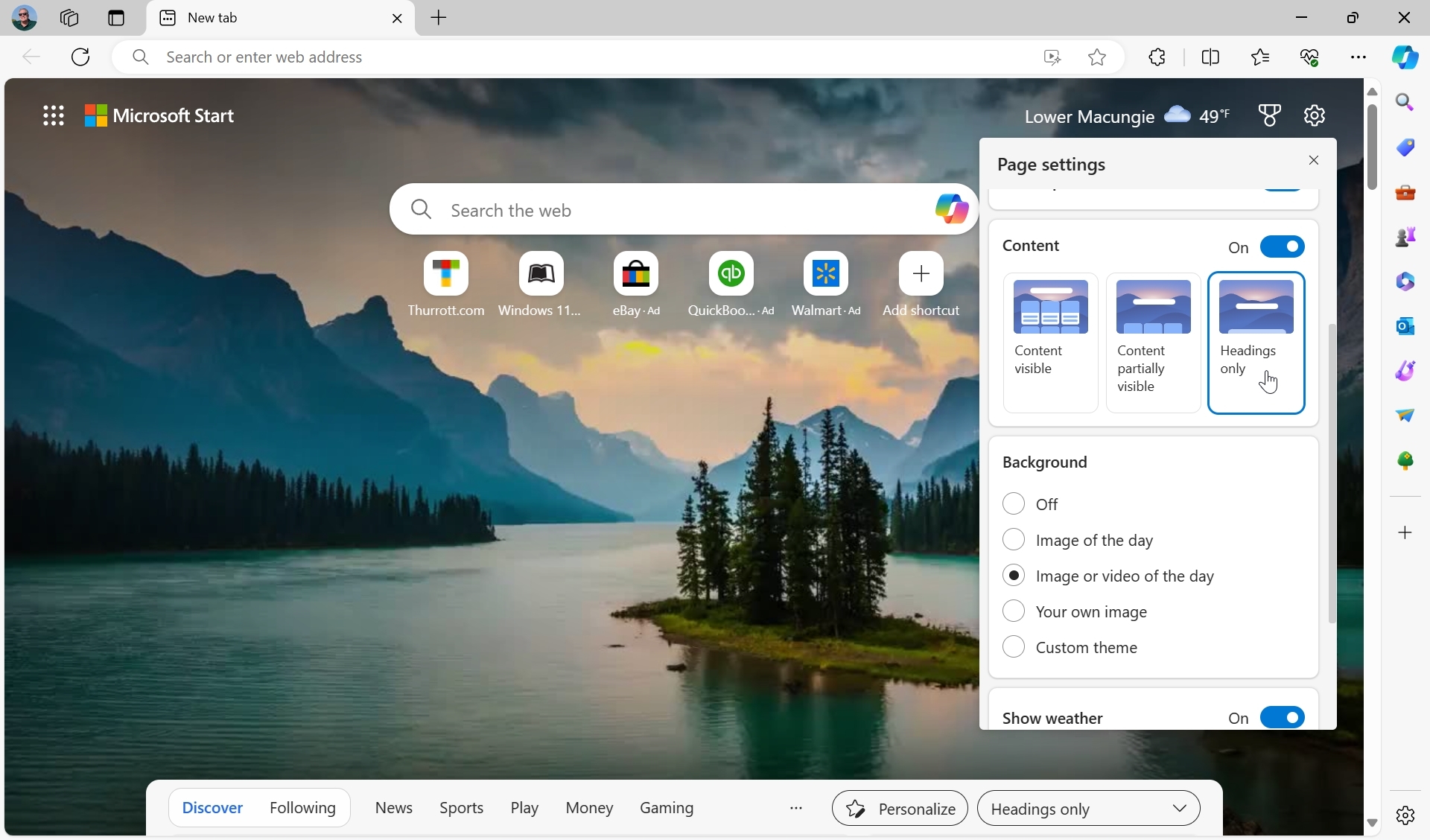
Content. Microsoft’s New tab page displays a Discover news feed by default. You can toggle this off entirely–which we recommend, given it’s low quality–or choose between three layouts, “Content visible,” “Content partially visible” (the default), and “Headings only” (shown below).

Background. By default, the New tab page displays a pretty new photo or video from Bing each day. But you can configure the background with no image, the Bing image of the day (with no videos), your own image, or an image supplied by a custom theme.
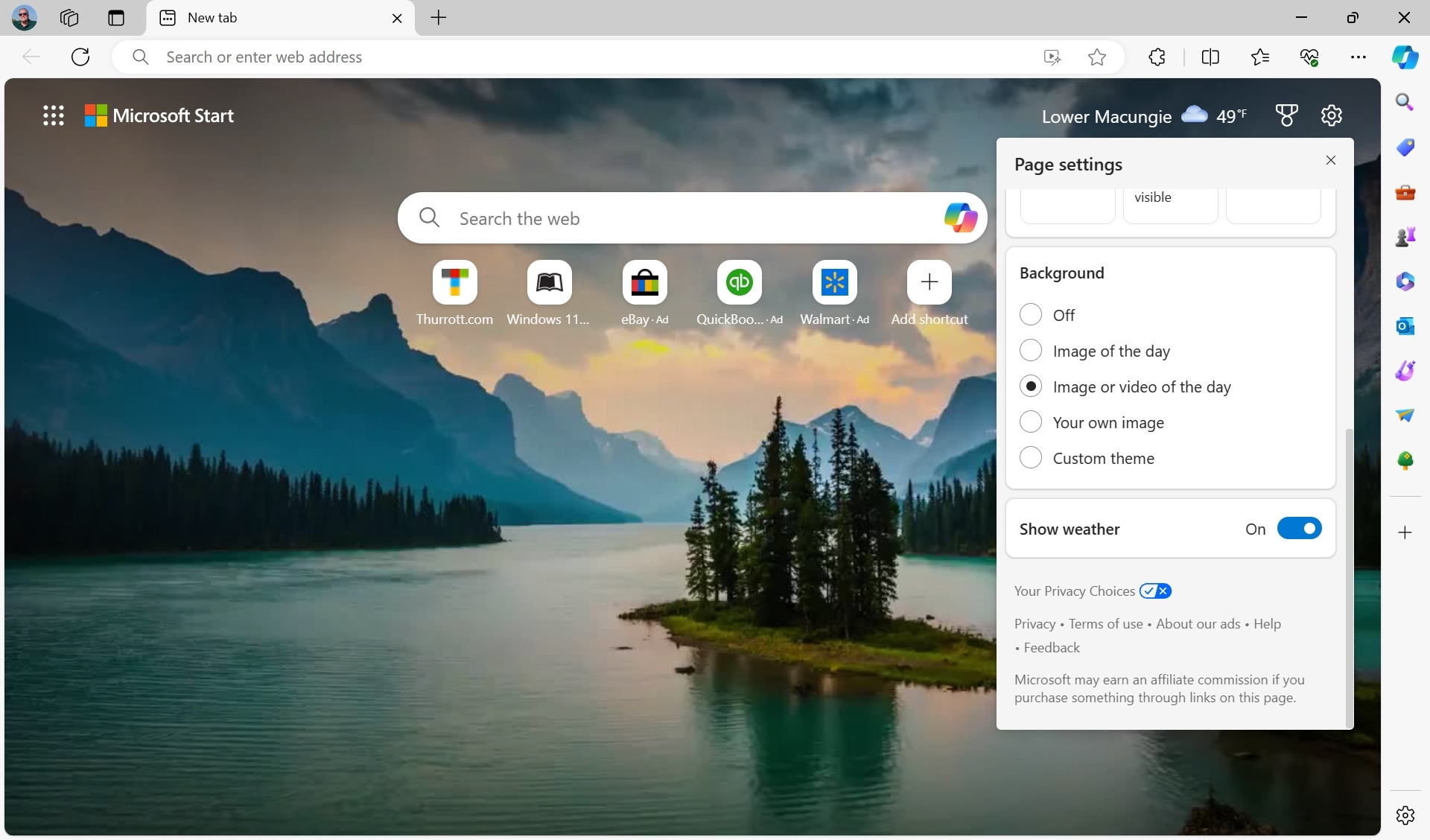
Show weather. The New tab page displays a small weather forecast graphic in the upper-right and, when necessary, a weather alert in the middle bottom, by default. To see a more detailed forecast in a pop-up card, just click the forecast graphic. The “See full forecast” link opens a tab to Microsoft Weather on the web. If you don’t want to see the weather forecast or alert on the New tab page, you can disable it here.
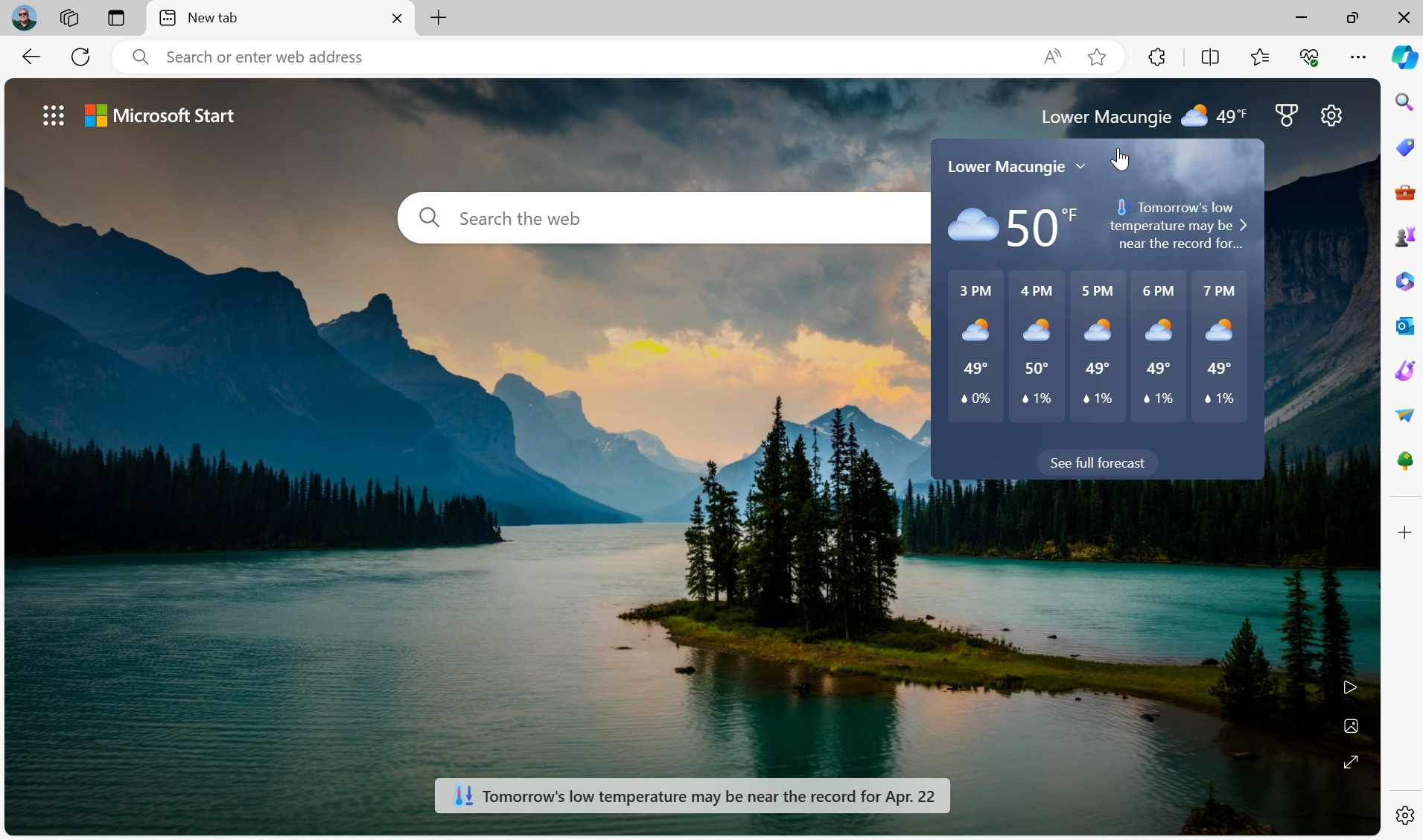

Be careful with Microsoft Weather: It’s a loud, busy website that will try to suck you into signing up for weather alerts while it silently steals your personal data in the background.
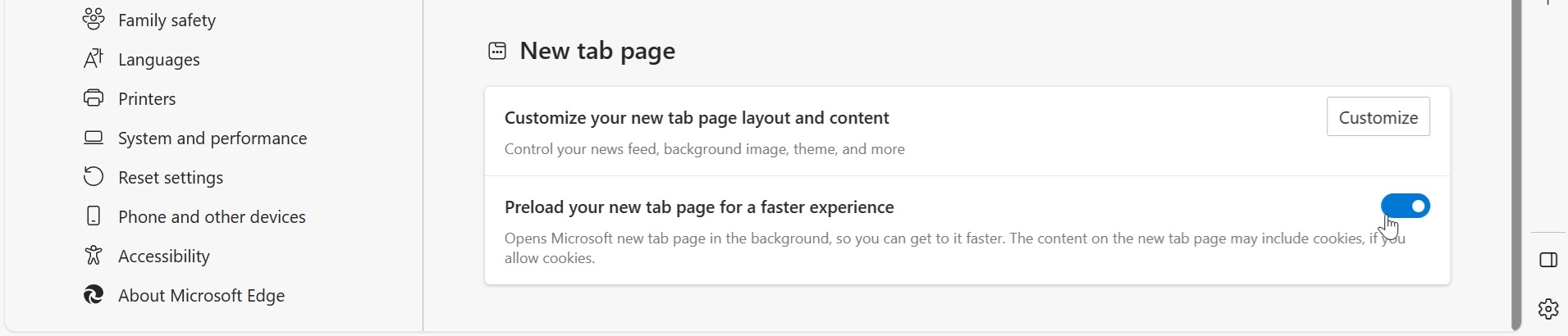
In addition to the options available in Page settings, you can also configure whether the New tab page preloads in the background while you’re using the browser. This option is set to “On” by default, and when configured that way, Edge will load the New tab page–especially its monster content feed–more quickly. But it does so at the expense of RAM: Leaving this enabled will consume more system resources.
To configure this option, open Microsoft Edge settings and navigate to “Start, home, and new tabs.” Then, scroll down to the “New tab page” section. You’ll see an option titled “Preload your new tab page for a faster experience.” Then, disable it.
Replace the New tab page with a third-party alternative
If you find Microsoft’s New tab page unacceptable–as we do–and would like to use a different Home view in Edge, you should consider trying an extension like Bonjourr or Momentum, both of which offer clean, ad- and distraction-free New tab experiences.
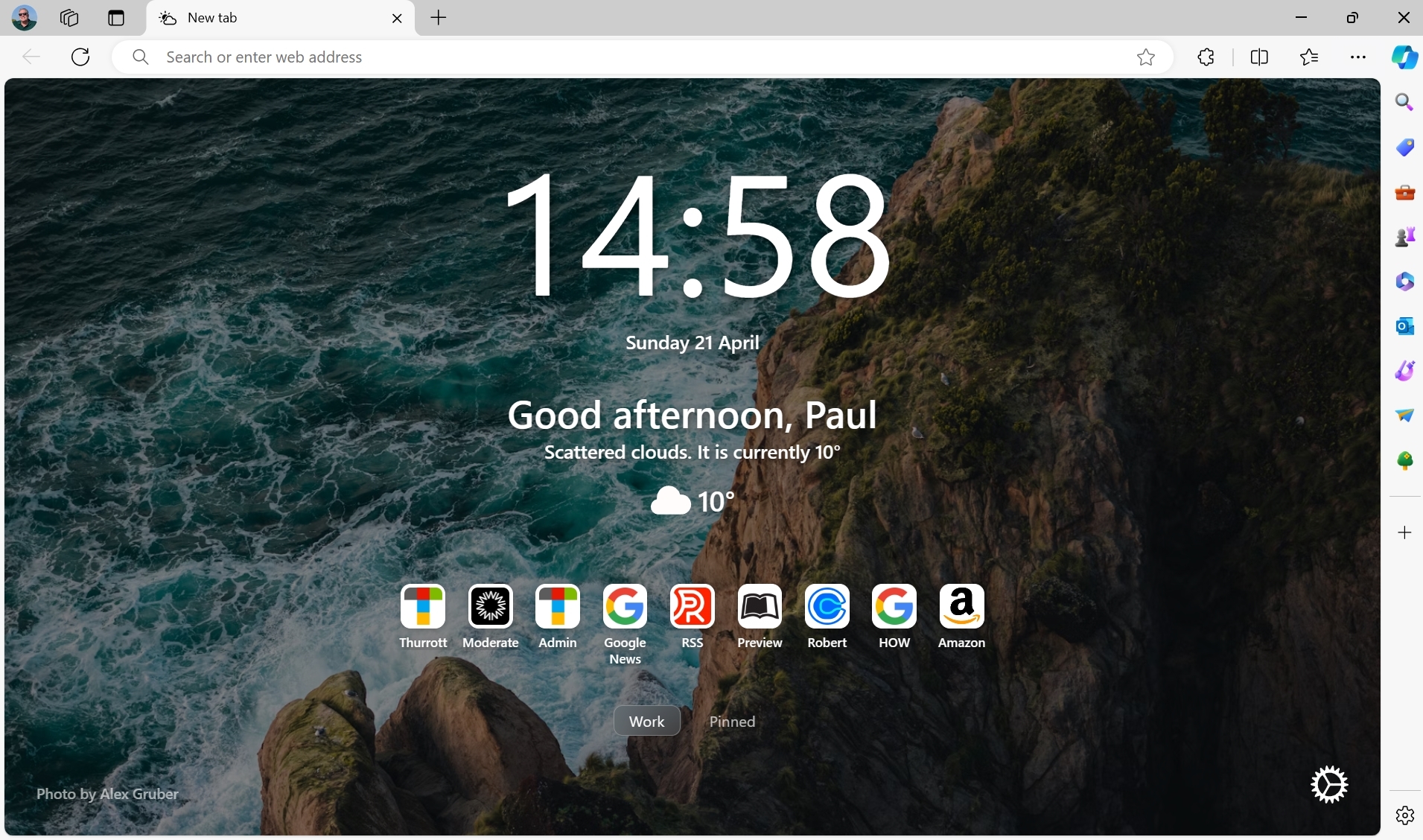
You can find other similar options with your favorite web search engine, Microsoft Edge Add-ons, or the Chrome Web Store.
We discuss extensions briefly in the Extensions section in the next chapter as well.
Configure Microsoft Edge to minimize tracking and prevent Microsoft from harvesting, abusing, and selling your personal data
Microsoft Edge helps keep you safe from malicious online threats like malware, phishing, and unsafe app and file downloads. But it also offers heavily promoted Tracking prevention functionality designed to stop the very behaviors that Microsoft itself engages in: Websites that collection your personal information and track your online activities.
You can view and configure this functionality in Microsoft Edge settings by navigating to “Privacy, search, and services.”
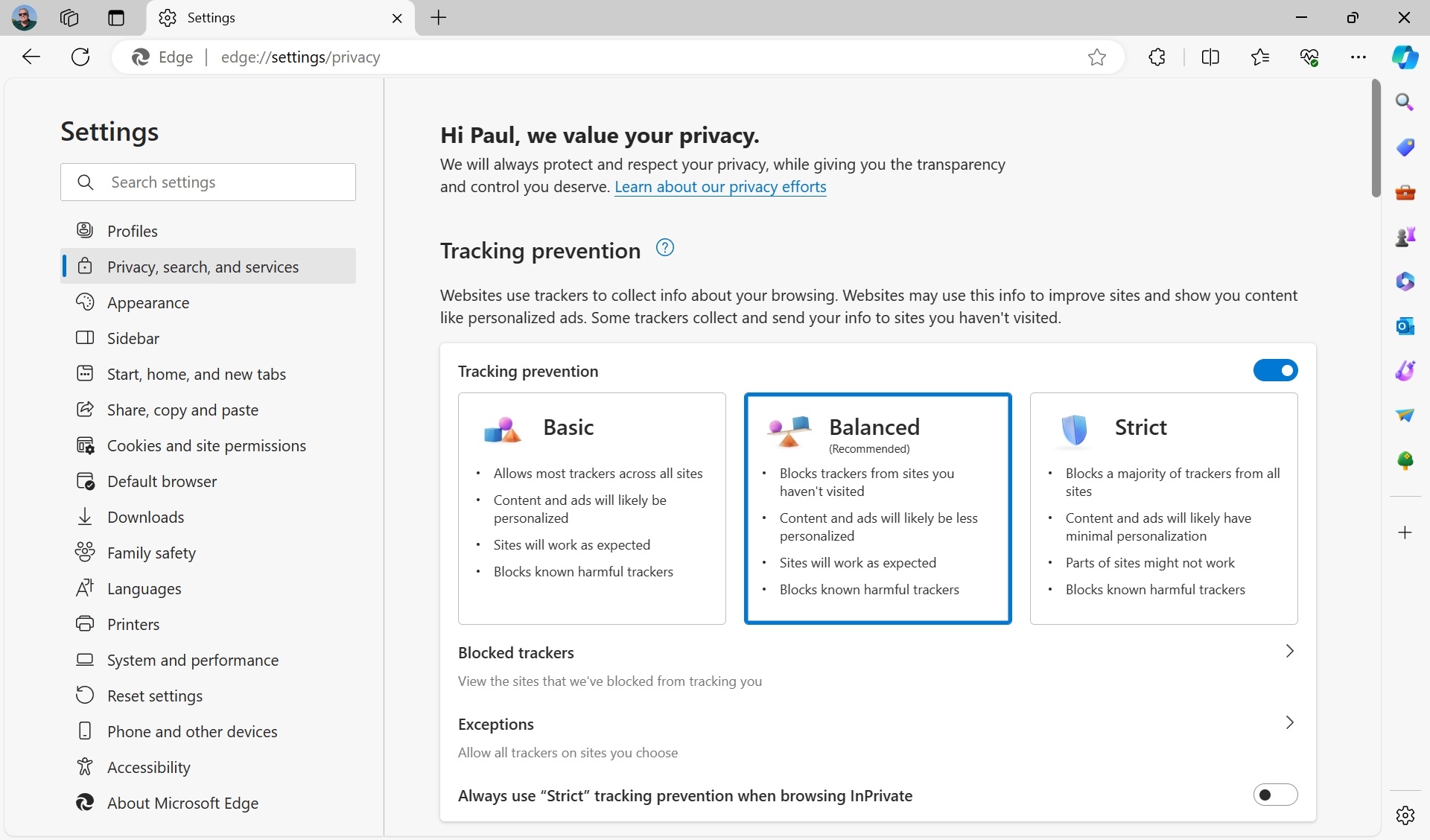
As you can see, Tracking protection offers three levels of protection–Basic, Balanced (the default configuration), and Strict–with what appears to be clear levels of functionality. And there’s even a “Blocked trackers” view so you can see the sites that it prevented from tracking you. But this is all theater. In its default configuration, Edge does nothing to prevent Microsoft from tracking your activities online, harvesting your personal data, and selling that data to third-party data brokers and advertisers.
You can see this for yourself by using Microsoft Edge to visit the Electronic Frontier Foundation’s Cover Your Tracks website. In its default configuration–with Tracking protection set to “Balanced”–Microsoft Edge doesn’t protect you at all. It doesn’t block trackers, nor does it protect you against fingerprinting, another method by which Microsoft and its advertising partners track your activities online.
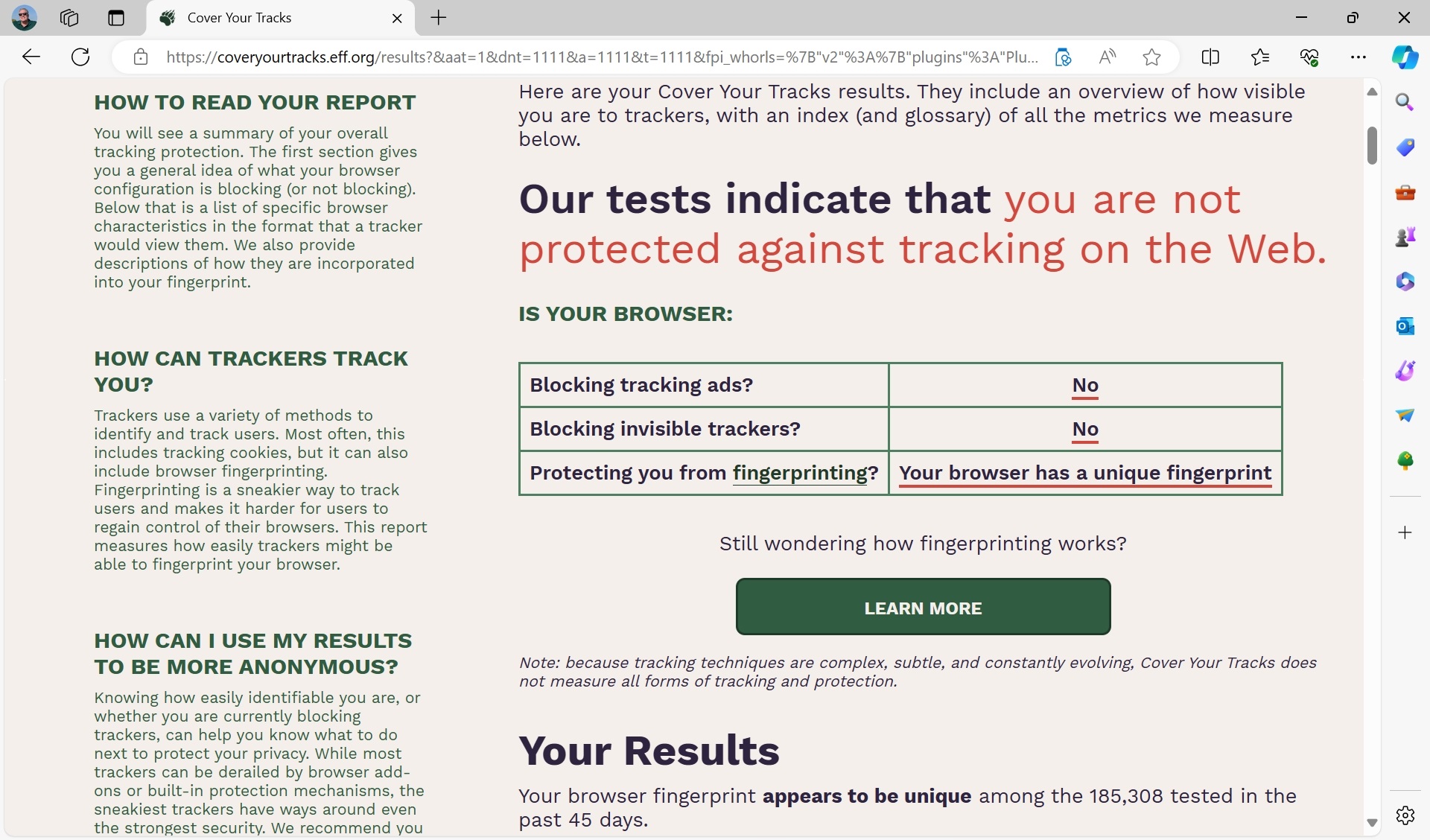
One potential solution to this issue is to configure Microsoft Edge Tracking protection to “Strict”: Doing so appeases Cover Your Tracks, which will report that the browser is now blocking trackers and fingerprinting effectively. But “Strict” also introduces incompatibilities and functional regressions on legitimate websites, leading to a game of whack-a-mole in which you are forced to disable Tracking protection on specific websites.
To fully protect yourself against trackers and the online advertisers that buy your personal data without compromising the user experience, we recommend using a web browser that respects and protects your privacy, like Brave or Mozilla Firefox. But if you are going to use Microsoft Edge, you should install a few privacy-focused extensions that will protect you better and minimize Microsoft’s secret activities. These extensions block all trackers, including those hidden in images used by advertising.
We recommend installing the following extensions. Each is freely available from the Microsoft Edge Add-ons browser extensions store.
Privacy Badger. This very effective tracking blocker discovers and blocks trackers based on behavior, and it automatically blocks trackers that do not respect the Do Not Track and Global Privacy Control signals that Microsoft Edge and other web browsers provide.
uBlock Origin. This thin and light anti-tracker uses a collection of respected and up-to-date filters to keep bad actors–including Microsoft–at bay.
Adblock Plus. The recognized leader in ad blocking and one of the most popular extensions in the world, Adblock Plus also blocks pop-ups, YouTube ads, and so-called “malvertisements,” making it even more useful.
To be clear, you should install all three of these extensions in Microsoft Edge.
Those with more extreme privacy needs might also consider using a virtual private network (VPN) service that protects your privacy by routing all the data that travels between your browser and the Internet through a secure, encrypted connection. We don’t advise using such a thing for full-time use–that would require a paid service, which can get expensive, and these solutions can slow down your connection speed–but a VPN is a suitable option in certain cases. Perhaps you need to use a public Wi-Fi hotspot and are unsure if it’s safe, for example.
To that end, Microsoft Edge includes a free built-in VPN service called Microsoft Edge Secure Network. It’s limited to 5 GB of data traffic each month with no option to pay for more, and it requires you to sign in with your Microsoft account. And while we haven’t fully evaluated this feature, it should be good enough for occasional usage. You just need to enable it first, as it is disabled by default.
To do so, open Edge settings, navigate to the “Security” section in “Privacy, Search, and Services,” and enable the option “Microsoft Edge Security Network.” When you do, the Browser essentials pane opens. This interface is described later in the chapter, but for now, just click “Get VPN for free.” (And then optionally close the pane.)
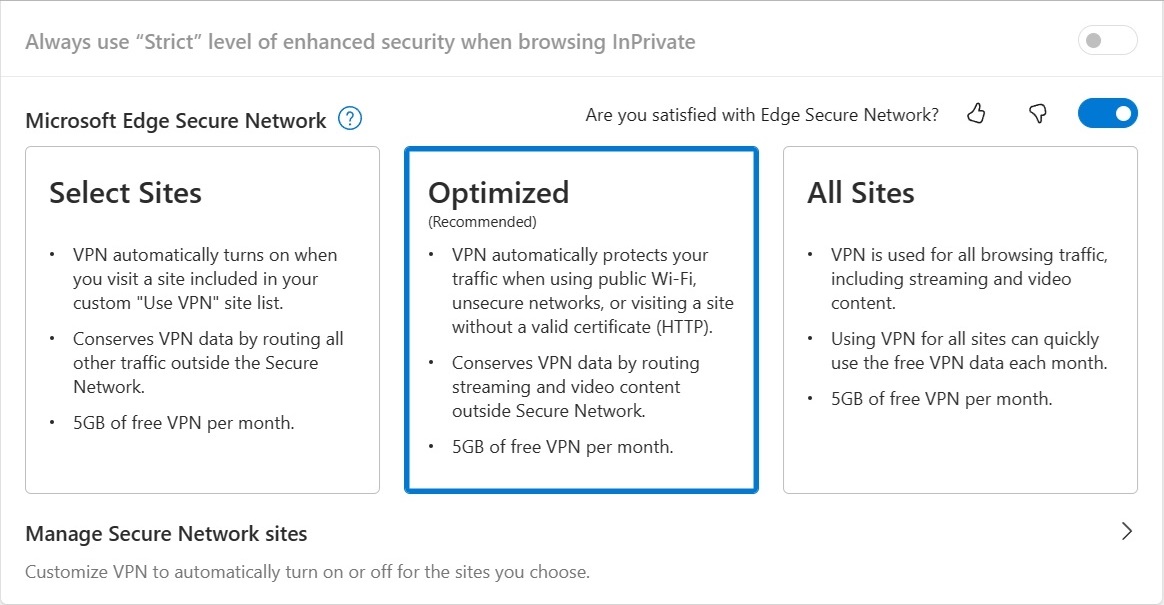
By default, Microsoft Edge Security Network is set to “Optimized,” but you can optionally configure it to encrypt the traffic between all the websites you visit or just a select list of sites that you specify.
Once Microsoft Edge Security Network is enabled, you can toggle the VPN on and off using Browser essentials.
If you need to use a VPN more frequently, you will need a paid option from a third-party. And while there are several good options, we respect and trust Wirecutter. Its rating of the best VPN service for most individuals is particularly credible, and Wirecutter routinely revisits this topic to ensure it’s recommendations are up-to-date.
Configure Microsoft Edge performance, efficiency, and safety features
Microsoft Edge integrates with Windows 11 in ways that other web browsers do not (and cannot) to improve its ongoing performance and efficiency as much as possible. But you should examine the relevant settings to ensure that Microsoft Edge is configured for your needs.
A Microsoft Edge feature called Browser essentials collects key browser performance and safety features in a single, easily accessible interface so you can see which are enabled and how they are impacting the browser.
Browser essentials is typically available via a toolbar button in the top right of the browser window. When you click this button, the Browser essentials pane appears.
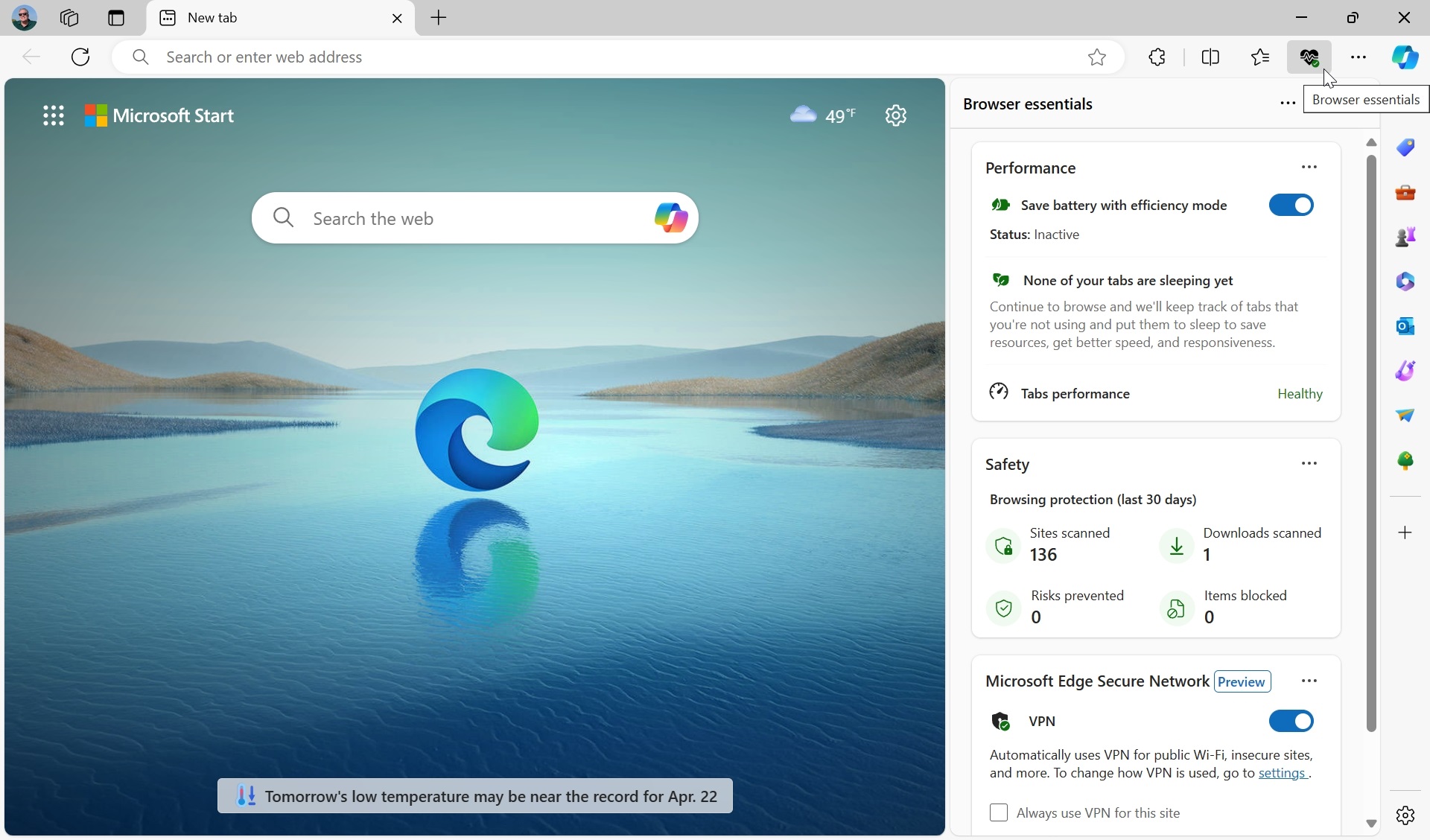
If the Browser essentials button isn’t visible–you may have previously hidden it–you can access this feature via an item the “Settings and more” (“…”) menu instead.
Browser essentials displays three main sections–Performance, Safety, and Microsoft Edge Secure Network–and while two of those sections offer minimal interaction capabilities, it’s mostly an informational dashboard. To actually configure the underlying features, you have to access Edge settings. Each of the sections displays a “More Options” (“…”) button in its upper-right to facilitate that.
In some ways, the most important thing to know about Browser essentials is that you can hide its toolbar button if you find it unnecessary, as most will. To do so, just right-click the button and choose “Hide from toolbar.”
Configure Efficiency mode and Sleeping tabs
Web browsers have become far more capable over the years, reducing our need to use other apps in many cases. The downside, of course, is that these applications also take up more microprocessor cycles, RAM, and other resources than ever before. And this can lead to decreased overall performance and poorer battery life.
To combat this problem, Microsoft has created two related Edge features, Efficiency mode and Sleeping tabs. Efficiency mode integrates with a Windows 11 power management feature of the same name to extend your PC’s battery life by dramatically reducing Edge’s microprocessor usage. And Sleeping tabs automatically puts inactive browser tabs to sleep, reducing microprocessor and memory usage significantly and improving battery life. By default, tabs that are asleep are visually faded to differentiate them from non-sleeping tabs.


Of course, these features come with specific performance-related trade-offs as well. Sleeping tabs, for example, take an extra second or so to wake up when you switch to them. And some websites don’t work well–or at all–when Sleeping tabs is enabled.
To achieve a sense of balance, Efficiency mode is configured by default to come on only when a portable PC is on battery power and the battery level is low. Sleeping tabs, meanwhile, is enabled by default on all PCs. But it works differently depending on whether Efficiency mode is enabled. If it is, inactive tabs go to sleep after just 5 minutes. But if Efficiency mode is disabled, you can configure how many minutes (or hours) of inactivity must pass before tabs are put to sleep.
You configure both features in Edge settings: Navigate to “System and Performance” and then scroll down to the “Optimize Performance” section.
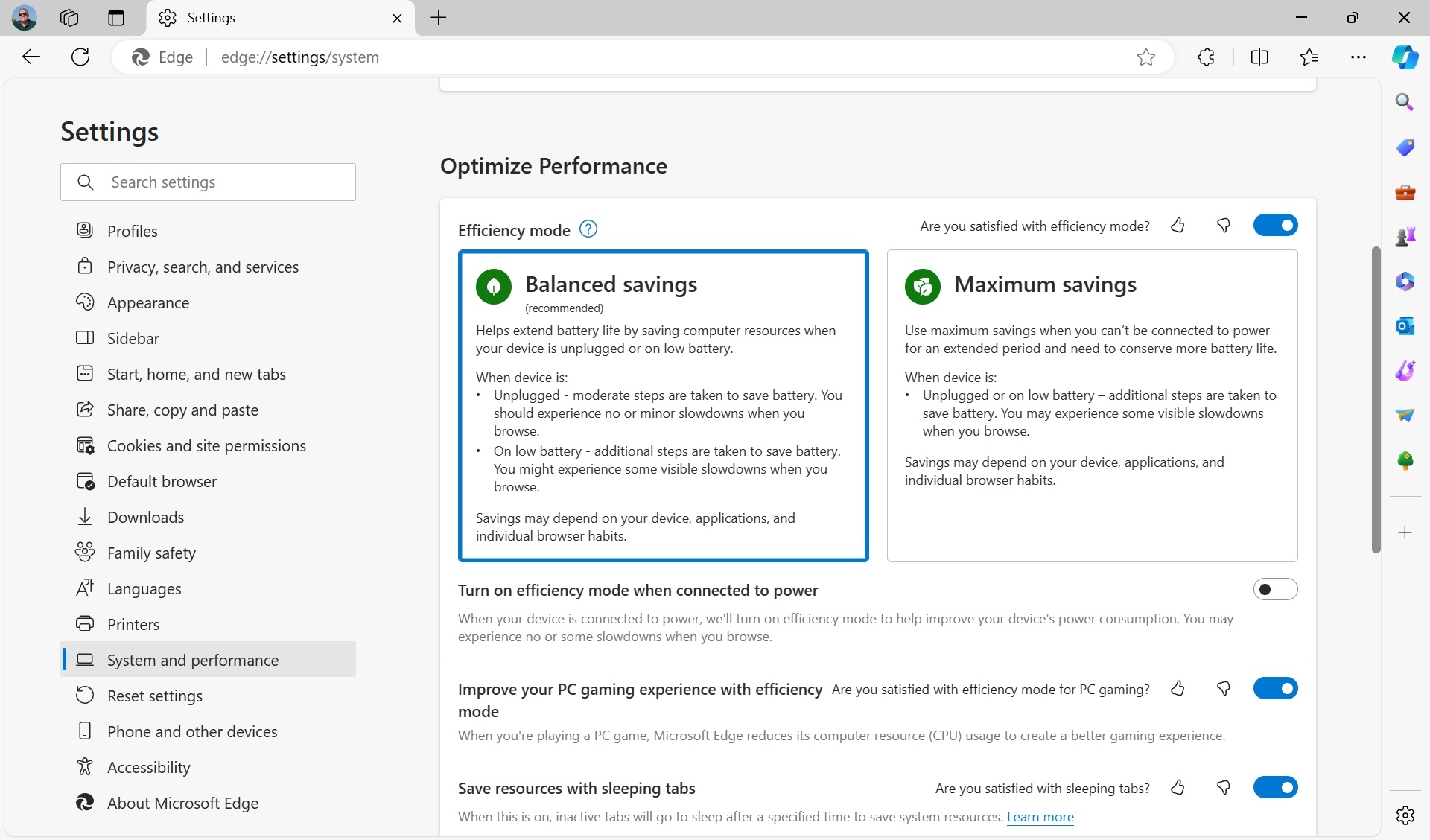

Here, you will find the following options:
Efficiency mode. This feature determines whether Efficiency mode is enabled when the PC is on battery power, which it is by default. And, when it is enabled, whether it should use Balanced savings (the default) or Maximum savings.
Turn on efficiency mode when connected to power. This option determines whether Efficiency mode is enabled when the PC is connected to power. It is disabled by default because it might slow overall browser performance.
Improve your PC gaming experience with efficiency mode. When you play a game on your PC, Edge will enable Efficiency mode automatically by default to free up microprocessor resources for use by the game.
Save resources with sleeping tabs. Enabled by default, this feature determines whether inactive tabs will go to sleep after the time specified under “Put inactive tabs to sleep after the specified amount of time” option described below.
Fade sleeping tabs. Also enabled by default, this option determines whether sleeping tabs are visually faded to differentiate them from non-sleeping tabs.
Put inactive tabs to sleep after the specified amount of time: This option determines how long a tab can remain inactive before going to sleep, assuming Sleeping tabs is enabled. The default is “1 hour of inactivity,” but you can set it to a range of values ranging from “30 seconds of inactivity” to “12 hours of inactivity.”
Never put these sites to sleep. Microsoft Edge uses heuristics to try and determine which websites may not work properly or at all with Efficiency mode and Sleeping tabs, and it adds those sites to this list to ensure that they work normally. You can also manually add any sites you wish to this list by clicking the “Add” button to this option’s right.
It’s difficult to recommend a single Efficiency mode and Sleeping tabs configuration that will work well for everybody. This will vary according to your usage patterns and how comfortable you are trying to out-think Microsoft’s best attempts at balancing the Edge user experience, performance, and battery life. But we can at least offer some general recommendations.
- If you are a PC gamer, do not mess with the Efficiency mode options in Edge: You will want the browser to take up as few microprocessor and other PC resources as possible so that the games you play work optimally.
- If you typically use only a few tabs at a time, there is no reason to leave Sleeping tabs enabled. Tabs respond more quickly when Sleeping tabs is disabled.
- If you find that switching to sleeping tabs is so slow that it’s annoying, consider changing the “Put inactive tabs to sleep after the specified amount of time” option to a longer interval. Or disable Sleeping tabs entirely, and see whether you notice that impacting battery life.
- If you use a desktop PC or a portable PC that is rarely used on battery power, consider disabling Sleeping tabs. You will never realize any real-world benefits to the resulting energy gains, and your tabs will perform better.
What do we do? We see no reason to mess with the Efficiency mode settings, but we always disable Sleeping tabs, as we value the performance of the Edge user interface over the minor efficiency gains this feature achieves.
Configure Microsoft Edge safety features
The Safety section in Browser essentials details some of the work the browser has done to protect you from malicious websites, downloads, and other online risks in the past 30 days. But you can view and configure the underlying safety features in Microsoft Edge settings by navigating to the “Security” section of “Privacy, Search, and Services.”
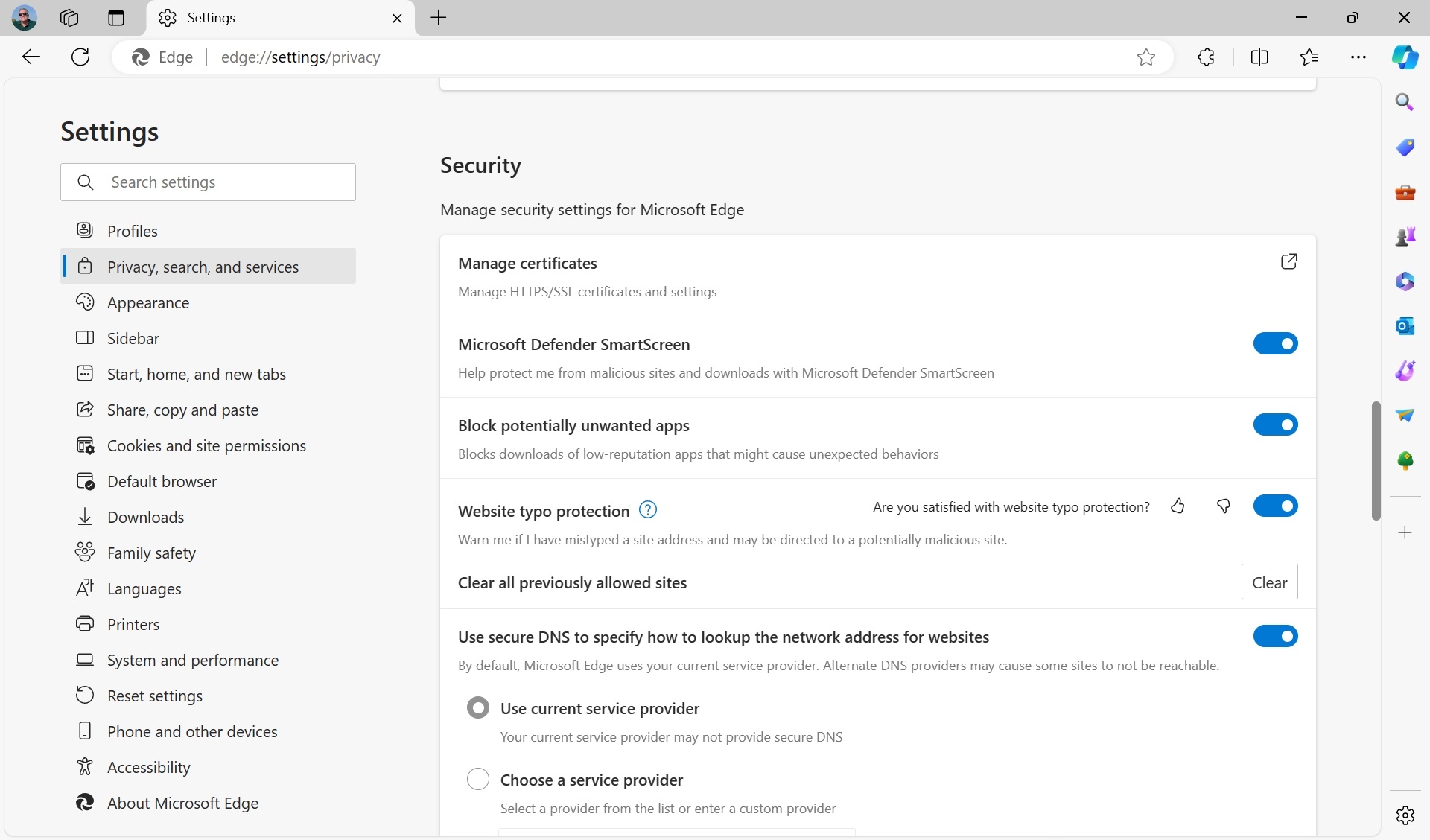
Because this is such an important topic, we have a separate Microsoft Edge Security and Privacy chapter that covers each setting and our configuration recommendations.
Configure a different default web browser and minimize the impact of Microsoft Edge
Most people will use Microsoft Edge only one time on purpose, when they install Google Chrome or some other web browser. But it’s not enough to just install another web browser in Windows 11. You also must configure it as the default web browser and, less obviously, make other configuration changes to ensure that Microsoft Edge doesn’t silently start in the background every time you sign in to Windows 11.
But depending on your views, even that may not be enough.
Microsoft specifically engineers Windows 11 to launch Edge even when you’ve done everything possible to configure the system to use another web browser. More specifically, key features like Copilot, Search, and Widgets use Microsoft Edge regardless of your default web browser choice or other configuration changes. Your choices here are to live with these incursions or look to a third-party utility that forces Windows 11 to honor your web browser configuration choices.
Configure the default web browser in Windows 11
Most web browsers prompt you to configure them as the default web browser. But it’s best to configure this Windows 11 feature explicitly.
To do so, you utilize the Default apps interface that we describe in the Apps Basics chapter. As noted there, this interface works a bit differently with web browsers.
To configure the default web browser, open the Settings app and navigate to Apps > Default apps.
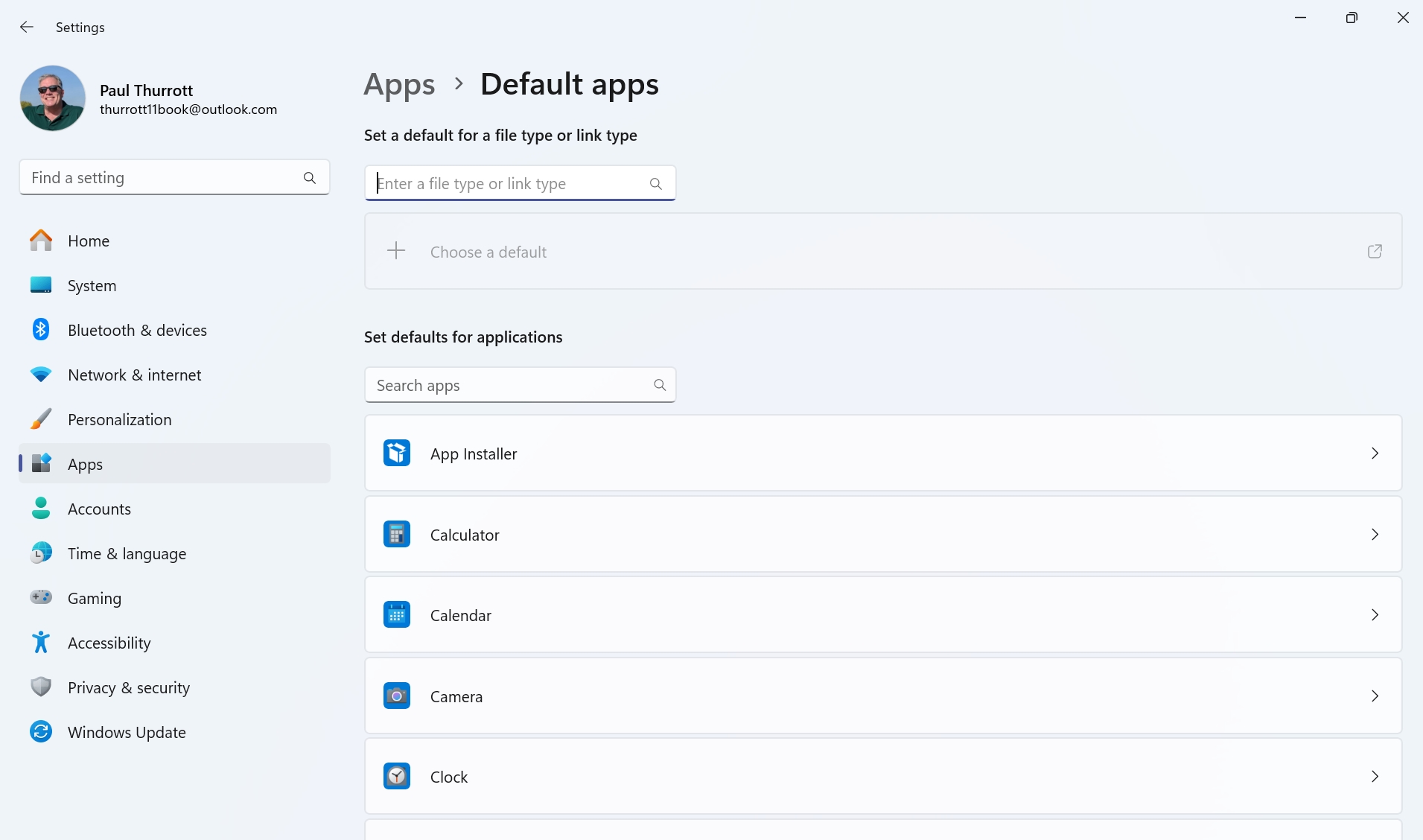
Then, find the web browser you prefer in the list of apps under “Set defaults for applications,” either manually–the list is alphabetical–or by using the search box. When you find the app you want, click it.
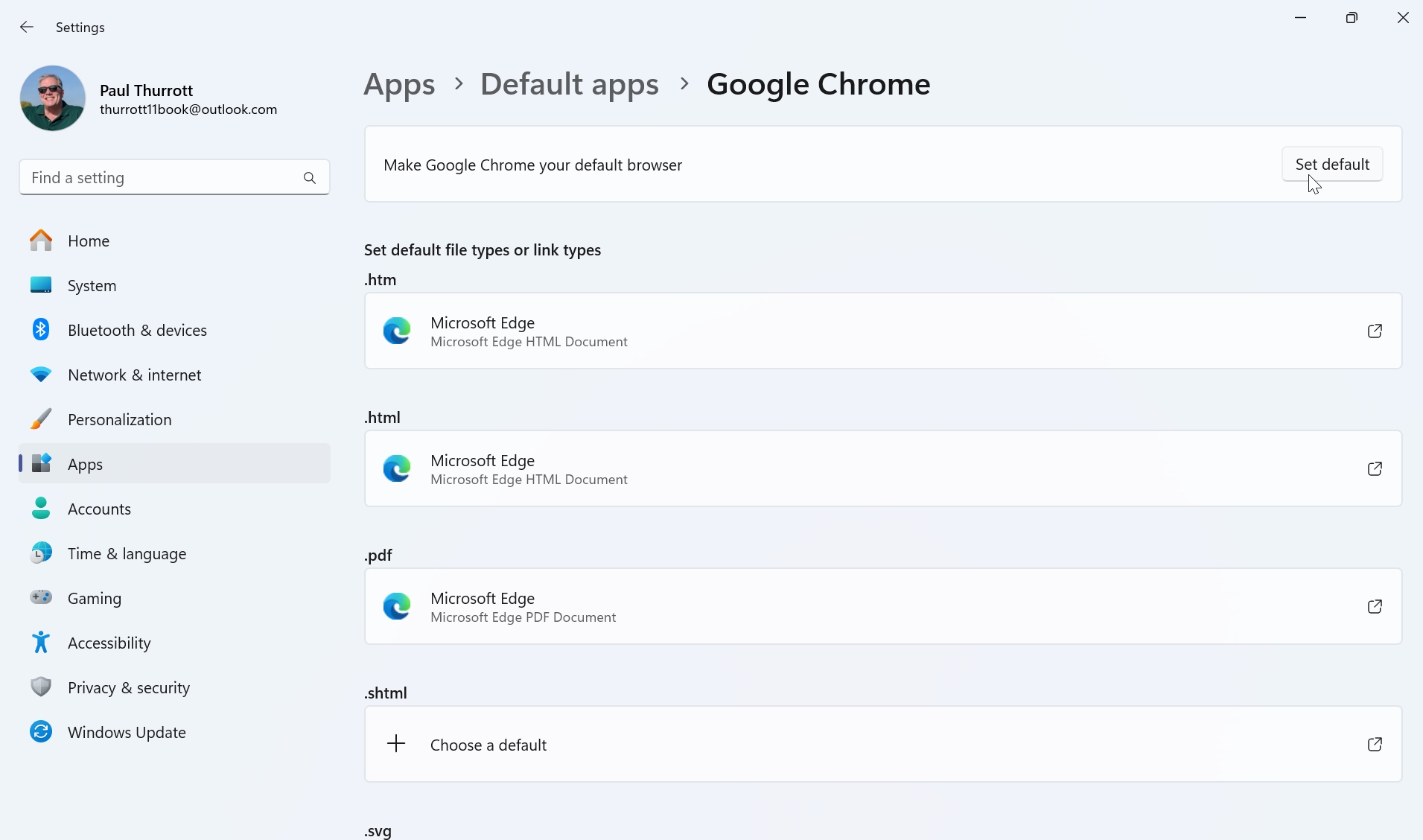
This interface lists all the file and link types that can be associated with the selected app. And because this is a web browser, there is a unique “Set default” button at the top that can minimize the time you spend here.
That said, clicking “Set default” doesn’t work as it did in previous Windows versions, and there’s no way to easily or quickly associate your favorite web browser with every file and link type it can open. Instead, when you click “Set default,” Windows associates two file types (.htm and .html) and two link types (HTTP and HTTPS) with that browser.
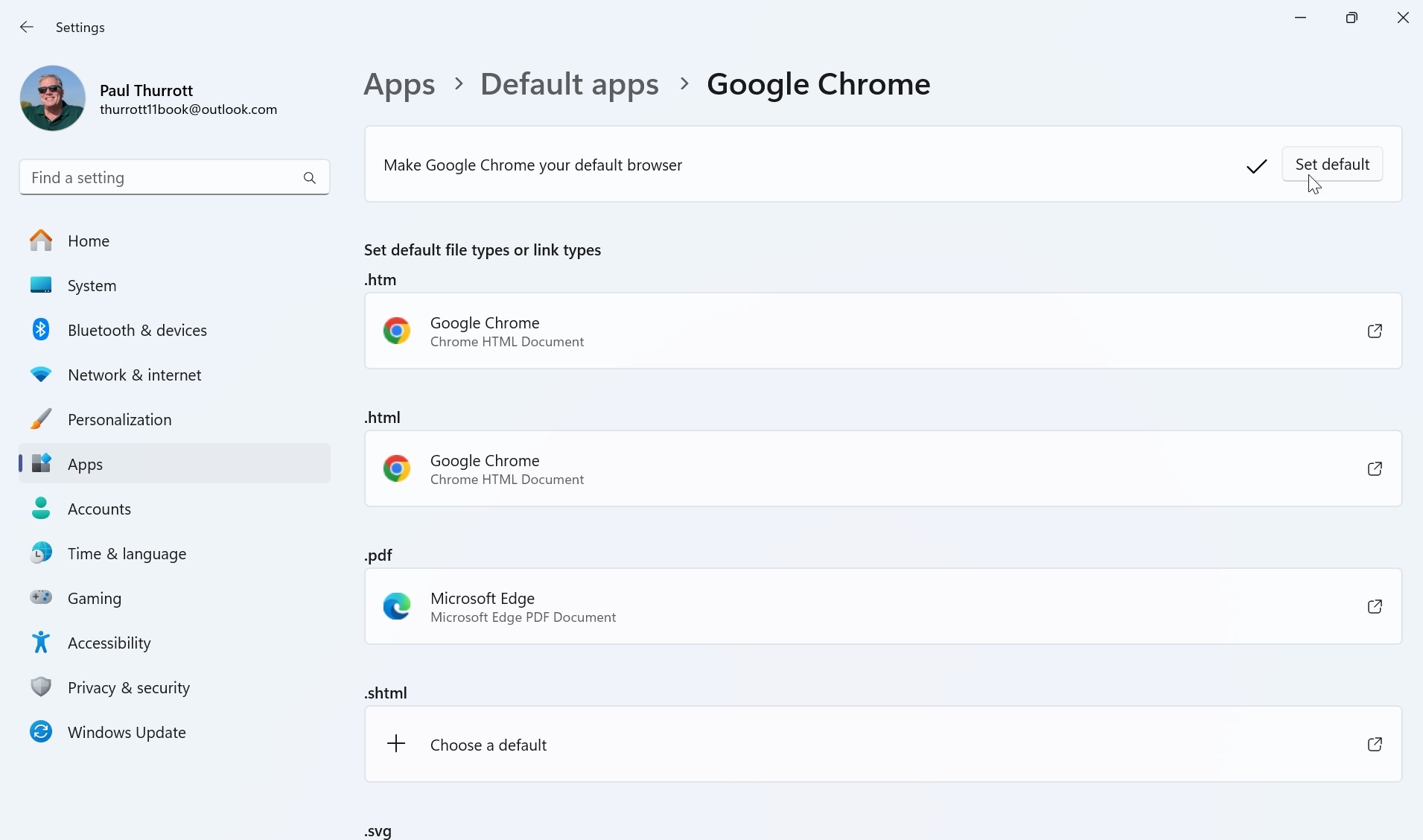
All the other supported file and link types are unchanged: They are still associated with Microsoft Edge in most cases (or are not associated with any app).
To fully configure your favorite browser as the default, you need to click each file and link type in this list and choose that browser in the “Select a default app” window that appears when you do so. There is no way to automate this.
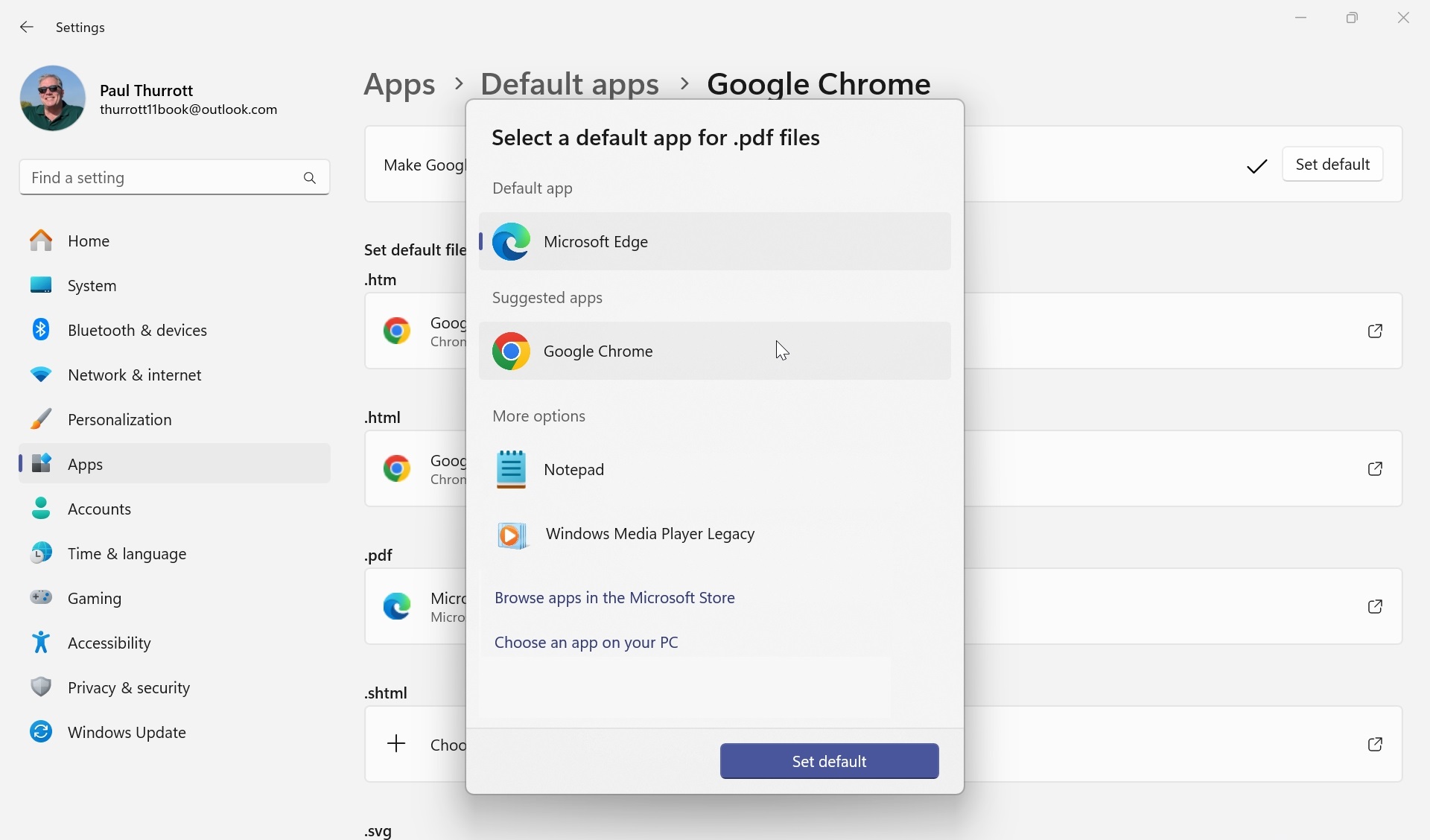
Doing this for every possible file and link type is not strictly necessary: We typically just configure the system to open PDFs with our preferred browser by associating it with the .pdf file type as shown above. Most of the other file and link types are unusual enough that explicitly configuring each is a waste of time.
Configure Windows 11 to minimize the impact of Microsoft Edge
You might think that choosing Chrome or another web browser as the default in Windows 11 is all you need to do. But that’s not the case: Microsoft has integrated Microsoft Edge with Windows 11 in ways that ensure its web browser still runs, in the background or overtly, even when you make that configuration change.
Fortunately, you can disable this functionality. There are multiple ways to do so, so we will highlight the most convenient of these methods.
The first is within Microsoft Edge: Open Edge settings, navigate to “System and Performance” and disable the option “Startup boost” under “System” at the top.
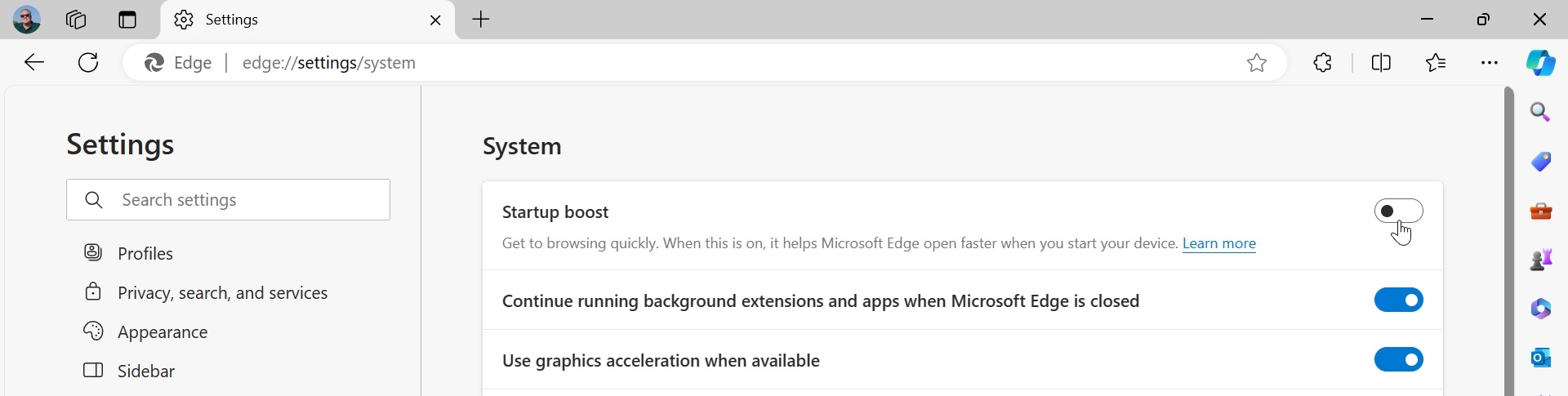
But you don’t need to run Microsoft Edge to prevent this browser from running in the background automatically. You can also do using the Settings app or by using the Startup apps interface in Task Manager. Because the former is the more modern interface, we will document that method.
Open the Settings app and navigate to Apps > Startup.
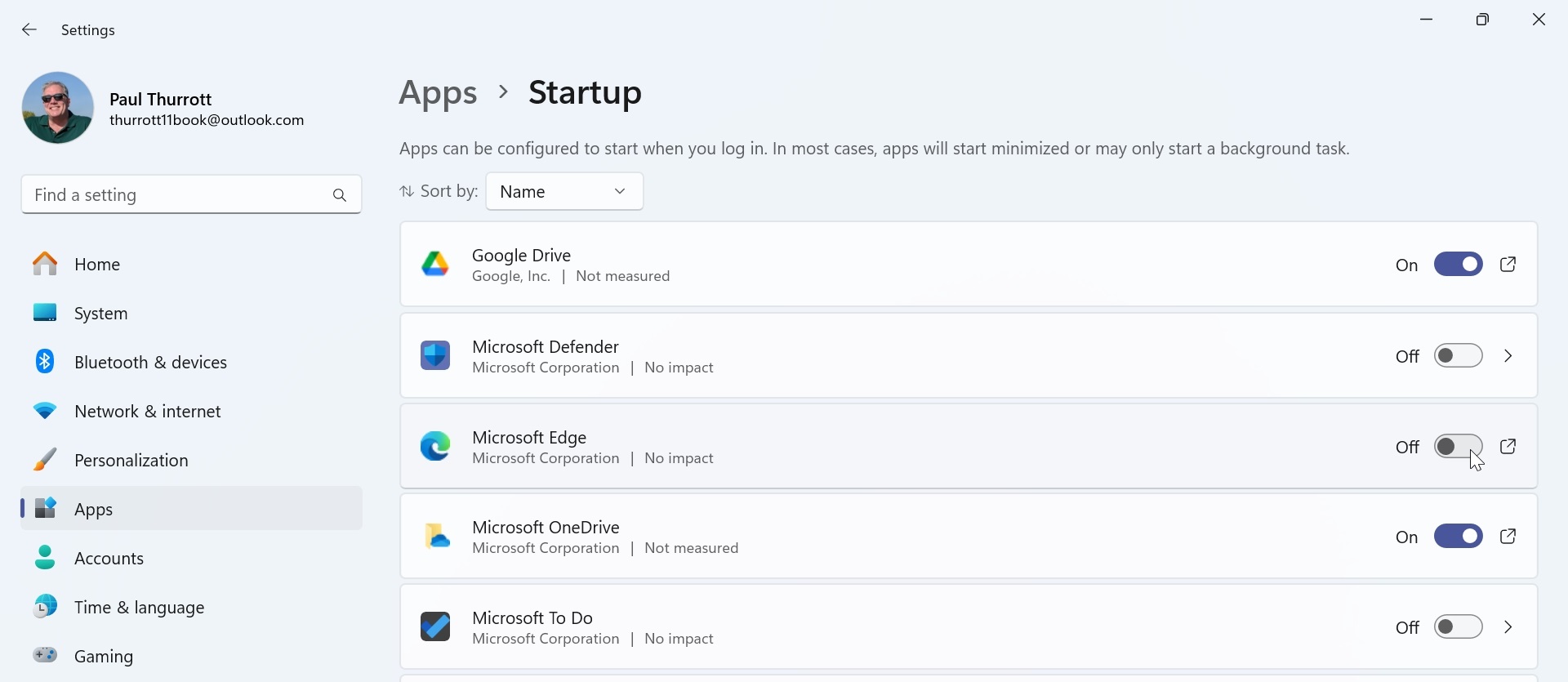
Then, locate Microsoft Edge in the list and change its startup configuration to “Off.”
Use a third-party utility to prevent Microsoft Edge from overriding your default web browser choice
You’ve done what you can to minimize the impact of Microsoft Edge by configuring another web browser as the default and preventing Microsoft Edge from silently running in the background each time you reboot your PC or sign in to Windows 11. But as noted previously, none of this will stop Microsoft’s web browser from appearing in certain circumstances, including when you open Copilot, or click a widget or news feed article in Widgets, a web link in Search highlights, or a web link in the Get Help app.
You can’t use Copilot in Windows 11 without invoking Microsoft Edge: This sidebar is created using an instance of Microsoft’s web browser. However, you can work around that by using your favorite web browser to access Copilot on the web instead.
Copilot on the web can’t be used to configure Windows 11 settings or access some Windows 11 features. This capability is limited to Copilot in Windows 11.
Unfortunately, there’s no workaround for the other Windows 11 behaviors that trigger Microsoft Edge against your will. Most people are best served by ignoring those Windows 11 features: After all, the stories available in Widgets are low quality, Search highlights is a distraction, and because you have this book, the Get Help app is superfluous. But you could also choose the nuclear option, a third-party app that will force Windows 11 to always open your default browser choice instead of Microsoft Edge.
One such choice is MSEdgeRedirect. It’s free and open source, and quite effective. But its configuration can be daunting and confusing.
When you install this utility, you’re prompted to choose a mode, and it may not be obvious which to choose.
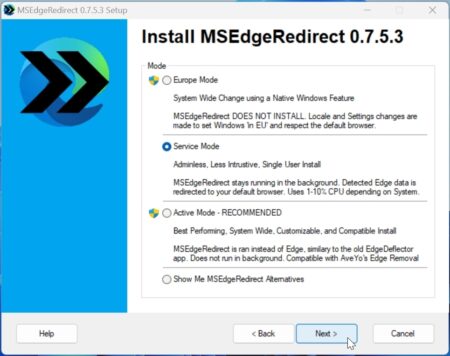
Choose “Active Mode,” click “Next,” and approve the User Account Control prompt that appears. A second configuration screen appears.
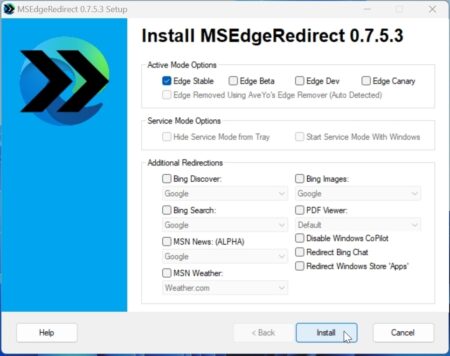
Here, you can optionally configure this utility to redirect various Bing and MSN services. For now, ignore these choices and click “Install.” Allow MSEdgeRedirect to create Start menu shortcuts so you can easily access it later if needed, and then click “Finish” to complete installation.
Voilà. Your default web browser is now your default web browser for everything, and not just the subset of the actions that Windows 11 normally allows.

Gain unlimited access to Premium articles.
With technology shaping our everyday lives, how could we not dig deeper?
Thurrott Premium delivers an honest and thorough perspective about the technologies we use and rely on everyday. Discover deeper content as a Premium member.